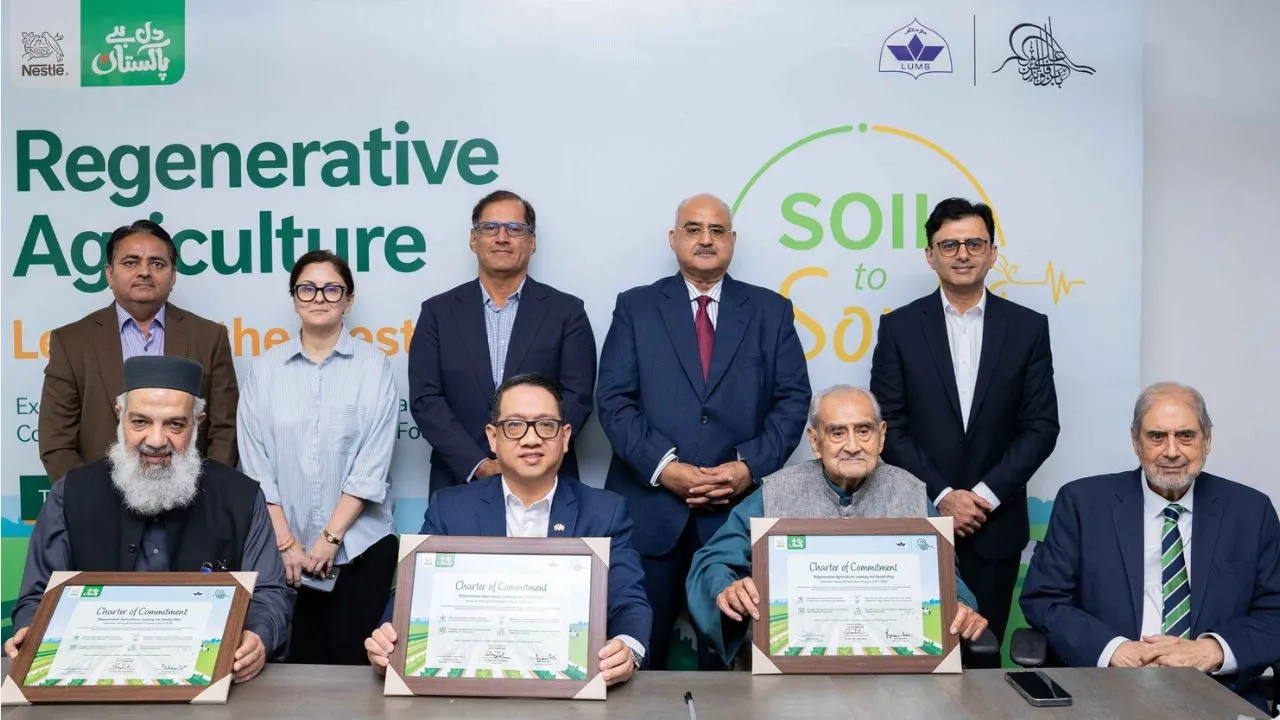
New Executive Training Program for Regenerative Agriculture in Pakistan
Strengthening knowledge and capabilities around regenerative agriculture will be at the center of a new multi-year Executive Training and Certification Program launched by Nestlé Pakistan, LUMS Rausing Executive Development Centre, and the Syed Babar Ali Foundation.
Titled Regenerative Agriculture: Leading the Nestlé Way, the program aims to develop regenerative agriculture leadership in Pakistan and contribute towards resilient food systems, environmental stewardship, and agricultural prosperity. The initiative brings together corporate leadership, academic rigor, and philanthropic vision to address pressing ecological challenges in the local farming sector.
Agriculture remains a foundational pillar of the national economy, employing a vast segment of the rural population and contributing significantly to gross domestic product. However, traditional farming methods often strain natural resources, particularly water supplies and soil fertility, making modern educational initiatives urgent. By partnering with educational institutions, corporate entities hope to bridge the gap between traditional farming habits and modern scientific techniques that preserve the environment while maintaining crop yields.
What the Regenerative Agriculture Curriculum Covers
Through two cohorts every year, participants will develop an understanding of regenerative agriculture encompassing soil health, water stewardship, crop nutrition, energy efficiency, emissions reduction, and farm economics. The initiative will also encourage innovation and agripreneurship, including the use of precision irrigation techniques.
The curriculum treats agriculture as an interconnected ecosystem rather than a collection of isolated practices. Students examine how altering one variable, such as tillage frequency or fertilizer application, affects long-term soil microbiology, moisture retention, and overall farm profitability. Economic viability is a core focus because sustainable farming methods must generate stable incomes for growers to gain widespread adoption across the country.
Water stewardship holds special importance given regional water scarcity concerns and heavy reliance on irrigation canals and groundwater extraction. Precision irrigation methods taught in the program help minimize waste by delivering moisture directly to root systems, lowering energy costs associated with pumping groundwater. Energy efficiency and emissions reduction round out the core learning modules, aligning local farming practices with global climate change mitigation targets.
Leadership Perspectives on the Training Initiative
Jason Avanceña, CEO and Managing Director, Nestlé Pakistan, said about the initiative: This program is an opportunity to build shared understanding and develop a network of informed advocates who can champion regenerative agriculture and keep Pakistan competitive with other leading agricultural economies around the world. For Nestlé, it is ultimately about creating shared value across our agricultural value chain.
Commenting on the initiative, Syed Babar Ali said: I have always believed that the true value of education lies in what we are able to pass on to the generations that follow us. Agriculture remains central to the country, and the challenges facing it require us to equip a new generation of leaders.
According to Dr. Tariq M. Jadoon, Provost at LUMS: This program has been designed to move beyond theory by bringing together scientific understanding, business considerations, and field exposure. Through areas such as soil health, water stewardship, climate resilience, and farm economics, participants will be able to examine regenerative agriculture as an interconnected system and consider how these principles can be applied and scaled in Pakistan.
Program Structure, Schedule, and Participant Capacity
The program will run yearly, with two cohorts planned annually and 25 participants in each session. The duration of the program will be four days comprising three days of classroom learning at REDC, LUMS, with one day of field-based learning.
Limiting cohort sizes to 25 individuals ensures high interaction between instructors and participants, allowing deep discussions on complex environmental and economic challenges. The combination of classroom lectures at the Rausing Executive Development Centre and practical exposure in the field gives attendees a complete view of how abstract environmental theories translate into real-world farming improvements.
Graduates of the certification are expected to return to their respective organizations, farms, or enterprises equipped to implement sustainable changes and educate others in their local communities. This multiplier effect is intended to spread sustainable techniques far beyond the direct participants of the training sessions.
Existing Corporate Sustainability Efforts and Future Targets
Nestlé Pakistan is already advancing regenerative agriculture across its agricultural value chain, with around 150 farmers benefiting from interventions covering approximately 9,330 acres. The company is supporting farmers in adopting practices and technologies focused on soil health, water efficiency, and climate resilience.
These on-the-ground interventions provide a practical testing ground for the concepts taught in the new executive education program. Farmers working directly with supply chain teams receive guidance on minimizing chemical fertilizer usage, protecting beneficial soil organisms, and managing crop residues without burning, which helps reduce seasonal smog issues.
Looking ahead, Nestlé aims to source 50% of its key ingredients from farmers adopting regenerative agriculture practices by 2030, as part of its efforts to advance regenerative food systems and its ambition to achieve net-zero greenhouse gas emissions by 2050. Achieving these corporate sustainability milestones depends heavily on expanding the pool of trained agricultural professionals who understand both the science and the business case for sustainable food production.