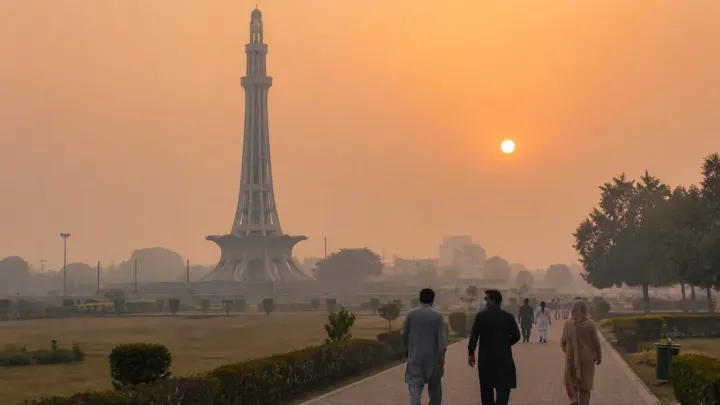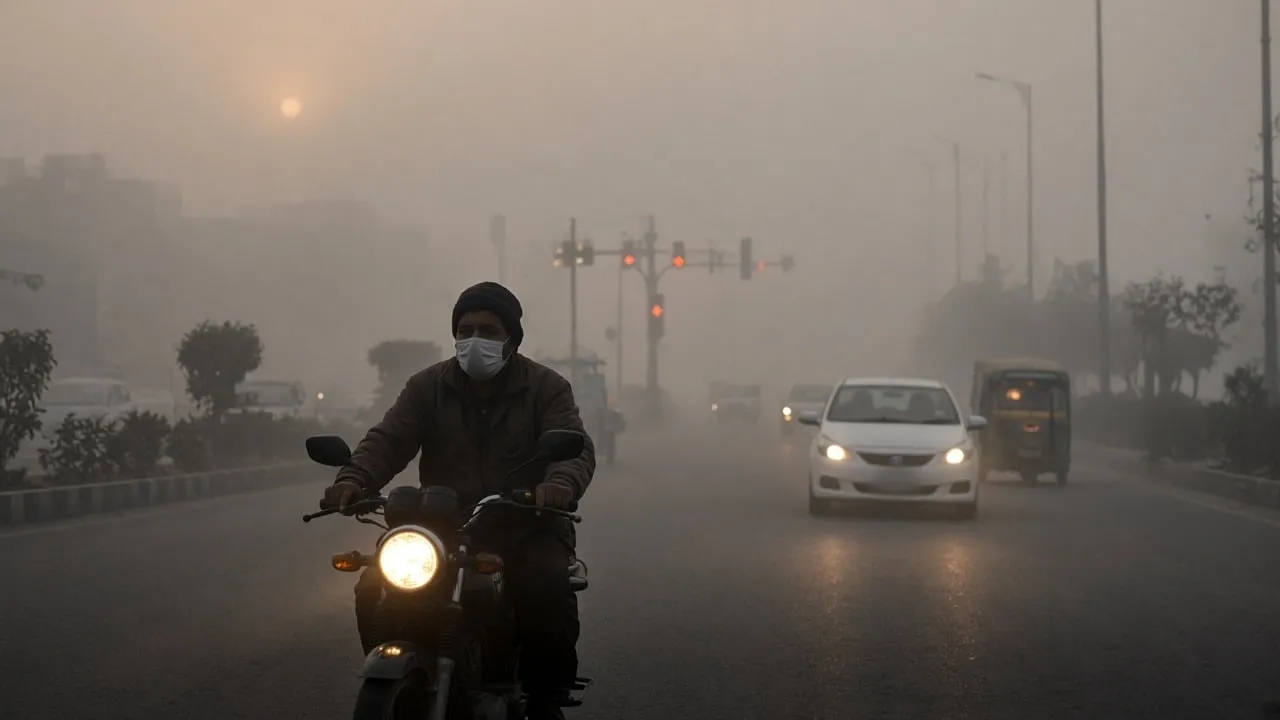
Hazardous conditions hit Lahore on Monday morning when the local Air Quality Index went beyond 530, alongside even heavier pollution in nearby Gujranwala.
Air monitoring platform IQAir documented an AQI reading of 535 in Lahore at 8 am. Concentration levels for PM2.5, which are microscopic particles capable of penetrating deep into lungs and reaching the bloodstream, reached 343 micrograms per cubic metre. Air pollution metrics entered the hazardous category during the early hours.
Five Punjab Cities Among the Worst
Live rankings from IQAir on Monday morning showed five cities from Punjab occupying five spots among the six most polluted locations in Pakistan. Gujranwala held the top spot with an AQI of 606, trailed by Lahore at 509, Faisalabad and Multan both registering 310, and Sialkot at 260. Peshawar occupied the sixth position with 216.
These figures fluctuated throughout the morning hours. Subsequent hourly reports indicated that Gujranwala rose to 675 and Lahore climbed to 535.
Crop Fires Surge Around Lahore
This rise in pollution coincides with a sharp increase in agricultural fires throughout the province. Data from monitoring platform HamariHawa indicates that satellites operated by NASA identified 13,241 fire points across Pakistani Punjab from October 1 to 29, marking a figure 4.2 times higher than the 3,158 spots found in Indian Punjab.
Roughly 92 percent of these fires occurred on agricultural land, likely associated with the burning of crop residue. Half of the monthly total, equating to 6,655 fire points, occurred during the final seven days of October, reaching a maximum of 1,327 on October 29. Okara recorded the highest count with 2,144 fires, followed by Gujranwala at 1,011 and Nankana Sahib at 1,003.
October Gains Fade
In a related development, a fresh evaluation by the Pakistan Air Quality Initiative has challenged official assertions that Lahore experienced its cleanest October in five years.
The provincial government previously stated that October 2026 was the cleanest October in Lahore for five years. Figures provided by Senior Minister Marriyum Aurangzeb indicated the city average AQI dropped to 180.5 from 204.6 during the previous year. Yet, research by the Pakistan Air Quality Initiative concluded that atmospheric conditions drove the majority of the progress in October.
Data from PAQI showed that mean PM2.5 levels during October 2026 decreased by 27 percent relative to the previous year across 26 monitoring locations. Still, after adjusting for meteorological factors, the actual reduction was calculated at only 4 percent.
The study credited most of the pollution drop to weather patterns, specifically an expanded nighttime atmospheric mixing layer that provided pollutants greater space to scatter.