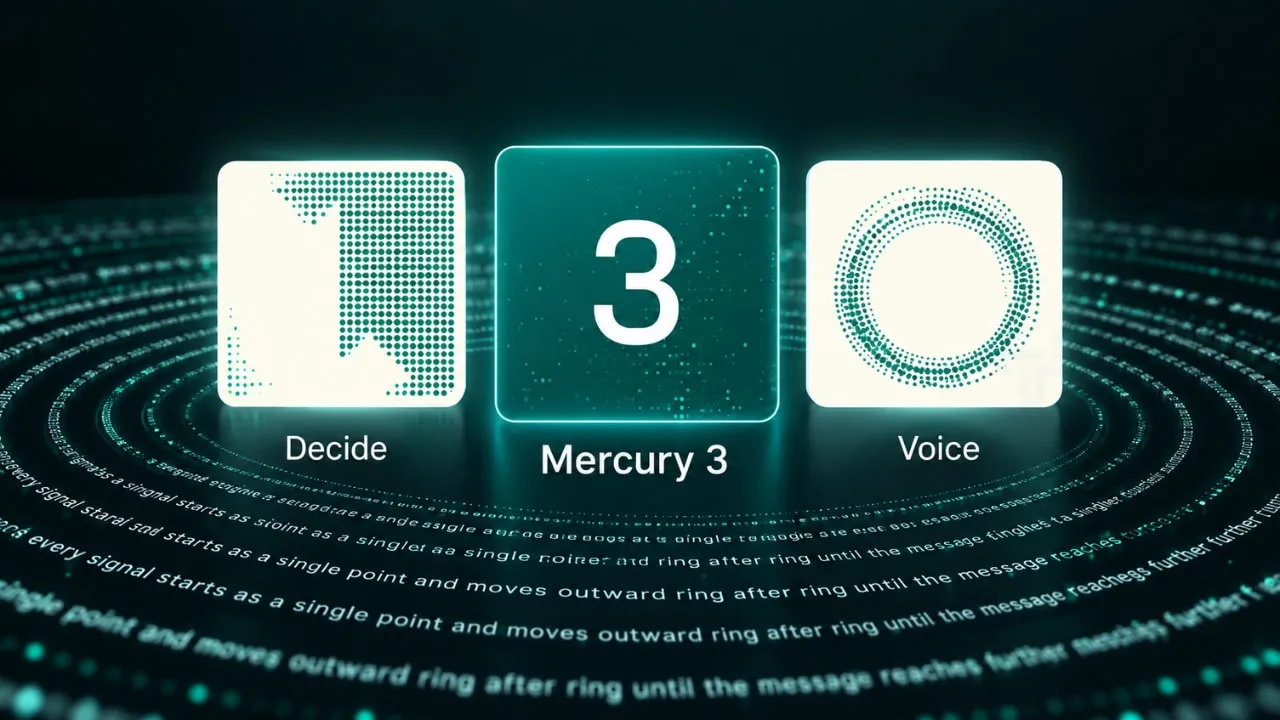
On October 19, co-founder Stefano Ermon announced that Inception released Mercury 3, a diffusion-based language model capable of generating text up to eight times faster than traditional artificial intelligence models.
Mercury 3 relies on a diffusion approach rather than the conventional word-by-word text generation. By refining multiple text blocks simultaneously, comparable to an editor reviewing a complete draft at once, the system achieves speeds exceeding 1,000 tokens per second on standard NVIDIA GPUs.
According to Inception, Mercury 3 surpasses GPT-6 Luna and Claude Haiku 5.5 on various benchmarks. Because the company has not yet shared exact benchmark names or scores, independent testing has not verified these assertions.
1/4 Today, we're releasing Mercury 3. Mercury 3 is by far our most powerful model and the most intelligent diffusion LLM ever released. It outperforms GPT-6 Luna and Haiku 5.5 on quality while running at 1000+ tok/sec. https://t.co/TYevDl43Lm
, Stefano Ermon (@StefanoErmon) October 19, 2026
A context window of 1 million tokens is included in the new model, marking a significant increase from the 260,000 tokens found in Mercury 2.5. Inception also reports that Mercury 3 is more than 40 times larger than the first Mercury model while keeping similar processing speeds.
Usage areas where latency harms usability are the main focus for Mercury 3. These uses involve live translation, interactive tutoring, writing assistants, and automated software agents. RevisionDojo, an early-access customer, stated that Mercury 3 reduced student feedback reply times to approximately one second.
Availability is currently open through the Inception API, Baseten, OpenRouter, and Vercel. Because it accommodates the OpenAI API format, software creators can incorporate it without extensive code rewrites.
Inception has progressed rapidly following the June 2025 debut of Mercury 1. Reasoning abilities arrived with Mercury 2, while Mercury 2.5 brought adjustable reasoning along with a 260,000 token context window. Last year, the firm secured $50 million from backers such as Microsoft, NVIDIA, and Snowflake. Ermon verified that work on the subsequent model has already began.
Skepticism persists regarding the long-term viability of the diffusion method. Although Google's Gemini Diffusion demonstrated comparable potential, it has lacked public updates following its debut presentation. Observers wonder if diffusion-based language models can compete effectively against fast-advancing autoregressive competitors.