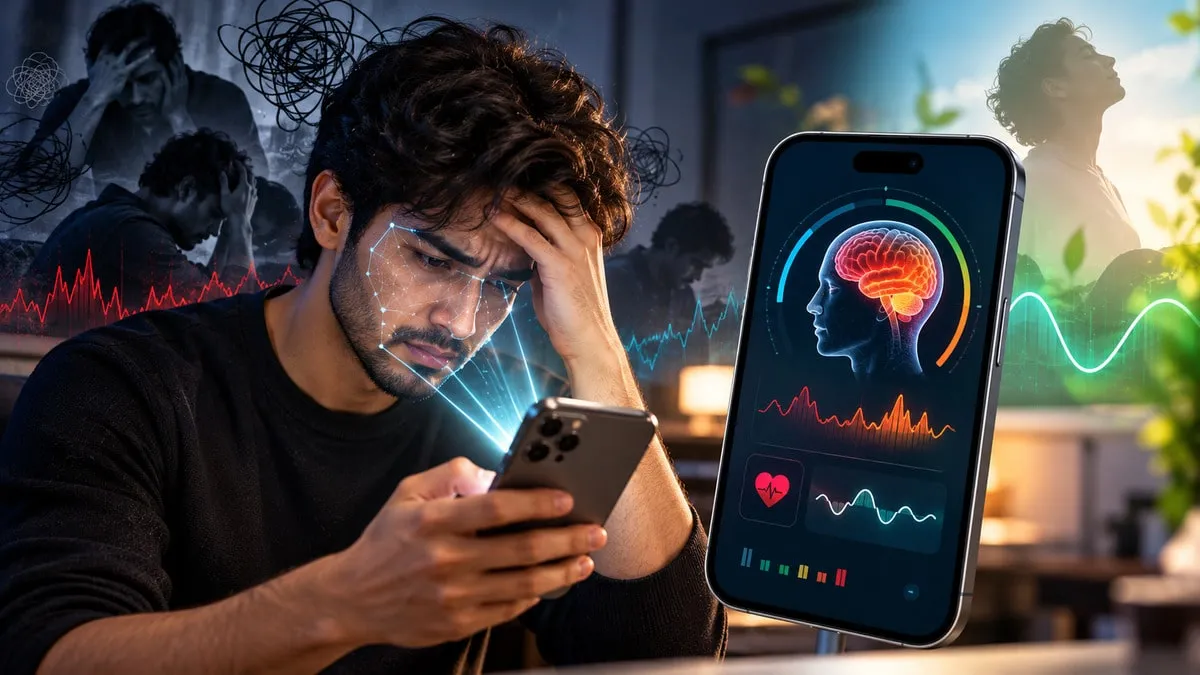
Researchers at the Korea Advanced Institute of Science and Technology developed a smartphone system that identifies mental stress by tracking routine phone activities such as messaging, web browsing, and financial transactions. In a trial involving 26 participants, custom models reached roughly 75% accuracy in distinguishing stressful days.
System Focuses on Tasks Instead of Apps
Investigators at the Korea Advanced Institute of Science and Technology created the platform, known as SHIRBT-MMF, which was first published in December 2025. Earlier stress-tracking studies often depended on metrics like screen time, app launches, and typing habits, but these can fluctuate when applications undergo updates. The team from the Korea Advanced Institute of Science and Technology instead concentrated on actions that stay consistent across various programs, treating messaging on KakaoTalk, LINE, and WhatsApp as a single category. Professor Uichin Lee, head of the research group, stated that phones should not merely measure usage duration, but rather serve as platforms where communication, searching, and payments constantly take place.
GPT-4o Helps Identify Repeated Behaviors
The platform spots screen-transition patterns occurring repeatedly across multiple days. A large language model then evaluates each pattern, giving it a basic label like messenger chatting, web browsing, or email reading. Investigators used OpenAI's GPT-4o for this function. During tests with email, browser, and messenger programs, SHIRBT-MMF recognized identical tasks correctly over 95% of the time.
Researchers Did Not Store Message Content
The platform was built to avoid gathering the actual text typed by users. Instead, it logged behavioral data, including typing activity, typing frequency, and screen transitions. Details regarding message recipients and call partners underwent hashing to conceal original identities.
Personalized Models Reached Around 75% Accuracy
Investigators tested the platform on 26 university students and office workers aged in their 20s and 30s. Sixteen individuals supplied roughly 30.5 days of data on average, while another 10 contributed approximately 105 days. Participants reported their daily stress levels, allowing researchers to build custom models separating stressful days from peaceful ones. The study noted 29 types of repeated behavior, with each participant regularly performing about seven of them. The top-performing model reached an average accuracy of 75.9% for the short-term group and 73.8% for the long-term group. Using fewer signals still yielded effective outcomes, as models based solely on chatting and payments, or just chatting, outperformed traditional methods. Investigators intend to decrease data collection to reduce system demands, and long-term dataset indicators varied less over time than conventional signals.
Small Sample Limits the Findings
The study demonstrated a link between phone behavior and stress, though it did not prove that specific actions cause or lower stress. The project also tested only Android users in their 20s and 30s, restricting the broad application of the findings. The group intends to broaden future studies to encompass more age brackets, jobs, and phone platforms. Personalization also matters, since a single universal model performed much worse than individual user models. Investigators will present the study at UbiComp/ISWC 2026 in Shanghai. Currently, SHIRBT-MMF stays a research initiative, but the findings indicate tracking repeated phone tasks provides a stable method for monitoring stress amid changing app interfaces.