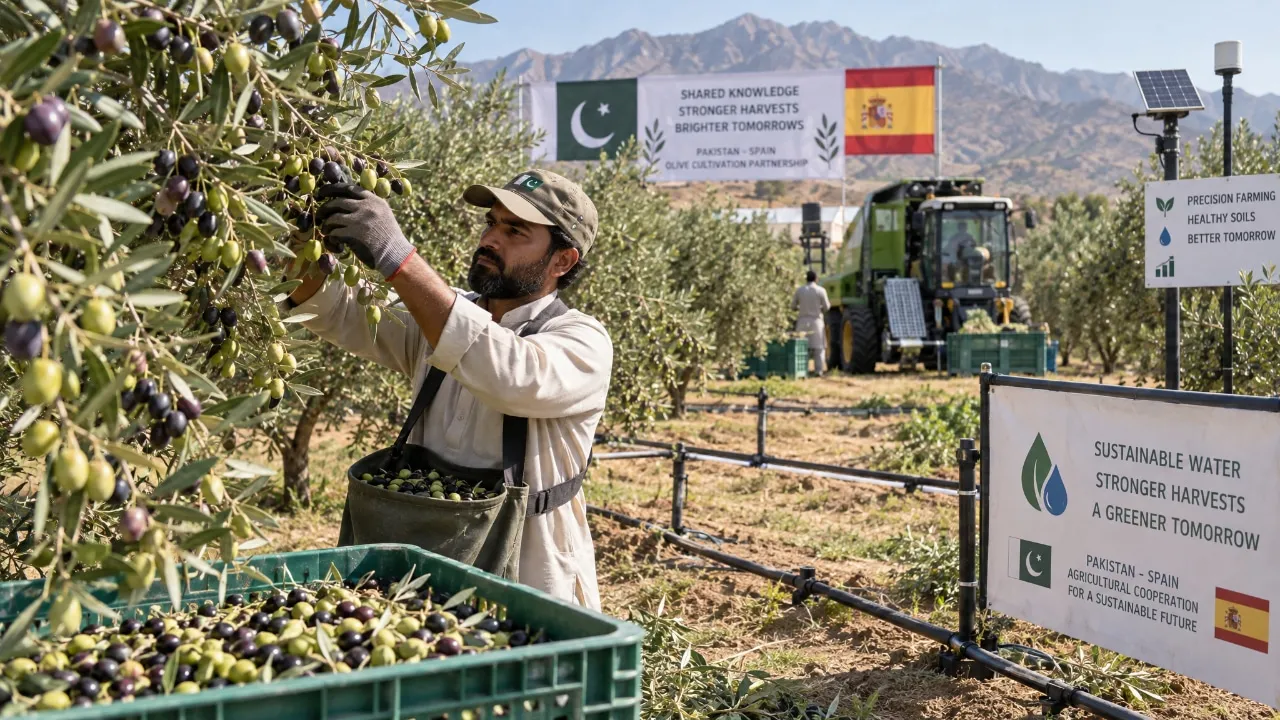
Pakistan and Spain Agree to Expand Agricultural Cooperation
Pakistan and Spain have pledged to deepen their bilateral agricultural collaboration, focusing particularly on sustainable water management, advanced agricultural technologies, olive oil production and olive planting. The diplomatic and economic engagement marks a significant milestone in agricultural diplomacy between the two nations. Officials from both governments met to establish frameworks aimed at modernizing farming practices and expanding specific crop sectors. The discussions centered on using European expertise to transform farming capabilities in South Asia.
The agreement was reached during a meeting in Turkey between Spain's Minister of Agriculture, Fisheries and Food, Luis Planas Puchades, and Federal Minister for National Food Security and Research, Rana Tanveer Hussain. High-level ministerial meetings of this nature provide the diplomatic impetus required for institutional partnerships. Both ministers used the neutral venue to align their strategic goals for bilateral trade, technical assistance, and sustainable resource utilization.
The two sides discussed opportunities to improve cooperation in olive cultivation, olive oil production and processing, agricultural research and the adoption of contemporary farming technologies. Agricultural experts from both countries acknowledge that shifting toward high-value crops can improve rural incomes. Processing infrastructure remains a core focus for the developing partnership, as producing commercial-grade oil requires strict adherence to international standards and specialized machinery.
They also explored ways to use Spain's expertise in water reuse technology, precision farming, effective irrigation systems and agricultural mechanization. Water scarcity represents a severe challenge for farming communities across South Asia. Incorporating modern European machinery and water-saving techniques can mitigate losses caused by inefficient traditional irrigation methods. Technical delegations will study these systems closely during upcoming exchange programs.
Spain Offers Technical Know-How to Pakistan
The Spanish minister expressed his nation's desire to share technical know-how and best practices with Pakistan by offering Spain's proficiency in modern irrigation, precision agriculture and sustainable water management. European agricultural institutions have spent decades refining methods to optimize crop yields while minimizing resource waste. Transferring this knowledge directly to South Asian agronomists helps bridge the technical divide. The cooperation relies on institutional frameworks designed for long-term capacity building.
He also welcomed Pakistan's proposal to send a technical delegation to Spain to study advanced agricultural practices, interact with relevant institutions and explore practical avenues for knowledge and technology transfer. Delegation visits allow local agronomists, researchers, and government officials to observe foreign farming operations firsthand. Direct observation ensures that imported technologies are properly adapted to local climatic and soil conditions. These visits create lasting professional networks between the two countries.
Federal Minister Rana Tanveer Hussain highlighted Pakistan's considerable potential in olive cultivation and the development of its olive oil industry. Certain regions in Pakistan possess soil and climatic conditions well-suited for growing olive trees. Government programs have previously planted millions of olive saplings across targeted districts. Transforming these vast plantations into a commercially viable industrial sector requires targeted international partnerships.
He emphasized the importance of benefiting from Spain's experience in olive orchard management, modern processing techniques, quality standards, value addition, and international marketing to enhance the productivity and competitiveness of Pakistan's olive sector. Spain stands among the global leaders in the cultivation and export of olive oil. Adopting Spanish standards for harvesting, cold-pressing, and bottling ensures that domestic products can compete effectively in foreign markets. Value addition transforms raw agricultural commodities into profitable consumer goods.
Tackling Water Shortages Through Agricultural Innovation
Rana Tanveer Hussain also stressed the necessity of implementing water-efficient agricultural technologies to tackle climate change and the growing shortage of water. Traditional flood irrigation wastes massive amounts of freshwater, which drains rivers and depletes underground aquifers. Modernizing irrigation infrastructure protects natural resources while sustaining agricultural productivity. Policy makers view water conservation as an urgent national priority.
He pointed out that collaboration in precision farming, contemporary irrigation and effective use of water resources could boost crop yields, lower input costs and advance sustainable agricultural growth. Precision farming uses data analytics, sensors, and GPS technology to apply water and fertilizers only where strictly needed. Lowering input expenditures directly increases profit margins for local growers. Sustainable growth ensures that farming communities remain economically viable despite changing weather patterns.
Both parties also discussed strengthening ties between agricultural research institutions, technical specialists and relevant organizations to foster capacity building, technology exchange and cooperation in agricultural innovation. Academic and scientific collaboration underpins long-term industrial success. Joint research projects can develop crop varieties resistant to drought and local plant diseases. Scientists from both nations will coordinate closely on experimental trials.
Through technical cooperation, knowledge exchange and the adoption of modern and sustainable farming methods, Pakistan and Spain reiterated their shared commitment to further agricultural cooperation. The ongoing partnership creates a structured pathway for future bilateral agreements. Both ministries plan to monitor the implementation of these initiatives through regular diplomatic channels. The joint effort ultimately aims to secure a stable and prosperous future for rural farming communities in Pakistan.





