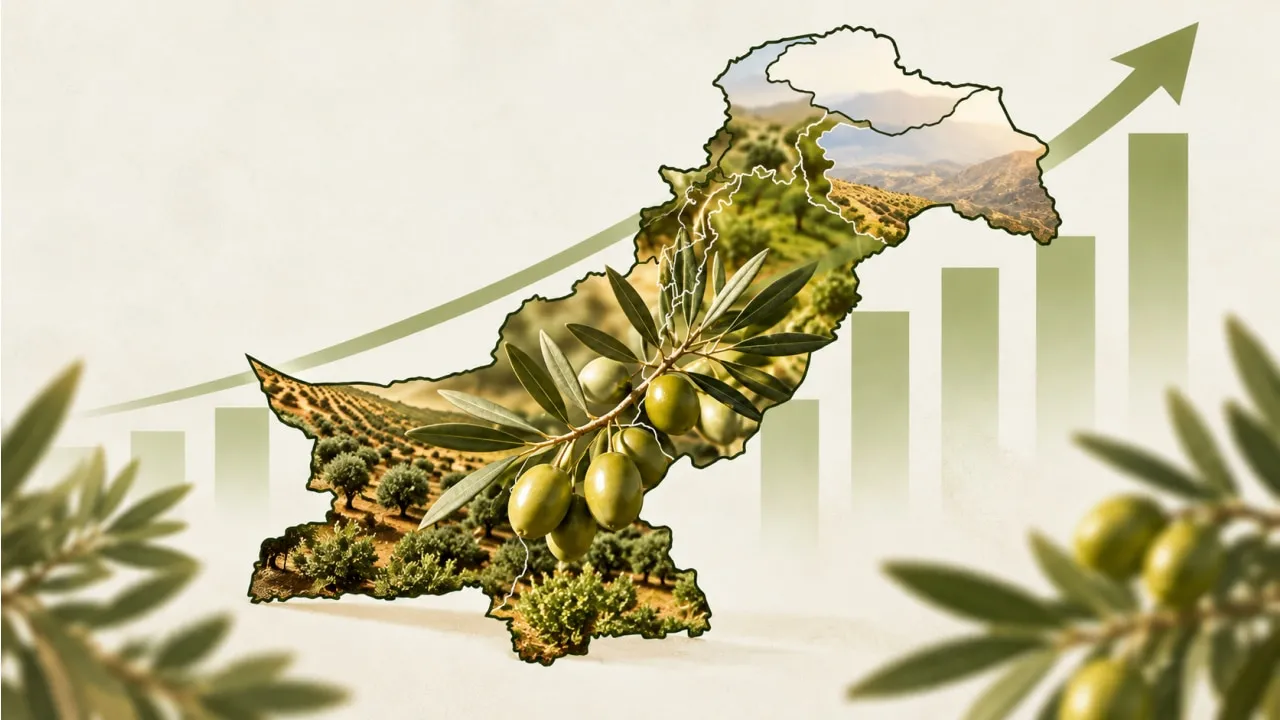
Pakistan domestic olive oil production is projected to reach 716 tons this year, according to a government survey seen by ProPakistani. Work to promote olive trees and their products in the country started in 1986, when the Pakistan Agricultural Research Council began cooperating with the Italian government to introduce olives and develop cultivation methods. Researchers later started working on wild olive species in the early 2000s to convert them into fruit-bearing varieties.
A five-year project following a debt swap agreement with Italy in 2006 aimed to link olive cultivation with rural economic development. This initiative was moved under the Pakistan Agricultural Research Council after the devolution of the Pakistan Oilseed Board and finished in 2012, leading to later projects that scaled commercial olive cultivation.
From Research to 7.6 Million Olive Plants
Efforts include importing, distributing, and planting millions of saplings alongside providing oil extraction equipment through government research bodies like the Center of Excellence for Olive Research and Training and private companies. The government has distributed millions of saplings for free and offered a subsidy of upwards of 67 percent on plants and drip irrigation systems.
Policies target expanding total cultivated olive land to 100,000 acres and tree numbers to 10 million by 2030.
Current projects fall under the National Olive Value Chain Policy 2024-2030. Under this policy, the government established the Pakistan Olive and Olive Oil Council beneath the Pakistan Oilseed Board to unite farmers, processors, and officials, while also launching the 'PakOlive' national certification trademark to ensure strict regulations and quality checks.
A government survey shows that 7.64 million olive plants are planted across 60,456 acres in 131 districts nationwide. Balochistan holds the largest share, with 3.20 million plants, which is 41.9 percent, across 24,620 acres in 31 districts.
Punjab follows with 2.24 million plants, making up 29.3 percent, across 17,000 acres in 31 districts. Khyber Pakhtunkhwa contains 1.66 million plants, representing 21.7 percent, across 14,690 acres in 32 districts.
The survey counts 205,929 plants in Azad Jammu and Kashmir, 117,958 in the Islamabad Capital Territory, 92,296 in Gilgit-Baltistan, and 129,384 in Sindh.
National olive oil production started at 19 kg in 2016 and has risen to nearly 716 tons in 2026, with olive fruit output estimated at 7,412 tons based on the government survey.
These figures remain small compared to total imports and the broader edible oil market, but represent substantial growth for a previously nonexistent industry.
Exports Grow 27-Fold
Olive oil exports expanded significantly over recent years, climbing from just 9 tons in 2020 to 249 tons in 2025, marking a 27-fold increase in volume over five years. Meanwhile, imports dropped 33 percent in volume from a peak of 4,479 tons in 2021 to 2,996 tons in 2025.
The government survey estimates Pakistan holds roughly 4 million hectares of land with olive-growing potential, alongside millions of wild olive plants. Unlike traditional oilseed crops that demand prime arable land and heavy water resources, olives grow well in diverse agro-ecological zones, particularly on rain-fed, marginal, and degraded lands where the government focuses its efforts.
The survey records 51 olive oil extraction units nationwide. Balochistan hosts 23 units, Khyber Pakhtunkhwa has 16, Punjab contains nine, Islamabad features two, and Azad Jammu and Kashmir has one, making up 2.0 percent.
Supporting infrastructure includes three value-addition laboratories, six fruit-processing units, five weather stations, nursery tunnels, and a national reference laboratory.
These facilities demonstrate that the government olive development program extends past planting into research, nursery growth, processing, and quality support.
During a media briefing for the PAC Agri Connections 2026 event, ProPakistani learned that Italian delegates visiting Pakistan recently rated olive oil from Balochistan at international quality standards.
ProPakistani also learned that while 100 kg of harvested olives generally yields 12 to 14 kg of oil globally, Balochistan olives reportedly yield around 18 kg of oil per 100 kg of fruit.
Combined with positive quality feedback, this indicates Pakistan can potentially compete with established olive oil producers.
The olive market includes products beyond cooking oil and table olives, such as personal care items like soaps, lotions, and skin care, olive spreads and tapenades, health supplements, olive leaf tea, and industrial pomace by-products including secondary frying oil, biomass fuel pellets, and animal feed.
However, according to the Pakistan Olives Market Study, traditional food items still command most consumer demand.
Consumer surveys show olive oil captures the highest share at 50 percent to 56 percent of regular consumption, followed by table olives at 32 percent to 39 percent, and olive-based care items making up 11 percent to 12 percent. For imported retail sales specifically, olive oil accounts for 68 percent, table olives 30 percent, and olive spreads or care items 2 percent.
The absence of local olive oil on nearby shelves stems from early-stage economies of scale, local distribution, and value chain development.
Awais Khan, CEO of the National Alliance for Safe Food, told ProPakistani that branding, packaging, and marketing present the primary bottlenecks because most farmers lack equipment in those areas and corporate involvement remains absent.
Awais added that the government holds an overarching plan to promote self-sufficiency in edible oils and lower import dependence, including sesame and other oilseeds.
Challenges Remain
Massive capital investment and long payback periods remain the biggest growth challenges.
Government policy documents state that olive trees do not yield fruit or produce financial returns during their first four years, while the extended break-even horizon stretches close to 10 years.
Government policy interventions target regions with marginal and under-used land, but access to agricultural extension and technical guidance in these areas stays limited.
State-backed initiatives historically operate under fixed five-year project lifespans, meaning support and momentum can decline before planted groves reach full commercial fruition when project windows expire.
A 2023 market study of the domestic olive oil market conducted under the Growth for Rural Advancement and Sustainable Progress project noted that 74 percent of consumers preferred imported olive oils while 26 percent favored local options, and three out of every four retail products came from international sources.
According to the study, olive oil constitutes only 0.3 percent of Pakistan edible oil imports due to a common myth that it is unsuitable for high-temperature cooking, alongside higher costs compared to alternatives.
The report noted that local consumption challenges involve missing quality testing facilities, a lack of coherent pricing that often makes local goods costlier than imports, little or no commercial player participation for value addition, limited use of appropriate harvesting tools, inadequate oil extraction infrastructure, and improper packaging.
Price sensitivity remains a challenge, with 73 percent of consumers considering it very important, while 71 percent attributed importance to brand reputation.
The largest share of olive plantations concentrates in Balochistan and Khyber Pakhtunkhwa, where security remains uncertain, and olive oil infrastructure investment requires a long payback period, leaving the future expansion and long-term sector sustainability to be determined.
Current numbers remain encouraging, but building a commercially viable industry demands sustained investment, a functioning value chain, and projects maintained long enough to fulfill their promise.