By Arshad Ali
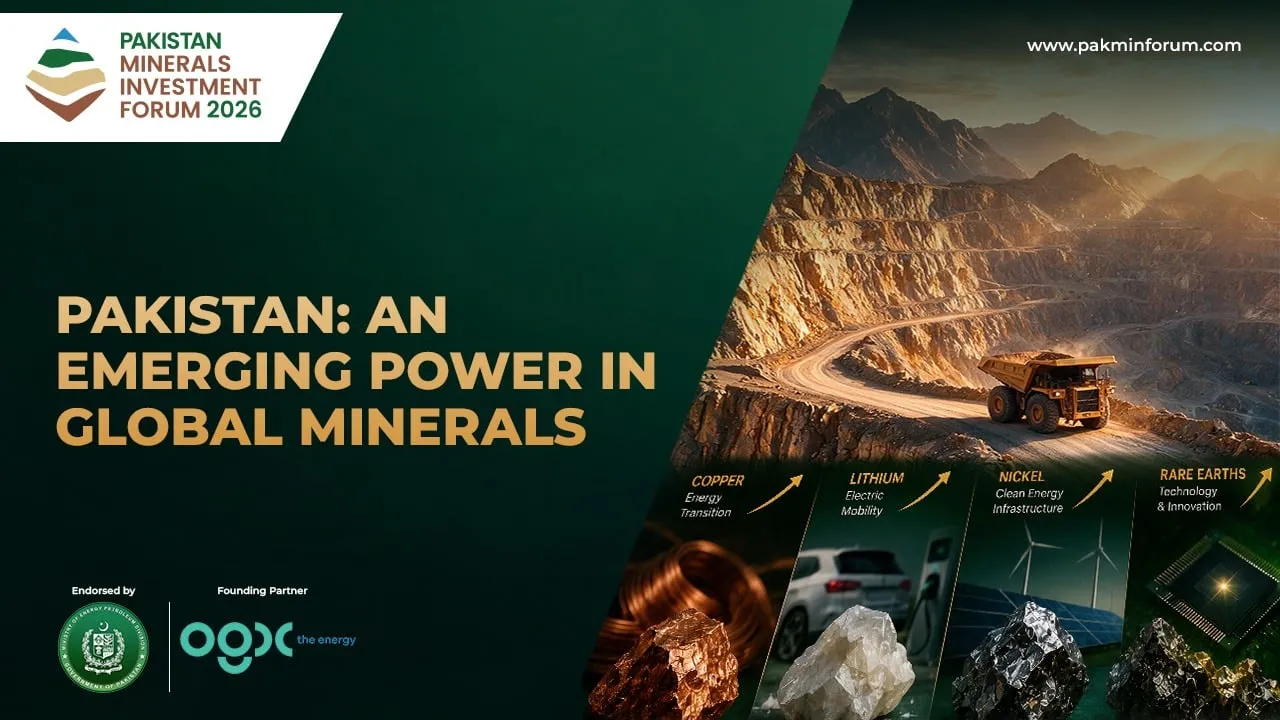
As the global energy transition accelerates, countries are racing to secure critical minerals like copper, lithium, and rare earth elements for electric vehicles and renewable energy. Pakistan is stepping into this space with an estimated $8 trillion in mineral wealth spread across 600,000 square kilometres. The country features 92 identified minerals, and 52 are commercially extracted.
To turn this potential into projects and investment, Pakistan introduced the National Minerals Harmonisation Framework to standardise mining rules. The government also set up the Pakistan Minerals Investment Forum as its main platform for investors.
Strategic Moment for Mineral-Rich Country
Mining accounts for about 3.2 percent of GDP, according to the US Department of Commerce. Pakistan sits within the Tethyan Metallogenic Belt, a corridor stretching from southeastern Europe through Turkiye, the Middle East, and the Himalayas into Pakistan, known for copper and gold deposits. The International Energy Agency noted that demand for energy minerals continued to grow strongly in 2026.
Copper and The Energy Transition
Copper is essential for electricity networks and electric vehicles. The Reko Diq copper-gold project in Balochistan's Chagai district holds a 50 percent stake by Barrick Mining Corporation, 25 percent by the Government of Balochistan, and 25 percent by three Pakistani state-owned enterprises.
In February 2025, Barrick announced an updated feasibility study estimating a 37-year mine life, capital investment of $8.83 billion, and first production by the end of 2028. Reko Diq contains around 3 billion tonnes of probable mineral reserves, with 15 million tonnes of copper and 26 million ounces of gold.
Lithium Adds a New Dimension
Lithium demand is projected to more than quadruple between 2024 and 2040. In July 2026, Oil and Gas Development Company Limited found lithium in formation water from a geothermal well in Sindh.
The company is conducting further technical work to determine commercial viability. This discovery relates to geothermal formation water rather than hard-rock mining.
National Framework to Improve Investor Confidence
The National Minerals Harmonisation Framework 2025 addresses licensing and regulations. The reform programme includes digitalising geological data and revitalising the Geological Survey of Pakistan.
The government is focusing on value-added mineral products and domestic processing capacity to capture a greater share of value.
Why PMIF26 Matters to Global Investors
The Pakistan Minerals Investment Forum connects Pakistan's mineral opportunities with international capital. PMIF26 will be held on November 12-13, 2026, at the Jinnah Convention Centre in Islamabad.
PMIF25 attracted more than 5,000 delegates from over 50 countries, with 16 MoUs signed and 18 panel discussions held.
The writer is a seasoned journalist with a strong background on economic affairs, the energy sector, Pakistan's mineral potential and emerging investment opportunities, with a focus on developments shaping the country's economic growth and future prospects.