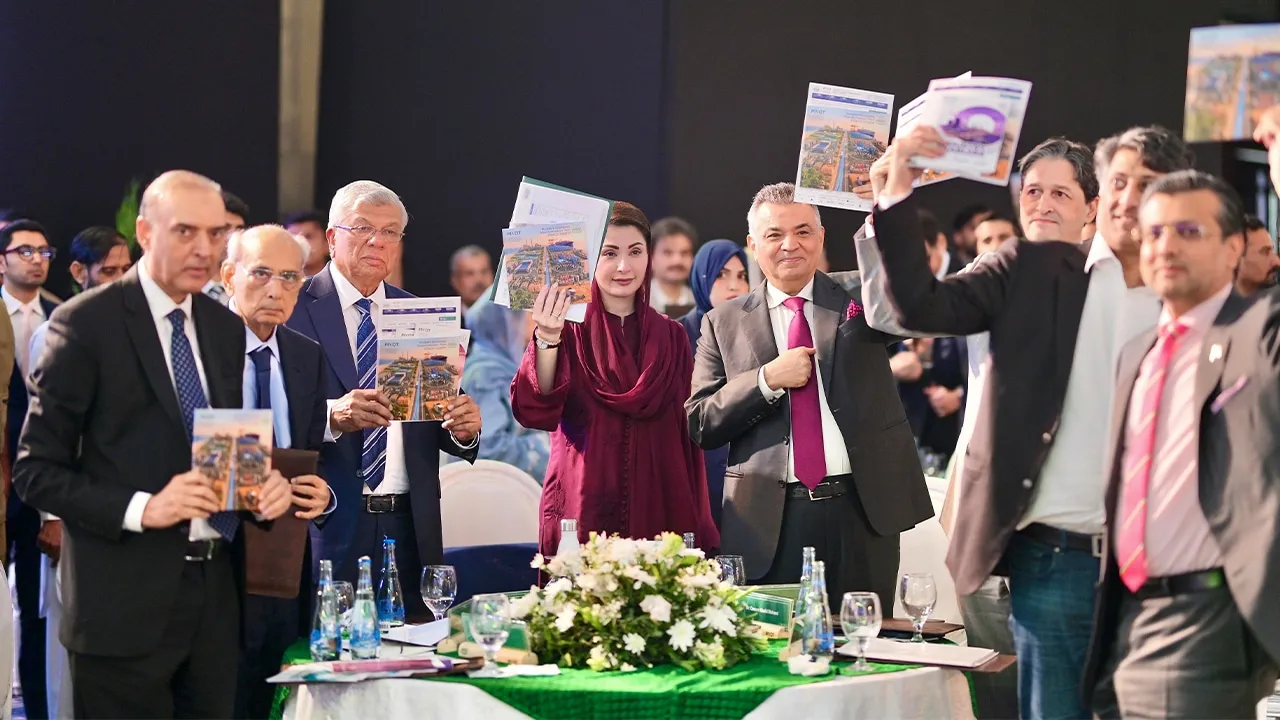
Punjab Chief Minister Maryam Nawaz Sharif formally revealed the Punjab Innovation, Value Addition and Economic Transformation Plan 2026-29, a broad Rs1,995.3 billion financial blueprint designed to turn Punjab into an export-driven industrial base. The project seeks $6.8 billion in extra exports, 162,000 new direct employment opportunities, and backing for over one million livelihoods.
During the introduction event, Chief Minister Maryam Nawaz Sharif stated: “Punjab is ready to move towards a new model of economic growth, one driven by industry, innovation, value addition and exports. Our objective is to create an environment where businesses can invest with confidence, industries can expand and our people can access better employment and livelihood opportunities.”
The presentation gathered corporate leaders, financial policymakers, international development personnel, and foreign envoys at the invitation of Chief Minister Maryam Nawaz. Notable business figures such as Mian Mansha, Arif Habib, Fawad Mukhtar, Ziad Bashir, and Osman Khalid Waheed joined the event, showing private-sector involvement.
State Bank of Pakistan Governor Jameel Ahmad represented the banking sector alongside directors and executives from commercial banks. International groups included foreign ambassadors and delegates from the World Bank, Asian Development Bank, and United Nations agencies.
Government officials, headed by Senior Minister Marriyum Aurangzeb and Chief Secretary Zahid Akhtar Zaman, provincial ministers, secretaries, and district focal officers, also attended to present the administration's execution plans.
Addressing the business community, the Chief Minister said: “My message to investors and industrialists across Pakistan and around the world is clear: Punjab welcomes your investment. We want to work with you, facilitate your businesses and create the conditions in which enterprise can grow. Government will facilitate, industry will lead.”
A core element of the PIVOT strategy is the Strategic Trade Enhancement Programme, backed by a new digital portal. Through this system, the administration plans Rs300 billion in discounted financing with interest rates from zero to five percent for qualified commercial groups, giving companies cheaper capital for growth.
This funding model is part of a wider investment structure mixing Rs1,089 billion in public spending with a goal of Rs906 billion in private-sector investment.
The Chief Minister said: “We are not looking at economic growth as a government-only responsibility. Sustainable growth requires private investment, a strong industrial base and a partnership in which the public sector enables the private sector to innovate, produce and compete. PIVOT is designed to turn that partnership into measurable economic progress.”
The roadmap assigns Rs753.7 billion toward boosting manufacturing output, supporting value addition, and building long-term export capability.
To tackle operational expenses and power issues, the administration set aside Rs50 billion for solar energy setups and Battery Energy Storage Systems. Another Rs50 billion was given for machinery duty refunds to encourage factories to upgrade equipment, use new technology, and meet global standards.
The program targets main manufacturing sectors like textiles, sports equipment, leather, surgical tools, pharmaceuticals, fans, cutlery, steel, and ceramics. Modern testing labs and plug-and-play facilities are also planned to help firms meet international compliance rules.
The Chief Minister said: “Our industries must not be limited to producing more; they must produce better, add greater value and compete in international markets. We want Punjab's manufacturers to have access to modern technology, reliable energy solutions, quality infrastructure and the financing they need to expand their businesses and exports.”
AGRICULTURE AND AGRO-PROCESSING: MOVING UP THE VALUE CHAIN
To shift farming past raw crop production toward higher-value processing, PIVOT features four dedicated agro-processing parks in Sargodha, Khanewal, Okara, and Bhakkar.
These sites aim to cut post-harvest waste, upgrade food-processing infrastructure, and link agricultural producers to advanced supply chains.
Farming value-chain steps include wheat value improvement and better market access for citrus, potato, and mango harvests, along with export financing for horticulture. The project also sets up Horticulture Authorities in 20 districts.
The scheme further backs commercial growth in livestock, dairy, aquaculture, halal meat, and milk sectors to raise output and build export avenues.
TOURISM, TECHNOLOGY AND SKILLS DEVELOPMENT
Aside from manufacturing and farming, the strategy covers tourism, digital services, and workforce training.
Tourism infrastructure will be improved to build destination-economy options, upgrade visitor facilities, and push private investment in hospitality.
To bridge the gap between education and job requirements, the scheme aims to train 402,060 people over three years, focusing on industry-driven skills for modern sectors.
The Chief Minister said: “Our young people must be prepared for the jobs of tomorrow. Skills development must respond to the actual needs of industry and the changing demands of the economy. We want training to lead to employment, entrepreneurship and better livelihoods.”
BUSINESS REFORMS AND DIGITAL INVESTOR FACILITATION
To better the business climate, PIVOT brings in administrative changes to ease commercial tasks and draw long-term investments.
Through the E-Biz digital project, the provincial government plans to digitize 300 public services for easier access. The project also looks to bring 2,000 firms onto e-commerce networks, update labor laws, and lease state land across nine economic sectors.
The Chief Minister said: “Investors should spend their time building businesses, creating jobs and expanding production—not navigating unnecessary administrative hurdles. We are working to make government services simpler, more accessible and more transparent.”
TRACKED, TRACEABLE AND ACCOUNTABLE IMPLEMENTATION
Execution and monitoring are handled through a central model led by a PIVOT Board chaired by Senior Minister Marriyum Aurangzeb.
Operational work will run through a PIVOT Secretariat in the Planning and Development Department and a cell in the Chief Secretary Office, with Deputy Commissioners acting as local focal points.
Progress will be watched via a central PIVOT Dashboard and an Industry Scorecard with set milestones and regular reviews.
Chief Secretary Zahid Akhtar Zaman explained the setup and noted the concept would become active within six months.
The Chief Minister said: “PIVOT will not remain a document of targets and commitments. Its implementation will be tracked, its progress measured and its results assessed. Every initiative must translate into real investment, stronger businesses, more exports and better opportunities for the people of Punjab.”
PRIVATE-SECTOR CONFIDENCE AND INVESTMENT MOMENTUM
Senior Minister Marriyum Aurangzeb stressed that the goal of PIVOT is for the government to act as a facilitator, allowing the private sector to lead growth.
Showing private interest at the launch, developer Arif Habib shared plans to build Pakistan tallest commercial tower at Lahore CBD One.
PIVOT lays out a three-year framework to turn economic potential into investment, industrial strength, higher exports, and more jobs.
The Chief Minister concluded: “Our ambition is to build a Punjab where businesses can grow, industries can compete globally, our farmers can earn more from their produce and our young people can find meaningful opportunities. We are opening the doors to investment and partnership. Together, we can turn Punjab's economic potential into prosperity.”