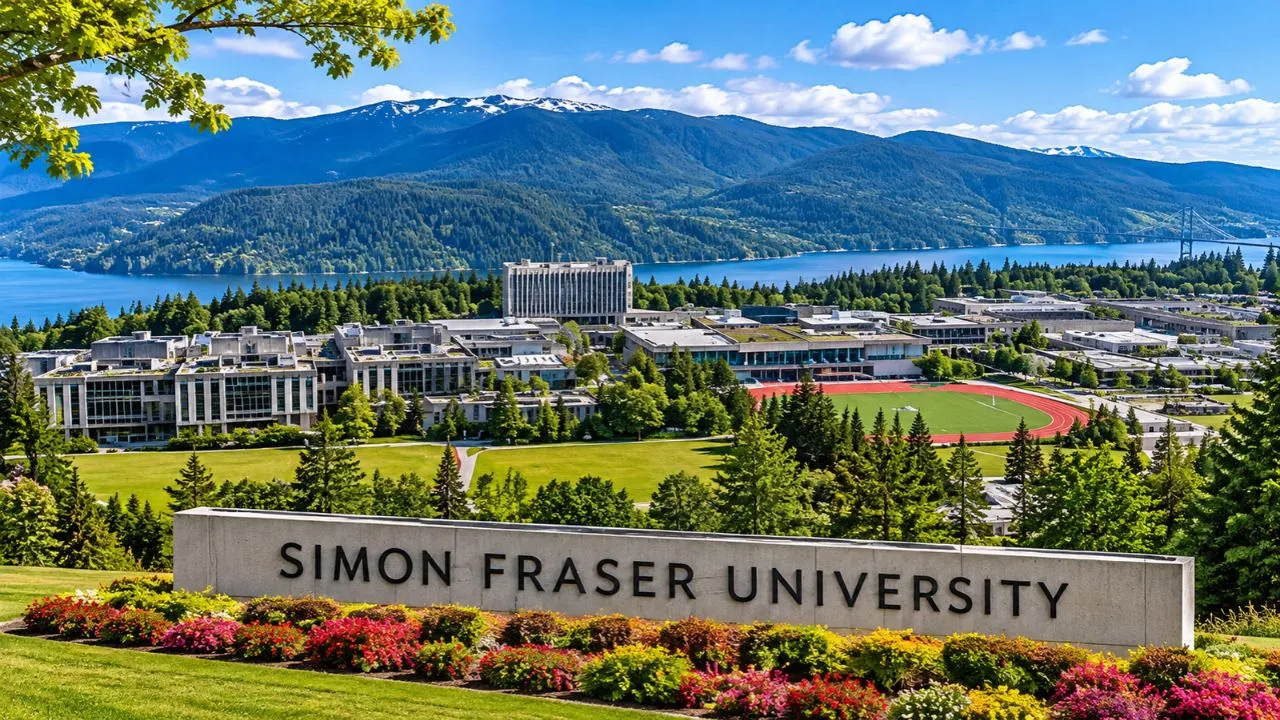
Simon Fraser University Graduate Research Opportunities in Canada
Simon Fraser University located in Canada has announced fully funded research openings for both Master's and doctoral scholars, featuring baseline annual stipends beginning at CAD 28,000 for Master's candidates and CAD 32,000 for PhD participants. These academic opportunities are hosted through the institution's Synthetic Aperture Radar Laboratory, commonly known as SARlab, situated within the province of British Columbia. The facility concentrates its academic investigations on satellite radar systems, remote sensing applications, artificial intelligence models, and environmental tracking.
Official university statements confirm that the laboratory provides guaranteed financial support spanning two years for Master's scholars and extending to four years for doctoral participants. Enrolled individuals can also secure extra financial assistance exceeding CAD 15,000 yearly through dedicated graduate fellowships and teaching assistant positions. The division currently lists three doctoral openings tied to an NSERC Alliance-supported initiative created in partnership with Canadian aerospace and technology firm MDA, alongside potential openings for Master's students.
Details of the SARlab Northern Mapping Project
Scholars joining the laboratory will engage with sophisticated satellite radar equipment and explore practical applications for these technologies. The current recruitment drive supports a specific initiative named Enhancement of SAR Research Methods to Identify and Create Community-Centric Mapping Applications for Canada's North. This project targets the creation of superior radar tracking networks designed specifically for northern settlements across Canada.
Researchers will merge Synthetic Aperture Radar methodologies with machine learning, artificial intelligence, and advanced engineering practices to observe ecological transformations and maritime movements. The framework also intends to build mapping tools that assist local populations while facilitating the exchange of scientific data and traditional knowledge systems. Access to specialized instruments, satellite datasets, and high-performance computing infrastructure forms a core component of the laboratory environment.
Stipend Levels and Financial Coverage
Eligible post-graduate scholars joining the facility receive structured research assistantship packages designed to offset living expenses and academic costs. The published starting annual stipend guarantees CAD 28,000 for Master's enrollees and CAD 32,000 for doctoral researchers. Furthermore, the laboratory notes that these financial stipends experience an increase once the student successfully publishes their initial research paper.
Additional income streams come through the School of Engineering Science via Graduate Fellowship or Teaching Assistantship frameworks, typically yielding CAD 15,000 or more each year. According to institutional guidelines, this supplementary funding generally suffices to cover mandatory tuition charges. Even so, prospective applicants must verify their individual financial documentation, tuition rates, compulsory fees, and living expenses prior to accepting any official appointment.
Open Doctoral Research Specializations
The institution has outlined three distinct doctoral research tracks under the umbrella of its Arctic mapping initiative.
1. Arctic Marine Remote Sensing
This doctoral track centers on formulating advanced radar methodologies to observe marine ecosystems across the Arctic. The chosen candidate will build techniques to locate and recognize small vessels amid challenging coastal environments characterized by sea ice, icebergs, and complex ocean surfaces. Investigations will use satellite and airborne radar data alongside artificial intelligence and signal processing algorithms. Candidates require a Master's degree in Electrical Engineering, Computer Science, Remote Sensing, Physics, Geomatics, or an equivalent discipline, with prior radar or machine learning exposure considered an asset.
2. Arctic Land Monitoring
The second doctoral option investigates landscape transformations across the Arctic using satellite radar instruments. Work will center on tracking permafrost degradation, ground movement, hydrological shifts, coastal erosion, and infrastructure durability. Researchers will construct advanced models applying Interferometric Synthetic Aperture Radar, geophysical modelling, and artificial intelligence. Applicants need a Master's degree in Geophysics, Remote Sensing, Earth Science, Engineering, Computer Science, Physics, or a related field.
3. Compact Polarimetric SAR for Maritime Surveillance
The third doctoral opening focuses on creating compact polarimetric radar techniques for ocean tracking and maritime security. Investigators will analyze how radar emissions interact with oceanic surfaces under varying wind conditions. The initiative seeks to refine vessel identification, ocean wind measurements, and upcoming satellite radar missions. Candidates must possess a relevant Master's degree in disciplines such as Electrical Engineering, Remote Sensing, Physics, Geomatics, or Computer Science, alongside proficiency in Python or MATLAB.
Candidate Qualifications and Entry Standards
Applicants must exhibit appropriate academic credentials and a demonstrated enthusiasm for scientific investigation. The laboratory welcomes individuals with backgrounds in remote sensing, radar systems, engineering, computer science, physics, geophysics, or geomatics. Strong software development capabilities, particularly in Python and C++, represent a significant advantage during the selection process.
Candidates are expected to display strong scientific writing abilities, a drive to publish academic findings, and clear verbal and written English communication. Master's applicants through the School of Engineering Science typically require a bachelor's degree in Electrical Engineering, Computer Engineering, Engineering Science, or a closely aligned field. Doctoral candidates generally must hold an appropriate Master's degree and prove their capability to perform independent academic research, alongside securing agreement from a faculty supervisor.
Language Proficiency and Application Documentation
The university maintains strict English language prerequisites for individuals seeking admission to the laboratory. Candidates submitting IELTS Academic scores must achieve an overall band of at least 7.0, with no individual subsection falling below 6.5. The institution also recognizes a TOEFL iBT score of 93, with a minimum of 20 in every section, under the older scoring framework. Because the university adopted revised TOEFL standards following scoring adjustments in January 2026, applicants taking the updated test must confirm equivalent score thresholds with the admissions division.
Interested parties must assemble an updated curriculum vitae, academic transcripts, and a detailed cover letter. The cover letter should outline the applicant's academic history, investigative interests, programming proficiency, and motivations for pursuing a position within the laboratory. For formal entry into the School of Engineering Science, candidates must submit a statement of interest, academic records, and contact details for three professional referees without needing GRE examination scores.
Procedure for Submitting an Application
Prospective scholars must initiate contact with Professor Bernhard Rabus, who oversees investigative operations within the laboratory. Candidates should transmit an email featuring their curriculum vitae, academic records, and cover letter directly to btrabus@sfu.ca. Submissions must explicitly state whether the applicant seeks a Master's or doctoral slot and clarify how their background aligns with ongoing projects. Following initial faculty communication, candidates must complete the formal university graduate admissions procedure.