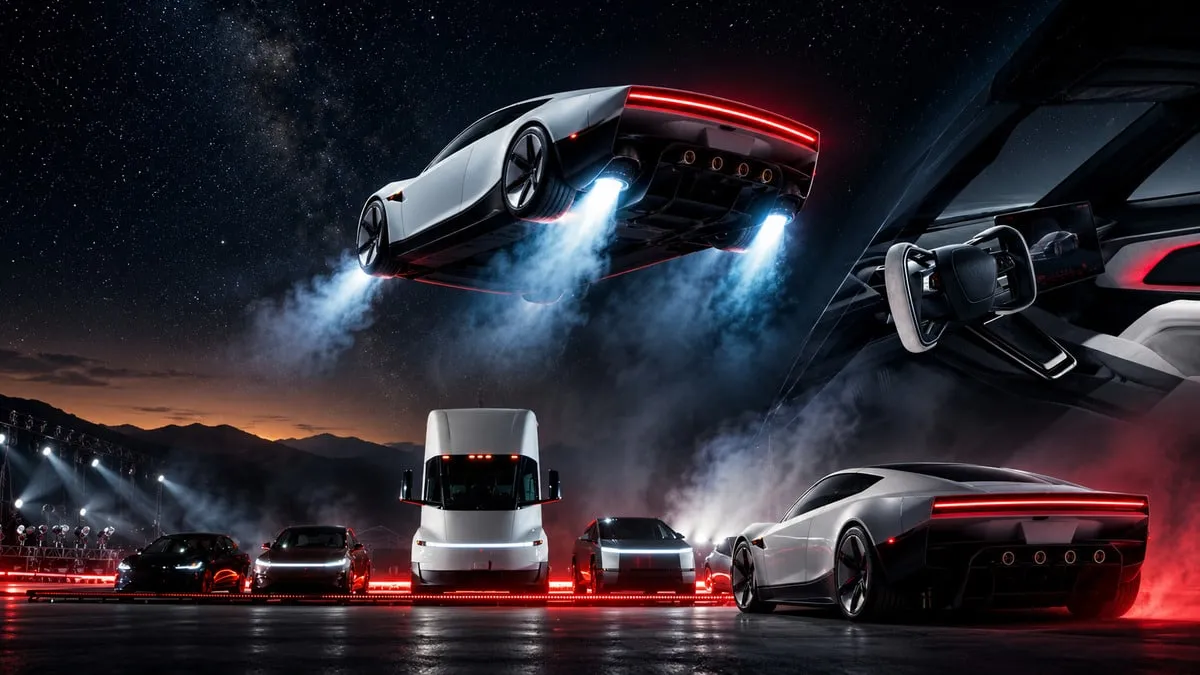
Nearly ten years after its initial announcement, Tesla revealed the next-generation Roadster on October 15 during an event in Waco, Texas, where the electric vehicle briefly cleared the ground, drove up a steep ramp, executed aerial tricks, and reached 0 to 60 mph in 0.81 seconds using technology adapted from SpaceX.
Tesla Roadster Takes Flight
Tesla showed the vehicle driving up a large ramp while relying on a suction system to stay glued to the surface. At the peak, the car used thrusters to spin in the air before landing safely. In a separate test, the Roadster flew over multiple Tesla models, such as the Cybertruck, Model 3, Model Y, Semi, and Cybercab. The company also displayed a 0 to 60 mph time of 0.81 seconds. These tests were strictly controlled, and Tesla has not demonstrated continuous aircraft flight.
How the Flying Roadster Works
Instead of depending on wings or helicopter rotors, the vehicle uses engineering inspired by SpaceX. It incorporates 10 cold-gas thrusters running on compressed air kept in high-pressure tanks. These thrusters supply the power required to lift the car, alter direction, and stabilize it during brief airborne moves. Tesla engineers note the setup uses about 600 liters of compressed air without burning rocket fuel. A fan-powered suction system underneath also creates strong downforce, helping the car grip surfaces during extreme stunts like inverted driving.
Three Roadster Versions
Tesla shared plans for three distinct editions of the car. The Performance model includes two seats, active aerodynamics, and a suction system, with reservations currently open. The Thrust variant offers two seats, rear cold-gas thrusters, and sub-one-second acceleration in a limited release. The Rocket version features a single seat, 10 thrusters, and short flight capability, though it is limited to an invitation-only basis and lacks approval for public roads.
Inside the New Roadster
The cabin sports a sparse design with a yoke steering wheel, a massive central screen, and molded seats. Tesla also included steer-by-wire capability and a movable rear wing. The interior prioritizes speed and handling over standard luxury amenities.
Price Has Not Been Announced
Tesla has not disclosed final retail costs for the new car. However, the business is taking $50,000 reservations for the Performance model and $250,000 reservations for the Thrust model, while the Rocket edition is strictly by invitation. All performance and range data come directly from the manufacturer and have not yet been independently tested on production models.
Production Now Targeted for 2028
The second-generation Roadster was first shown in 2017 with a planned 2020 delivery date. The firm missed that deadline and pushed back the release repeatedly while prioritizing other vehicles like the Model 3, Model Y, and Cybertruck. Production is now aimed at 2028, placing the vehicle about eight years behind its initial timeline. While the recent showcase proves Tesla built a functional prototype capable of fast acceleration and short flights, questions remain about what features will make it to production, final pricing, and whether the company will hit its 2028 goal.