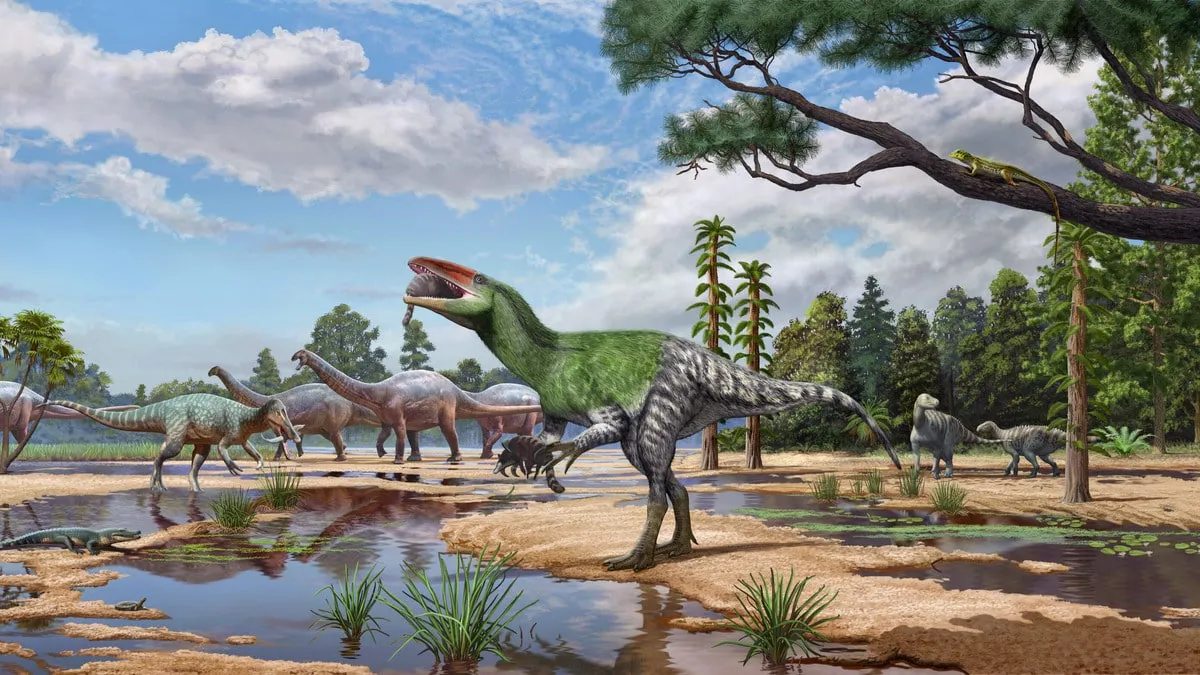
A dinosaur fossil that sat largely ignored inside a museum collection for nearly a hundred years has been classified as a previously unknown meat-eating species equipped with large curved claws. Named Invictibellatrix amberina, this creature inhabited the area now known as Britain around 120 million years ago and reached roughly the dimensions of a large tiger. Experts led by University College London examined the specimen, which was first uncovered on the Isle of Wight, and published their results in Royal Society Open Science.
First Known European Megaraptoran
The team identified Invictibellatrix as the initial known European representative of the megaraptorans, an insufficiently understood family of bipedal carnivorous dinosaurs linked to tyrannosaurs. Unlike Tyrannosaurus rex, which depended heavily on powerful jaws, megaraptorans possessed narrower heads, muscular arms, and large curved claws likely used for catching prey. Certain members of this lineage later transformed into massive apex predators rivalling the biggest tyrannosaurs in size. Invictibellatrix, however, stood as one of the earliest and smallest known megaraptorans. Its name translates to unconquered female warrior, pointing to the group's subsequent rise as major predators.
Fossil Had Been in Museum Collection Since 1924
The breakthrough arose from a fragment situated at the back of the skull that entered the Natural History Museum collection back in 1924. The specimen stayed largely neglected for almost 100 years prior to detailed examination by researchers. Lead author Dr. Cassius Morrison of UCL Earth Sciences calculated that the animal measured approximately three to four meters in length and stood slightly taller than 1.5 meters. It likely possessed feathers and claws measuring roughly 10cm to 20cm. Scientists believe it hunted small dinosaurs, mammals, and lizards, filling an ecological role comparable to that of a modern hyena.
Could Have Been Dangerous to Human-Sized Prey
Morrison stated that while humans never coexisted with the dinosaur, a human-sized animal would have served as suitable prey for Invictibellatrix. He contended that the smaller predator could theoretically present a more direct threat to humans than a T. rex, which would likely view a person as too small to bother hunting. The comparison served to demonstrate the probable hunting behavior of the dinosaur instead of suggesting any human encounter.
Major Gap in Megaraptoran History Filled
Megaraptoran fossils remain scarce, leaving scientists uncertain about where the group originated and how it dispersed across the ancient world. One hypothesis suggests megaraptorans first evolved in Asia, travelled through Europe, and eventually reached Gondwana, which encompassed modern-day Africa, South America, and Antarctica. Until now, no megaraptoran fossils had been identified within Europe. Co-author and UCL PhD student Charlie Scherer noted that the discovery supplies the first proof that megaraptorans inhabited Europe and backs the theory that they migrated to Gondwana via this path rather than crossing between southern islands.
CT Scans Helped
Investigators employed computed tomography scans to analyze the skull fragment without causing damage. The scans enabled them to build a detailed three-dimensional reconstruction of the fossil and digitally inspect the cavity that once held the dinosaur brain. The group compared its anatomy against skulls and braincases belonging to tyrannosaurs, spinosaurs, raptors, and other carnivorous dinosaurs. Several unusual characteristics helped differentiate it from known species, such as an oval opening where the spinal cord joined the brain and a distinct hourglass-shaped crest. Computer-based comparisons also consistently placed the fossil within the megaraptoran category.
Megaraptorans Later Became Giant Predators
The scientists additionally investigated how megaraptorans spread and evolved across millions of years. Their models integrated fossil evidence, evolutionary ties, ancient geography, and prehistoric climate conditions. The outcomes indicate megaraptorans were widely dispersed throughout the Early Cretaceous but subsequently vanished from Laurasia, the northern landmass comprising much of present-day North America, Europe, and Asia. Within Gondwana, nevertheless, certain specimens developed into enormous predators featuring curved claws stretching around 35cm. One instance, Maip macrothorax from present-day Argentina, is estimated to have attained nine to 10 meters in length and weighed roughly as much as an elephant. Researchers remain unsure why megaraptorans died out in northern territories, though climate shifts, environmental changes, and competition alongside other large predators like tyrannosaurs may have contributed.
Fossil Was Collected by an Amateur Paleontologist
The fossil was originally gathered by amateur paleontologist Reginald Walter Tooley near the foot of a cliff along the southwestern coast of the Isle of Wight. Tooley collected upwards of 1,000 fossils, which subsequently entered the Natural History Museum collection. Professor Paul Barrett, the senior study author from the Natural History Museum, stated that the discovery demonstrates how historically gathered museum specimens can still yield significant scientific finds even after decades of analysis. The species name amberina points both to amber discovered within the rocks holding the fossil and to the female given name. Researchers explained that the genus name also aimed to offer encouragement to individuals encountering bullying, discrimination, victimization, and oppression. The discovery proves that even fossils gathered generations ago can still uncover previously unknown species and supply fresh insights regarding how prehistoric animals evolved and dispersed globally.