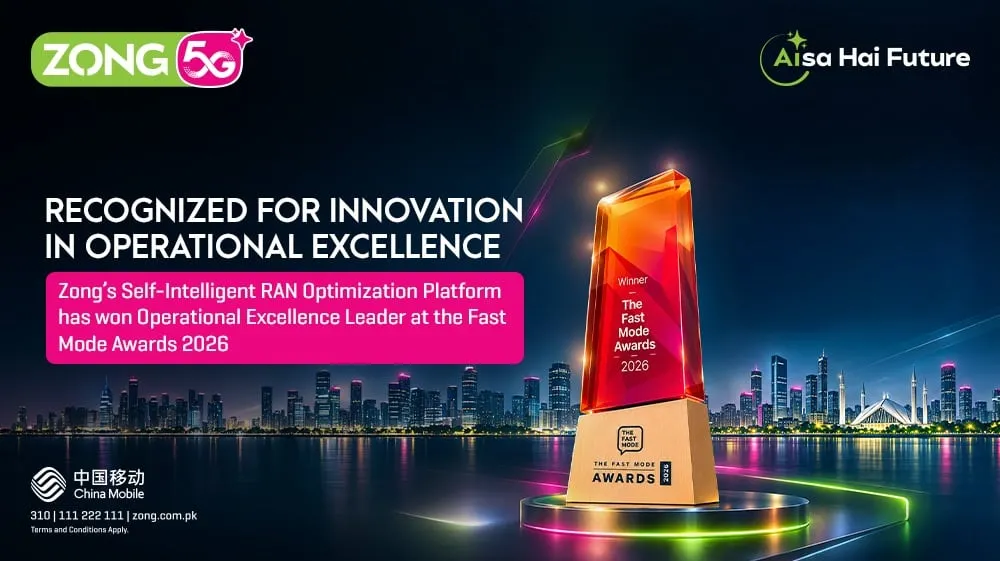
Zong Wins Operational Excellence Leader Award at The Fast Mode Awards 2026
Zong, Pakistan's Leading Technology Services Enterprise and a wholly-owned subsidiary of global technology leader China Mobile, has won the Operational Excellence Leader award for Innovation at The Fast Mode Awards 2026. The recognition highlights the company's work on its AI-driven Self-Intelligent RAN Optimization Platform. This accolade marks the second international recognition this year for AI-driven innovation secured by the telecommunications enterprise, pointing to ongoing changes in how digital networks are managed and maintained across the country.
The award places a spotlight on the strength of home-grown engineering capabilities within Pakistan. By developing advanced technology solutions internally, the company demonstrates its leading position in network operations and technology innovation within the national telecommunications sector. Industry observers note that such international honors reflect the growing importance of software-driven automation in emerging markets.
What is the Self-Intelligent RAN Optimization Platform?
Developed entirely in-house, the platform marks Pakistan's first deployment of Level 4 autonomous network operations on a live commercial network. This achievement represents a major technical advancement in intelligent network management. Radio Access Network, or RAN, systems form the backbone of mobile communications, connecting user devices to the core network via radio waves. Managing these systems traditionally requires extensive manual oversight.
The new platform aligns closely with the corporate strategy of AI enablement. It operates through an intelligent closed-loop mechanism that autonomously detects network congestion, executes corrective actions, and validates the outcomes without requiring human intervention for every minor adjustment. By automating these tasks, the system shifts the burden away from traditional engineering teams.
How Autonomous Level 4 Network Operations Work
Level 4 autonomy in telecommunications refers to systems that can make decisions and execute changes independently in most operational scenarios. Traditionally, optimizing mobile networks involved multi-day processes where engineers reviewed performance reports, identified bottlenecks, and manually applied configuration changes. The new platform transforms these manual workflows into automated, real-time operations.
The system enhances operational agility and maintains optimal network performance across heavy traffic loads. It establishes a scalable foundation for delivering consistent and reliable customer experiences nationwide. Users benefit from fewer dropped connections and faster data speeds during peak usage hours because the network adjusts itself instantly to demand spikes.
Commenting on the achievement, Zong's Chief Technology Officer, Mao Weiliang, said: “At Zong, we see AI and advanced technologies as fundamental to our technology leadership and the evolution of next-generation intelligent networks. Through our Self-Intelligent RAN Optimization Platform, we are taking AI beyond monitoring and recommendations to autonomous decision-making and execution, transforming network operations. Developed in-house, this innovation reflects our ability to translate advanced AI into real-world operational impact, demonstrating that world-class technology can be conceived, developed and deployed in Pakistan. It also marks an important step towards fully autonomous, self-optimizing networks at scale, delivering greater operational intelligence, network efficiency and superior customer experiences.”
The Broader Impact of AI on Pakistan Telecommunications
The integration of artificial intelligence into telecommunications infrastructure carries significant implications for businesses and everyday consumers. As data consumption grows rapidly across the country, traditional network management approaches struggle to keep pace with demand. Automated systems allow operators to maintain high service quality without needing a proportional increase in technical staff for routine maintenance.
Businesses relying on mobile connectivity experience fewer disruptions, which supports digital commerce and remote work initiatives. For the broader economy, the successful deployment of home-grown Level 4 autonomy demonstrates that local engineering teams can build complex software that meets strict international standards. This success encourages further local research and development investments within the technology sector.
Future Outlook and Digital Transformation Goals
The enterprise continues to sustain investments in 5G, artificial intelligence, and next-generation digital solutions. These financial and technical commitments translate technological innovation into smarter networks and greater operational efficiency. Executives view these steps as essential for maintaining competitiveness in a fast-evolving digital marketplace.
This achievement reinforces the ambition to lead the country transition toward a digital and intelligent future. The organization aims to bring its brand promise of “Aisa Hai Future” to life through ongoing innovation, intelligent connectivity, and transformative digital possibilities. Observers will monitor how these autonomous systems scale across the entire commercial infrastructure in the coming months.