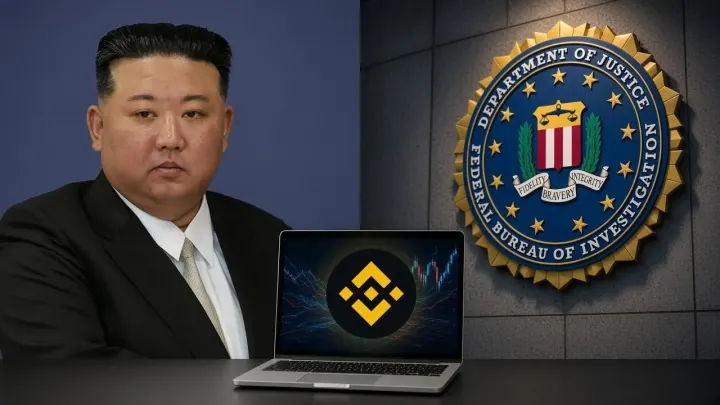
Binance customers withdrew a staggering $4.7 billion in net funds. This massive capital flight happened immediately after Binance lifted a 48-hour withdrawal freeze on Sunday morning following a massive crypto hack. Previously, hackers drained roughly $6.3 billion from the platform across multiple blockchains on Thursday evening. Consequently, this marks the largest cryptocurrency theft in financial history.
October 2026 alone witnessed 35 separate crypto hacks across the industry. However, the historic Binance breach dwarfed them all. For comparison, the last major industry spike occurred in December 2020 when the LuBian hack wiped out $3.5 billion.
The FBI officially identified the culprits behind this massive heist. Agents confirmed that North Korea's state-sponsored TraderTraitor group orchestrated the highly sophisticated attack. Furthermore, blockchain analytics reveal that North Korea-linked hackers have already stolen $7.4 billion in 2026. The regime reportedly uses these stolen funds to finance its weapons programs.
Why the Binance Hack Matters for the Crypto Ecosystem
The Binance breach is not an isolated technical failure; it reflects a broader trend of state-backed actors targeting high-value digital assets. Since the emergence of cryptocurrencies in 2009, exchanges have been prime targets because they hold large pools of liquid tokens. Binance, the world's largest exchange by volume, reported $128 billion in total assets at the time of the hack, making it an attractive prize for sophisticated adversaries.
Historically, the most damaging hacks have spurred regulatory scrutiny. The 2014 Mt. Gox collapse led to Japan's first cryptocurrency licensing regime. The 2020 KuCoin breach prompted tighter AML standards in several jurisdictions. The current incident is likely to accelerate discussions in the United States, the European Union, and Asia about mandatory insurance, real-time monitoring, and cross-border cooperation against state-sponsored cybercrime.
How Binance Responded to the $6.3 Billion Theft
Despite the record-breaking theft, Binance successfully avoided widespread panic. The $4.7 billion net outflow represents a relatively modest 2.8 percent of the $128 billion in total assets held on the platform. Moreover, a quick influx of $2.7 billion in deposits helped stabilize the exchange.
Binance executives confirmed they will cover the entire loss using company funds. The exchange immediately deployed money from its corporate treasury, its Futures Insurance Fund, and the Secure Asset Fund for Users. By Sunday, the company had successfully patched 95 percent of the compromised infrastructure.
Currently, Binance has restored withdrawals for Bitcoin, Ether, and US dollars. However, transfers for some minor cryptocurrencies remain partially suspended. Interestingly, customers reacted much more calmly compared to previous industry disasters. For instance, Binance processed $6 billion in outflows over 72 hours after the FTX collapse. Similarly, investors pulled $7 billion from Circle following the Silicon Valley Bank crash.
Market Shock and Asset Recovery Efforts
The historic breach sent immediate shockwaves through the broader financial markets. Consequently, Bitcoin prices crashed to a six-week low before recovering to around $78,000 on Monday. Spot Bitcoin exchange-traded funds also suffered heavy losses. Investors pulled $643 million from these funds on Friday, marking the largest daily withdrawal in October. Additionally, the sudden market crash liquidated over $1.3 billion in leveraged trading positions.
Meanwhile, the industry launched aggressive asset recovery efforts. Binance quickly coordinated with major stablecoin issuers to block the stolen money. As a result, companies like Circle successfully froze roughly $3 billion. This encompasses almost half of the total stolen funds. The attackers are now rapidly swapping the remaining unfrozen assets through decentralized protocols to evade authorities. Ultimately, analysts warn that this record-breaking theft could severely damage institutional appetite for digital assets moving forward.
What the FBI's Attribution Means for International Cybersecurity
The FBI's public attribution to North Korea's TraderTraitor group is significant because it marks one of the few times a U.S. law-enforcement agency has named a specific state-sponsored unit in a crypto-theft case. TraderTraitor, previously linked to ransomware campaigns and illicit mining operations, is known for exploiting zero-day vulnerabilities in blockchain nodes. Their involvement suggests a level of resources and planning beyond typical criminal gangs.
North Korea's reported theft of $7.4 billion in 2026 underscores a strategic shift: using illicit crypto proceeds to fund missile development and other weapons programs. This creates a direct link between digital-asset security and geopolitical stability, prompting calls for a unified international response, including sanctions on wallets tied to the regime and enhanced information sharing among financial intelligence units.
Practical Takeaways for Binance Users and the Wider Crypto Community
- Review Withdrawal Limits: Users should verify their withdrawal thresholds and enable two-factor authentication to reduce exposure.
- Monitor Asset Coverage: Binance's Secure Asset Fund for Users currently covers up to $250,000 per user; understanding this limit helps gauge personal risk.
- Stay Informed on Exchange Status: Minor tokens may remain partially suspended; checking the official status page before initiating trades can prevent failed transactions.
- Consider Diversification: Concentrating large balances on a single exchange amplifies risk; spreading assets across cold wallets and multiple platforms is a standard risk-mitigation practice.
What Comes Next: Ongoing Investigations and Potential Regulatory Actions
Law-enforcement agencies in the United States, South Korea, and the United Kingdom have opened parallel investigations. Binance has pledged full cooperation and has provided forensic logs to the FBI's Cyber Division. The next procedural milestone is a subpoena expected in early November that will compel the exchange to disclose internal security audits.
Regulators are likely to issue guidance on mandatory insurance reserves for crypto-asset custodians. The U.S. Securities and Exchange Commission has already hinted at a rulemaking process that could require exchanges to maintain a minimum of 10 percent of user holdings in a liquid, insured fund.
For investors, the key watch-points over the coming weeks are: the price trajectory of Bitcoin and major altcoins, the volume of frozen assets reported by stablecoin issuers, and any official statements from the United Nations Security Council regarding sanctions on North Korean crypto-related entities.