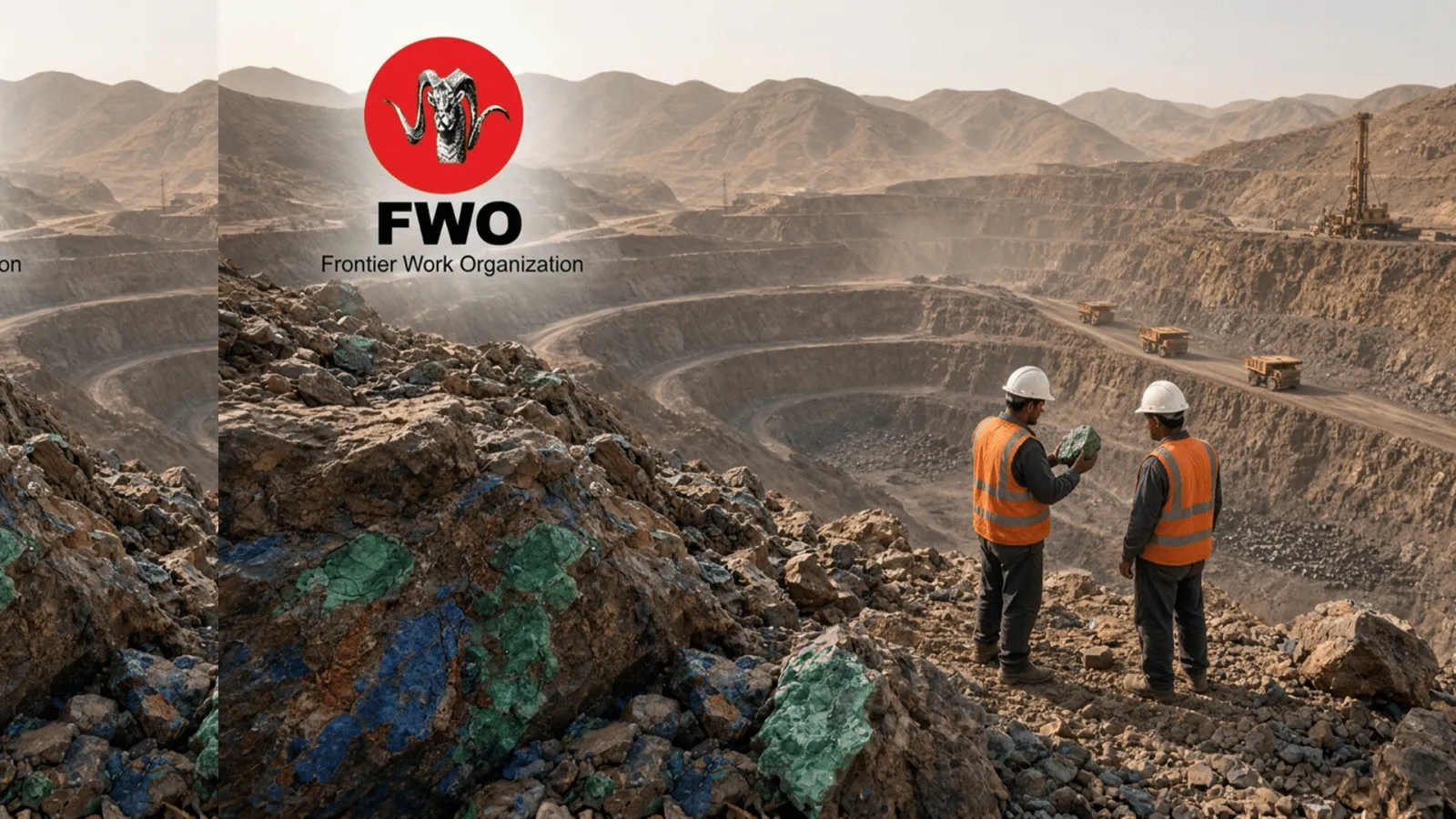
Frontier Works Organisation Discovers Copper in Chagai District
Frontier Works Organisation has discovered 350 million tons of copper in the Dasht-e-Kain area of Balochistan's Chagai district at a drilling depth of 500 metres, based on half of its drilling data released so far. The chief executive of Frontier Works Organisation announced this major find at the ongoing Pakistan Minerals Investment Forum 2026 in Islamabad. This discovery brings significant attention to the mineral wealth of Balochistan and highlights the expanding capabilities of local organizations in resource exploration.
Frontier Works Organisation operates as the sole entity working on the exploration at this site, with no joint venture partner involved in the process. With the second half of the drilling data still pending, the full size of the deposit will become clearer once all results are analysed. Geological experts and industry observers are waiting for the final dataset to understand the complete economic potential of the Dasht-e-Kain area.
Understanding the Geography of Chagai Copper Belt
Dasht-e-Kain sits firmly in the Chagai copper belt, which is a recognized metallogenic province in the rugged terrain of Balochistan. This region is already home to the giant Reko Diq copper-gold project and the Saindak mine, both of which hold international significance. The presence of multiple large deposits makes the Chagai district one of the most critical mineral corridors in the region.
Earlier geological studies placed Dasht-e-Kain's estimated reserves at about 350 million tons, behind only Reko Diq and Saindak among the belt's evaluated deposits. The recent drilling results confirm the earlier geological models and provide concrete physical evidence of the vast mineral wealth hidden beneath the desert surface. Mining specialists note that exploration in this remote region requires advanced engineering and substantial logistical planning due to the harsh climate and lack of infrastructure.
Global Demand for Copper and Pakistan Export Ambitions
Copper demand is rising worldwide as it is a key metal for power grids, electric vehicles and renewable energy, which makes large new deposits valuable for Pakistan's export ambitions. Industrial nations and technology manufacturers require a steady supply of refined copper for electrical wiring, motors, and battery systems. The green energy transition relies heavily on copper to connect solar farms, wind turbines, and charging stations to national power grids.
For Pakistan, finding new mineral reserves offers a path toward economic diversification and foreign exchange earnings. Traditional export sectors face severe competition, so expanding into mineral extraction provides a new avenue for growth. Government officials hope that certified reserves of this magnitude will attract international buyers and long-term industrial partners to fund large-scale processing facilities inside the country.
Recent Discoveries in the Chagai Mineral Corridor
The announcement adds to a busy week for Chagai, highlighting a surge in successful exploration activities across the district. National Resources Limited reported copper and gold at eight new sites in the district, expanding the known footprint of valuable minerals. At the same time, Mari Energies announced a gold and copper discovery near Reko Diq, adding further momentum to the mining sector.
These concurrent discoveries point to a systemic shift in how the region is being explored using modern technologies. Private and state-backed firms are deploying advanced geological surveys and deep drilling rigs to map deposits that were previously difficult to detect. Industry analysts suggest that this cluster of announcements could transform the district into a globally competitive mining hub over the coming decade.
Investment Strategies at the Pakistan Minerals Investment Forum 2026
A total of 13 memorandums of understanding were also signed during the two-day forum, which the government is using to attract foreign investment into Pakistan's mining sector. International investors have historically hesitated to enter the local market due to security concerns, regulatory hurdles, and infrastructure deficits. Events like the Islamabad forum serve as platforms for policymakers to present regulatory reforms and showcase verified geological data directly to global mining corporations.
The Ministry of Petroleum and Natural Resources has been working to streamline licensing procedures and offer better terms for foreign explorers. Officials emphasized that transparency and consistent policy frameworks are essential to turn raw geological discoveries into operational mines. The success of these initiatives will depend on how quickly the government can implement these reforms and secure binding financial commitments from international partners.
What the Future Holds for Balochistan Mining Projects
As Frontier Works Organisation prepares to release the remaining half of its drilling data, attention turns to the feasibility studies required before commercial extraction can begin. Mining projects require massive capital expenditure, water supply arrangements, and heavy transport links to move extracted ore to ports for export. Developing a mine of this scale typically takes several years of planning, environmental assessments, and construction before the first batch of commercial copper can be shipped abroad.
Local communities in Balochistan watch these developments closely, expecting job creation, infrastructure development, and a fair share of economic benefits from the extraction of their natural resources. Provincial leaders have stressed the importance of local employment and sustainable environmental practices in all new mining agreements. Balancing industrial ambitions with regional welfare remains a central challenge for both federal and provincial authorities as the mining sector enters a new phase of expansion.





