Google and NASA Partnership for Space Exploration
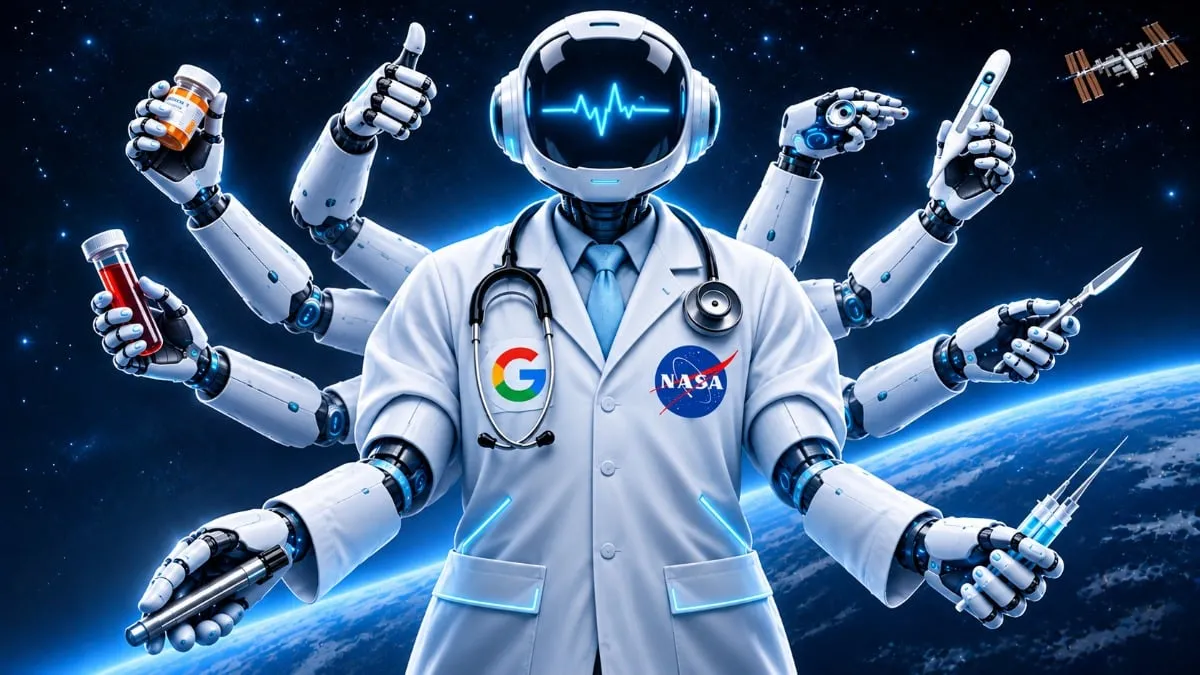
Technology giant Google has joined forces with the National Aeronautics and Space Administration to create an advanced artificial intelligence robot. This experimental machine is designed to assist space crews with urgent medical emergencies during upcoming long-duration journeys to the Moon and Mars. As humanity looks toward establishing a permanent presence beyond Earth, deep space exploration presents unprecedented physiological and psychological challenges for astronauts. Space agencies must invent new tools to keep travelers safe when traditional support structures are millions of miles away.
Beyond emergency medical care, the machine under development is being engineered to perform everyday tasks inside spacecraft. These duties include moving heavy equipment, organizing vital supplies, and handling routine maintenance chores. By taking over these repetitive physical responsibilities, the machine allows human crew members to focus their energy on high-priority scientific research and mission objectives. The collaboration leverages top-tier software engineering from Silicon Valley alongside decades of spaceflight expertise from the American federal agency.
While the concept sounds like science fiction, early laboratory trials have already yielded encouraging data. According to Google, the experimental system achieved an 85 percent success rate in an initial test that required the machine to locate and transport a medical bag. Despite this early milestone, developers emphasize that the project remains firmly in the development phase. The device is not yet capable of performing independent medical procedures or functioning without human supervision.
Why Astronauts Need Autonomous Medical Support
Travelers heading toward Mars will face immense dangers if a crew member falls seriously ill or suffers a traumatic injury. The vast distance between Earth and the Red Planet creates severe communication hurdles that modern technology cannot easily bypass. Because radio waves take time to travel across the solar system, communications between astronauts and flight surgeons on the ground experience major delays. According to Google, messages transmitted between Earth and Mars require up to 44 minutes for a complete round trip.
This staggering time lag means that real-time consultations with ground-based physicians are impossible during critical moments. If an astronaut experiences a sudden health crisis, waiting nearly an hour just to ask a question and receive an answer could prove fatal. To solve this dangerous isolation problem, Google and NASA are building a mobile mechanical assistant that can evaluate situations and act locally when direct help from Earth is out of reach.
This ambitious initiative builds directly upon earlier digital tools developed by the two organizations. The current project expands on the Crew Medical Officer Digital Assistant, which is an artificial intelligence medical support system that Google and NASA began testing in 2025. That previous software platform was created to help astronauts interpret health symptoms and make clinical choices when immediate guidance from mission control was unavailable. The new hardware project takes that digital capability a step further by adding mobility and physical manipulation skills.
How the Artificial Intelligence Robot Will Operate
The machine is being designed to process spoken instructions from astronauts and execute physical tasks inside the cramped confines of a spacecraft. Imagine a scenario where a crew member suffers from intense back pain that could point to the formation of kidney stones. In this situation, the robotic system could retrieve an ultrasound machine from storage and set it up for immediate use. The astronaut responsible for medical duties would then review the diagnostic images and determine the correct course of treatment.
Google notes that the device could eventually assist with basic clinical routines, such as monitoring vital signs or helping position equipment during ultrasound scans. However, the system is strictly meant to serve as an assistant rather than a replacement for human medical professionals. It will never make independent treatment decisions or perform invasive procedures without direct human oversight. When medical duties are absent, the machine shifts to utility functions, securing loose tools and helping maintain the habitat.
This versatility ensures that the hardware remains useful throughout every phase of a multi-year expedition. Spacecraft interiors require constant upkeep, and minimizing the time crew members spend on chores directly improves mission safety and mental well-being. By handling cargo and sorting supplies, the mechanical helper acts as an extra pair of hands in environments where every kilogram and every hour counts.
Technical Challenges and Laboratory Testing Results
Engineering a machine to operate reliably in microgravity or deep space environments requires solving complex software and hardware hurdles. Google and NASA have established rigorous testing protocols in laboratory settings to evaluate movement and object recognition. During one notable experiment, the system was tasked with finding a specific medical bag and moving it across a test room. The machine completed this objective successfully in approximately 85 percent of the initial trials.
While this high success rate demonstrates clear progress, researchers caution that the hardware is far from space-ready. Engineers are actively refining how the system maps its surroundings and interacts with physical objects without causing damage. To accelerate this work, NASA's Jet Propulsion Laboratory is adapting specialized technology originally created for tracking objects in deep space. This navigation software helps the machine orient itself inside enclosed habitats.
Furthermore, developers use Google DeepMind's MuJoCo simulation software to test movement patterns in a virtual world before deploying code to physical machines. Power consumption represents another major design constraint for the engineering team. Google reports that researchers have tested roughly 15 different computing devices to find hardware capable of running complex artificial intelligence algorithms without draining limited spacecraft electricity resources.
Timeline and Institutional Collaboration for the Space Project
As of now, Google has not announced a specific launch date for deploying the artificial intelligence medical robot into actual space missions. The initiative remains in preliminary testing phases, and corporate representatives have not confirmed the completion of a flight-ready prototype. Building a reliable tool for deep space requires extensive refinement of mobility, safety protocols, and human-robot interaction mechanics.
The overarching development effort relies on a broad institutional partnership. Contributors include Google Cloud, NASA's Human Research Program, Johnson Space Center, and the Jet Propulsion Laboratory. Each organization brings unique expertise in cloud computing, space physiology, and robotic hardware design to the table. This collaborative framework ensures that the resulting technology meets the stringent safety standards required for crewed spaceflight.
The ultimate goal for Google and NASA is to deliver a reliable assistant that understands simple voice commands and reduces the operational burden on astronauts. If future trials succeed, this technology will provide a vital safety net for explorers venturing into the solar system. By bridging the communication gap during medical emergencies, the project aims to make long-duration space travel safer than ever before.