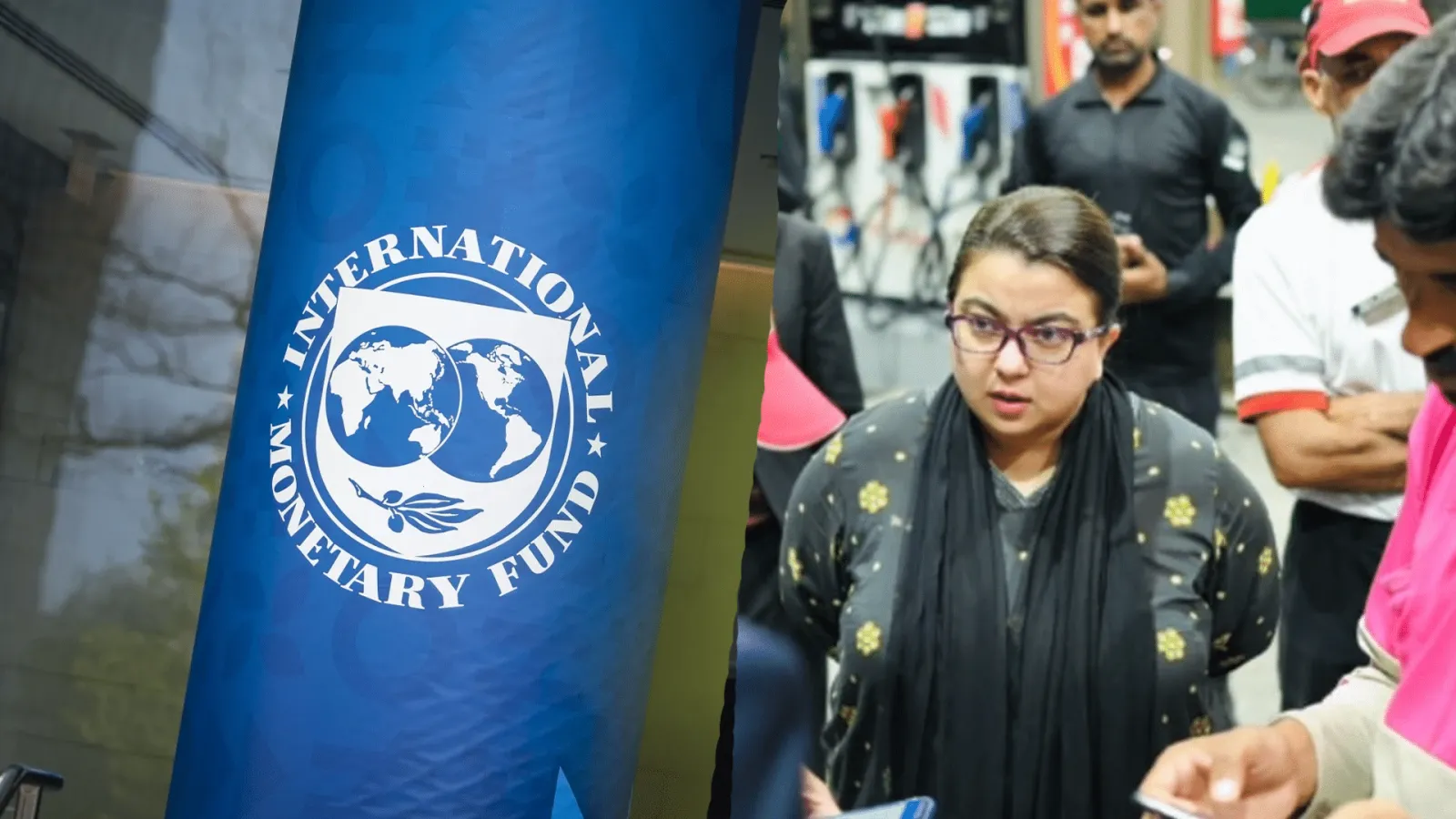
The International Monetary Fund (IMF) has once again told Pakistan to phase out its petrol subsidy for motorcyclists, rickshaw drivers and small car owners, and warned that any future fuel support must be limited, time-bound and paid for within this year's budget.
"The fuel support scheme should be phased out, given its broad targeting," an IMF spokesperson told Arab News.
IT Minister Shaza Fatima played a key role in helping develop and implement the Rs. 75 billion digital fuel subsidy program. Prime Minister Shehbaz Sharif last month also announced a Tamgha for her on March 23 for her role in implementing the subsidy.
If oil prices surprise on the upside again, IMF wants any new relief targeted through established social assistance programs and accommodated within the FY27 budget envelope.
Why the IMF Is Pressuring Pakistan on Fuel Subsidies
The IMF's request comes as part of a broader review of Pakistan's $7 billion Extended Fund Facility. The Fund has repeatedly stressed that macro-economic stability depends on reducing fiscal gaps, and fuel subsidies are among the largest recurring expenditures. By limiting the subsidy, the government can free up fiscal space for debt service, social safety nets and structural reforms required under the program.
Pakistan's reliance on imported Gulf oil makes it vulnerable to global price swings. The Fund noted that the Middle East war remains a significant headwind, meaning any further escalation could push import bills higher and strain foreign exchange reserves.
What Is at Stake for Motorists
The scheme, launched in September amid the US-Iran war, gives motorcycle and rickshaw users a weekly petrol token worth Rs. 500. Owners of cars up to 800 cc get Rs. 100 off per litre on up to 10 litres every 10 days. The government recently extended the fuel subsidy till December but IMF doesn't want it to last any longer.
Petrol hit a record Rs. 458.41 per litre on April 3 and has since eased to around Rs. 330. Under the loan program, Pakistan has committed to let domestic fuel prices follow international rates while protecting the most vulnerable.
Motorists who rely on the subsidy face a potential rise in out-of-pocket costs once the tokens are withdrawn. For a typical motorcyclist, the weekly Rs. 500 token represents roughly 15 percent of monthly fuel spend. For small-car owners, the Rs. 100 per litre discount can shave up to Rs. 1,000 off a ten-day fill-up, a noticeable relief in a high-inflation environment.
Background of the Digital Fuel Subsidy Program
The digital fuel subsidy was introduced in September 2023 as a response to soaring global oil prices following the US-Iran conflict. The program was designed to be transparent, using biometric verification and a mobile app to distribute weekly tokens directly to eligible riders and drivers. The Rs. 75 billion budget allocation reflected the government's intent to cushion the poorest transport workers while avoiding blanket subsidies that could distort market prices.
Since its rollout, the scheme has been praised for reducing cash-handouts and limiting corruption, but critics argue that the eligibility criteria are too broad, covering a large segment of the population that may not be truly vulnerable.
$1.2 Billion Riding on IMF Board Decision
IMF warned that the Middle East war remains a significant headwind for Pakistan given its reliance on Gulf oil and gas, and that sustained volatility could weigh on the outlook. Inflation stood at 9.6 percent in October, down from 10.3 percent a month earlier.
The staff-level agreement reached last month still awaits Executive Board approval, expected in December subject to program requirements.
Once approved, Pakistan will receive about $1 billion under the $7 billion Extended Fund Facility and $210 million under the Resilience and Sustainability Facility, taking total disbursements to around $5.7 billion.
How the Funding Structure Works
The Extended Fund Facility (EFF) is a multi-year arrangement that provides financing to countries facing balance-of-payments problems while they implement structural reforms. The Resilience and Sustainability Facility (RSF) is a newer instrument that supports climate-related investments and social protection measures. Both facilities require the borrowing country to meet quantitative targets, such as fiscal deficits below a set percentage of GDP, and qualitative benchmarks, such as strengthening public financial management.
For Pakistan, the $1 billion EFF tranche is tied to the removal of broad-based subsidies, including the petrol scheme. The $210 million RSF tranche is earmarked for projects that improve energy efficiency and expand safety-net programs for low-income households.
What Happens If the Subsidy Is Not Phased Out
If the government were to maintain the subsidy beyond the IMF's deadline, the Fund could withhold the next disbursement, putting pressure on Pakistan's foreign-exchange reserves and potentially forcing a devaluation of the rupee. A delayed disbursement would also affect the timing of other reforms, such as tax administration upgrades and public-sector wage rationalisation.
Conversely, a swift phase-out, coupled with targeted cash transfers through existing social assistance programmes, could satisfy the Fund's conditions and unlock the remaining financing. The government has indicated readiness to channel any new relief through the Benazir Income Support Programme and other established schemes.
Practical Takeaways for Readers
- Motorcyclists and rickshaw drivers should expect the weekly Rs. 500 token to disappear once the subsidy is withdrawn.
- Owners of cars up to 800 cc should anticipate losing the Rs. 100 per litre discount on up to 10 litres every 10 days.
- Households that qualify for existing social assistance programmes may receive alternative cash support, but eligibility will be stricter.
- Fuel prices are likely to track international market levels more closely, meaning future spikes could translate directly into higher pump prices.
Stakeholders, including transport unions and consumer groups, are monitoring the situation closely. The next major milestone is the IMF Executive Board meeting in December, where the staff-level agreement will be reviewed.





