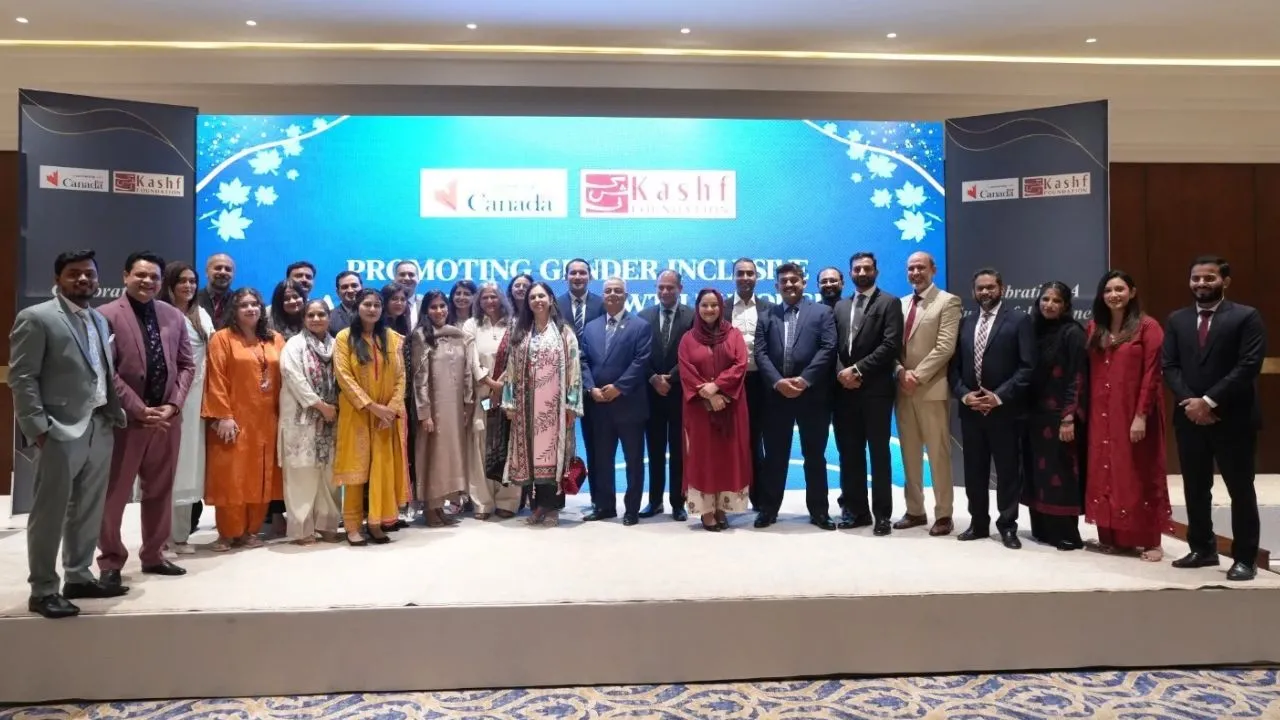
On a day at the Marriott Hotel in Islamabad, Kashf Foundation hosted an event commemorating ten years of collaboration with Global Affairs Canada, showcasing work that has touched more than 1.6 million individuals in 63 districts across all four Pakistani provinces.
The gathering, themed "Promoting Gender Inclusive & Equitable Growth through Women's Economic Empowerment," assembled diplomats, business executives and social-sector representatives. Speakers included Roshaneh Zafar, Founder and Managing Director of Kashf Foundation, and H.E. Tarik Ali Khan, High Commissioner of Canada to Pakistan. Tauseeq Haider oversaw the proceedings, while Harriet Roos, Head of Cooperation at the Canadian High Commission, delivered closing remarks. Attendees also watched films on the partnership's journey, media projects and an independent impact assessment.
Looking Beyond Access to Finance
The Kashf-Canada partnership was founded on the belief that credit alone cannot solve the hurdles women face in starting and growing businesses.
Many women micro-entrepreneurs from low-income backgrounds lack financial literacy, business management skills, face restrictive social norms and receive little household support, limiting their opportunities.
To counter these constraints, the programme blended financial services with education, business development, health awareness and community engagement.
During the decade, 1.4 million women received assistance ranging from basic financial literacy to structured financial education and business development training, aimed at improving their ability to manage finances, run enterprises and make informed decisions.
The initiative also delivered maternal and reproductive health education to women, men and mothers-in-law, and ran gender-awareness programmes to foster greater household backing for women's economic roles.
H.E. Tarik Ali Khan stressed this broader view, stating, "Kashf Foundation has always treated women's economic empowerment as an entire household question. GAC is proud to have supported that approach and to have seen how economic opportunity, skills and changes in social norms can work together."
The Role of Media in Changing Mindsets
Media and storytelling formed a key component of the partnership's strategy to break social barriers.
Through television dramas, public-service campaigns and community theatre, Kashf Foundation sparked conversations on issues directly affecting women.
Television productions on family planning, girls' education and cybercrime each attracted an average audience of more than 120 million viewers, illustrating the reach of popular entertainment for social awareness.
One recent drama, Aik Aur Pakeezah, tackled cyber harassment, forced marriage and justice barriers.
A fireside chat at the event, moderated by Simi Raheal and featuring Nameer Khan, Bee Gul and Saifi Hassan, examined media's capacity to challenge gender norms and broaden public engagement.
What the Evidence Shows
The event highlighted results from an independent third-party impact assessment covering financial inclusion, business performance and household decision-making.
Based on data from 2,596 households in 14 districts, the study showed benefits of pairing financial access with practical training and broader support.
Women who received microloans plus financial management training posted 17% higher income gains and 34% greater savings than borrowers without the training.
Those who took part in business acceleration training earned 26% more than loan-only recipients.
After business acceleration training, over one-third of participants reported deciding where and how to save, and 33% were managing their businesses independently.
Among surveyed clients, 94.5% said women's inclusion in household decisions had increased, while 83.4% noted family support for their businesses.
Community engagement results showed 88% of men involved in social theatre reported changed views on gender roles.
Ten Years of Partnership, and Lessons for the Future
Harriet Roos emphasized the need for long-term collaboration, stating, "The evidence from this partnership shows the value of investing not only in women's access to finance, but also in the skills, relationships and support systems that enable them to use those opportunities."
Kashf Foundation, launched in 1996 as Pakistan's first specialised microfinance institution with five clients, now serves roughly 1.2 million active clients.
Roshaneh Zafar reflected, "Ten years ago, with the support of Global Affairs Canada, we set out to prove that when women move forward, families prosper, communities strengthen and economies grow. We've seen and made the impact. Now it's time for policymakers and businesses to take these lessons to scale."
The partnership's evidence suggests that women's economic empowerment yields the best results when financial opportunities are paired with skills, support systems and efforts to shift social barriers.