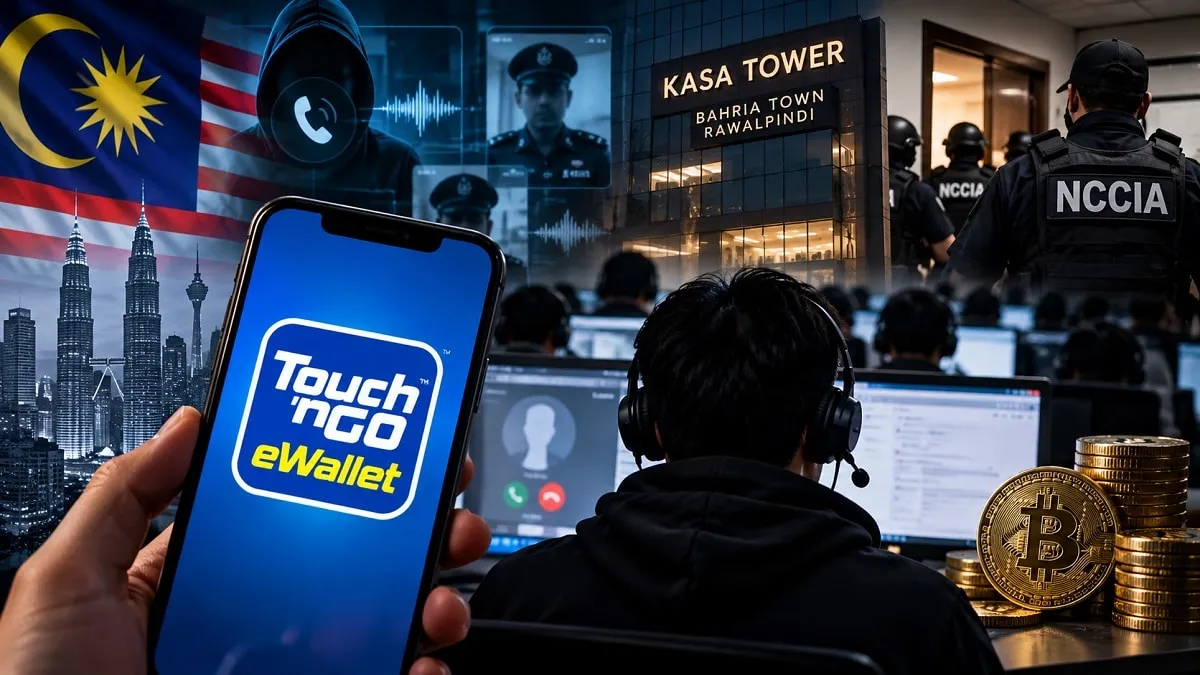
Pakistan's National Cyber Crime Investigation Agency (NCCIA) has lodged a case against 130 persons accused of running an organized cyber-fraud operation from KASA Tower in Bahria Town Phase VIII, Rawalpindi.
The FIR, cited by ProPakistani, says the scheme targeted Malaysian citizens by posing as bank customer service agents, impersonating Malaysian police officers, threatening legal action, and moving money through digital payment services and cryptocurrency.
The charge sheet invokes Sections 13, 14 and 16 of the Prevention of Electronic Crimes Act (PECA), 2016, as amended in 2025, together with Sections 34, 383, 419, 420 and 109 of the Pakistan Penal Code.
According to the FIR, a source tip prompted the NCCIA enquiry, after which search and seizure warrants were obtained from a Rawalpindi court and a raid was carried out at the Bahria Town premises.
Preliminary technical analysis of seized devices and the set-up suggested the location was being used to execute cyber-enabled financial fraud against Malaysians.
The FIR alleges that callers used VoIP apps to pose as bank representatives, informing victims of alleged suspicious transactions in their accounts.
Victims were then transferred to individuals claiming to be Malaysian police officers; some callers wore police uniforms and displayed office-style backdrops during video calls.
According to the FIR, the victims were threatened with accusations of money laundering and criminal prosecution, pressuring them to send money.
Investigators say the funds were received via Malaysia's Touch 'n Go eWallet and later converted into cryptocurrency through various channels.
The document outlines a hierarchy: a Malaysian identified as "Jack" operating from Cambodia allegedly directed the scheme, Mohamad Shawalludin was named as the local supervisor, and Hew Wei Lun was described as the manager of the call centre.
Pakistani nationals using the aliases Sohail, Rich, Martin and B are alleged to have facilitated the operation.
A Chinese national residing in Sector D-12, Islamabad, is said to have taken cryptocurrency from the operators and provided equivalent cash in Pakistani rupees.
The FIR lists 130 individuals with passport details, but notes that filing a case does not prove each person knowingly participated; their roles will be examined during the investigation.
The legal provisions cited cover electronic and cybercrime offences, common intention, extortion, cheating by personation, cheating and dishonest inducement of property delivery, and abetment.
According to NCCIA records, the 130 arrested individuals are Malaysian nationals whose visas had expired, allegedly living in Pakistan without valid immigration status while conducting cybercrime.
The case followed an Istighasa report submitted through Head Constable Gulzeb, with permission from the competent authority. Sub-Inspector Amjad Bilal of NCCIA Rawalpindi is mentioned in connection with the registration, and Sub-Inspector Liaqat Ali has been assigned the investigation.
The FIR states the probe will look into the overseas controller, local supervisors, call-center staff, financial facilitators and cryptocurrency handlers, as well as any other participants.
No figures are given for the total amount defrauded, the number of victims, the value of cryptocurrency involved, or money recovered during the raid.
The allegations remain under investigation and judicial review; the FIR does not constitute a finding of guilt, and each accused's responsibility must be proven through evidence and due process.