Federal Government Unveils New Auto Policy To Boost Exports
The federal government on Saturday unveiled a new automotive policy that targets a thirty-fold increase in the exports of the sector, from $200 million to $6 billion, and aims to bring vehicle prices down gradually, with a special focus on affordable cars and electric vehicles.
Information Minister Attaullah Tarar and Adviser to the Prime Minister on Industries and Production Haroon Akhtar Khan announced the policy at a press conference. Akhtar said it was approved after prolonged consultations and that Prime Minister Shehbaz Sharif had devoted considerable time to its preparation.
The announcement marks a major shift in how the state plans to manage the automotive sector, which has faced stagnation in global markets for years. Officials stressed that past strategies failed to expand international sales, prompting a fresh framework based on strict targets and structural changes.
The Six Pillars Of The New Automotive Framework
Haroon Akhtar said the policy rests on six pillars: affordable vehicles, especially for the middle and lower-middle classes; exports; localisation; vehicle safety; EV promotion; and transparency.
These core areas form the foundation of the administration's long-term vision for industrial growth and consumer relief. By addressing each pillar through specific regulatory adjustments, the government hopes to balance local manufacturing demands with international competitiveness.
Officials explained that each pillar connects directly to broader economic goals, such as reducing the trade deficit and modernizing domestic production facilities to meet global environmental and safety standards.
How The Policy Aims To Reduce Car Prices
He said the prime minister had also introduced a tariff policy to lower production costs and the import bill for raw materials. Prices of all vehicles, except luxury vehicles, will come down, according to the adviser.
Prices will fall gradually as duties on completely built units and assembly plants are reduced each year, leading to competitive tariffs after five years, he explained. Lower prices will mainly benefit middle- and upper-income buyers.
This phased reduction is designed to protect local assemblers from sudden market shocks while forcing them to improve efficiency. Consumers can expect incremental price adjustments rather than immediate steep drops.
Mandatory Export Targets And Penalties For Carmakers
Describing large industries as a government priority, Akhtar said the auto sector is a major contributor to large-scale manufacturing. Policies for the sector have been framed for the past decade without any rise in exports, he said, adding that the new policy is built around exports, and manufacturers that miss their targets will be fined.
This penalty mechanism marks a departure from voluntary compliance models used previously. Carmakers must now integrate global supply chains or face financial repercussions for failing to meet specified overseas sales quotas.
The shift aims to transform domestic assemblers from purely domestic-facing operations into active participants in international trade, leveraging local labor and infrastructure.
Stricter Consumer Protections And Quality Standards
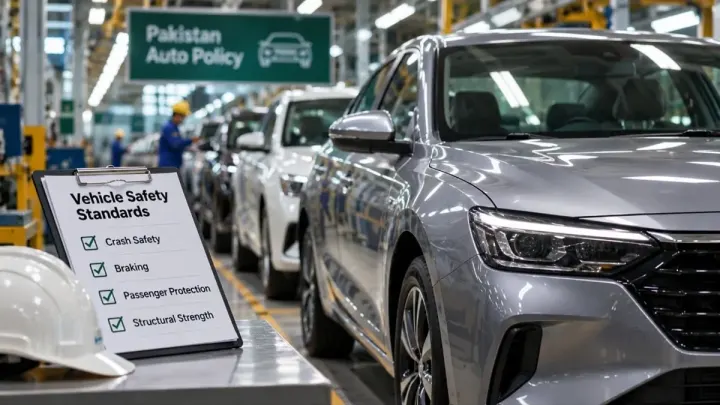
Under the policy, carmakers will not be allowed to take an advance of more than 20 percent of a vehicle's price from customers. A total of 45 new standards have also been added to bring locally assembled vehicles up to international quality levels.
The cap on advance payments addresses long-standing complaints about manufacturers holding consumer funds for extended periods without delivering vehicles on time. Meanwhile, the new quality standards aim to ensure that locally built cars are safe and reliable.
نئی آٹو پالیسی میں تمام اسٹیک ہولڈرز کی مشاورت، ٹیکنیکل ڈیٹا کے تجزیے اور دنیا کے مختلف ماڈلز کا جائزہ لیا گیا۔مقامی صنعت میں جدت، ویلیو ایڈیشن اور لوکلائزیشن کو فروغ دیا جائے گا تاکہ روزگار کے مواقع پیدا ہوں اور گاڑیوں کی برآمدات ممکن ہوں۔
— Attaullah Tarar (@TararAttaullah) November 7, 2026
الیکٹرک وہیکلز کی حوصلہ افزائی سے… pic.twitter.com/tnZWMIrvtO
Industry observers note that these standards will require substantial upgrades in testing facilities and manufacturing processes across local assembly plants.
Promotion Of Electric Vehicles And Charging Infrastructure
On electric vehicles, Akhtar said their importance has grown following recent regional tensions. The financing limit for electric vehicles has been raised from Rs2 million to Rs10 million, and import duties on charging stations have been reduced.
In a post on X, Tarar said the policy was developed after consultations with all stakeholders, analysis of technical data and a review of global models. He said innovation, value addition and localisation would be promoted to create jobs and enable vehicle exports.
The minister said encouraging electric vehicles will reduce carbon emissions and the oil import bill, and that incentives have been provided for setting up charging stations. He described the policy as a significant step toward providing citizens with affordable, high-quality, and environmentally friendly transportation.
Background And Economic Context Of The Auto Sector
The domestic automotive industry has historically operated behind high tariff walls, protecting local assemblers from foreign competition while often resulting in high prices and limited technological advancement for consumers. Past policy frameworks focused primarily on domestic substitution rather than export-led growth, leaving the sector vulnerable to macroeconomic fluctuations, currency devaluation, and rising material costs.
Large-scale manufacturing plays a critical role in national employment and industrial output, making automotive sector reforms a central focus for successive administrations. However, previous attempts to diversify exports failed to gain traction due to high production costs, supply chain bottlenecks, and a lack of competitive scale among local vendors.
The new strategy attempts to break this historical pattern by tying government support and tariff adjustments directly to export performance and local value addition. By encouraging competition through reduced duties on imported vehicles and components, planners hope to force domestic players to modernize.
Impact On Consumers, Manufacturers, And The Economy
Middle- and lower-middle-class buyers stand to gain from initiatives focused on affordable transportation and stricter limits on booking advances. The reduction of duties on raw materials and the phased lowering of tariffs on assembly plants should eventually reflect in lower retail prices for standard passenger cars.
For manufacturers, the policy introduces both opportunities and rigorous compliance demands. While access to cheaper raw materials and higher financing limits for electric vehicles offer relief, the mandatory export quotas and financial penalties for missing targets require a complete operational reorientation.
On a macroeconomic level, expanding vehicle exports from $200 million to $6 billion would diversify the national export base significantly. Furthermore, promoting electric mobility aims to curb mounting fuel import bills and lower urban air pollution levels.
Future Outlook And Implementation Timeline
The implementation of the tariff reductions is structured over a five-year period, during which duties on completely built units and assembly components will decrease annually. Stakeholders will need to monitor how regulatory bodies enforce the newly introduced quality standards and export penalties.
The success of the electric vehicle push will depend on how quickly investors establish charging infrastructure, aided by the newly reduced import duties and expanded financing limits. Observers will watch for upcoming regulatory notifications detailing the exact penalty structures and export verification mechanisms.