Could Another Planet Be Hiding at the Edge of Our Solar System?
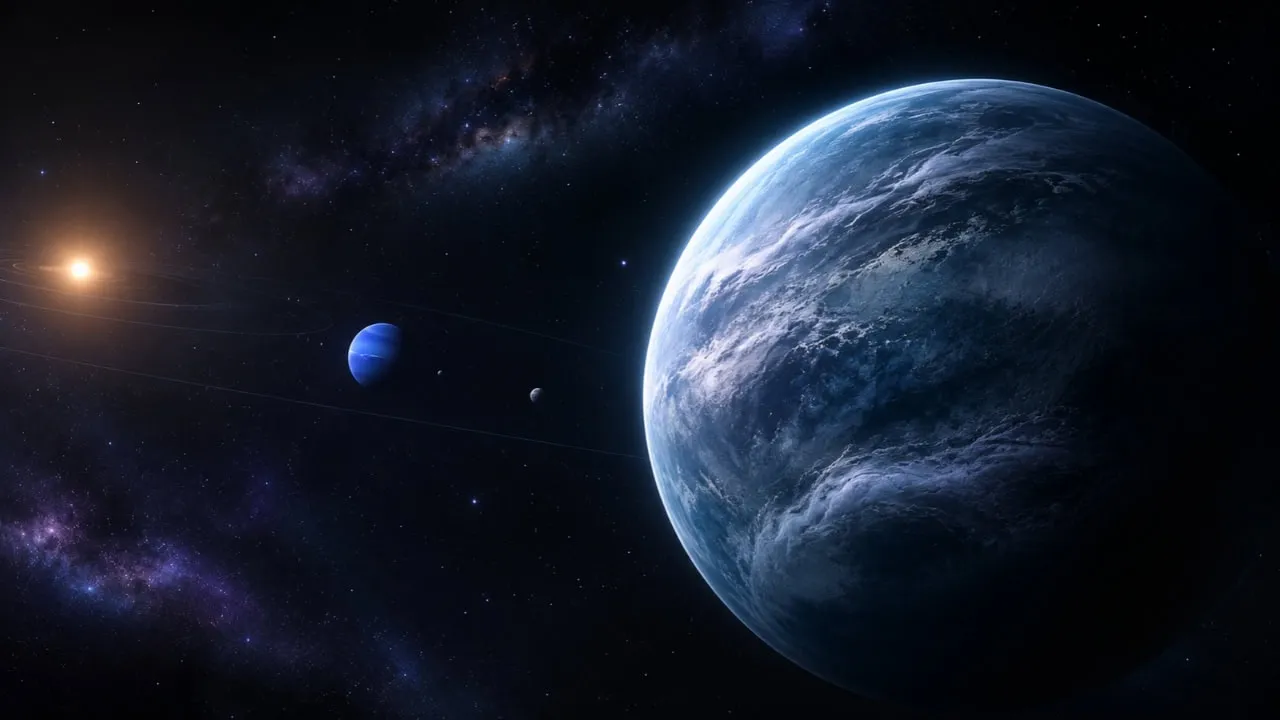
Scientists may have found new evidence that another planet is hiding at the edge of our solar system. A study published in the Monthly Notices of the Royal Astronomical Society proposes a hypothetical world called Planet X2 or PX2. It could have 1.5 to 2 times the mass of Earth and orbit hundreds of times farther from the Sun. This theoretical proposal opens a fresh chapter in modern astronomy, challenging researchers to rethink the boundaries and contents of our cosmic neighborhood.
Patryk Sofia Lykawka, an adjunct associate professor at the University of Southern Queensland who works at Kindai University in Japan, led the research. His team ran computer simulations covering roughly 4.5 billion years of solar system evolution. The simulations tested how a distant planet with different masses and orbits might influence icy objects beyond Neptune. These long-term digital models help astronomers understand how gravitational forces shape celestial bodies over immense spans of time.
What Are the Characteristics of Planet X2?
The results suggest Planet X2 could follow a highly elliptical orbit with a semi-major axis between 350 and 500 astronomical units. For context, one astronomical unit equals the average distance between Earth and the Sun. Even at its closest point, PX2 would remain at least 200 AU away. That places it far beyond Neptune's orbit at roughly 30 AU, deep within the freezing expanses of outer space.
The proposal differs from the more widely discussed Planet Nine hypothesis. That theory suggests a much more massive world could explain certain strange orbits in the outer solar system. Planet X2, by contrast, would weigh significantly less but still exert enough gravitational pull to shape the paths of distant icy objects. Researchers continue to examine how smaller yet distant bodies might leave noticeable gravitational signatures.
Understanding the Trans-Neptunian Region
Beyond Neptune lies the trans-Neptunian region. It contains numerous icy bodies, many of them in the Kuiper Belt between 38 and 50 AU from the Sun. However, astronomers have also found objects travelling along unusually elongated and highly tilted orbits. One striking example is Sedna, whose extreme orbit takes it far beyond the known planetary region. Standard models struggle to explain these paths using only the gravity of known planets.
The team's simulations showed that PX2's gravity could pull certain objects away from Neptune's gravitational influence. It could also push others into unexpectedly tilted or stretched orbits. The model successfully reproduced several unusual orbital patterns among distant trans-Neptunian objects. However, the researchers acknowledged that some gaps remain between simulations and actual observations.
Why Scientists Believe PX2 Might Exist
"Imagine discovering, after decades of mapping our Solar System, that another planet has been hiding from us all this time," Lykawka said. "If this planet exists, it could change how we understand the history of our Solar System."
Co-authored by Associate Professor Patryk Sofia Lykawka from Kindai University, UniSQ, and the National Astronomical Observatory of Japan, along with Assistant Professor Pedro Bernardinelli from the University of Washington and the University of São Paulo, and Professor Jonti Horner from UniSQ, the study combines advanced computational power with decades of observational astronomy data.
Planet X2 remains entirely hypothetical for now. Nobody has directly observed it. But the Vera C. Rubin Observatory's ongoing sky survey could help astronomers test the theory. The observatory's wide-field camera scans large portions of the sky repeatedly. As a result, it is well suited to spotting faint, distant objects that previous surveys may have missed.
How Astronomers Plan to Find Planet X2
If confirmed, the discovery would add a new member to our solar system's planetary family for the first time since Neptune's identification in 1846. Finding such a faint and distant world requires cutting-edge technology capable of detecting tiny reflections of sunlight from millions of miles away.
Observatories like the Vera C. Rubin facility use massive digital cameras to capture deep-space imagery over consecutive nights. By comparing multiple images of the same patch of sky, scientists can track moving objects against the fixed background of distant stars. This method has successfully uncovered numerous smaller asteroids and comets, and it offers the best hope for confirming or refuting the Planet X2 hypothesis in the coming years.