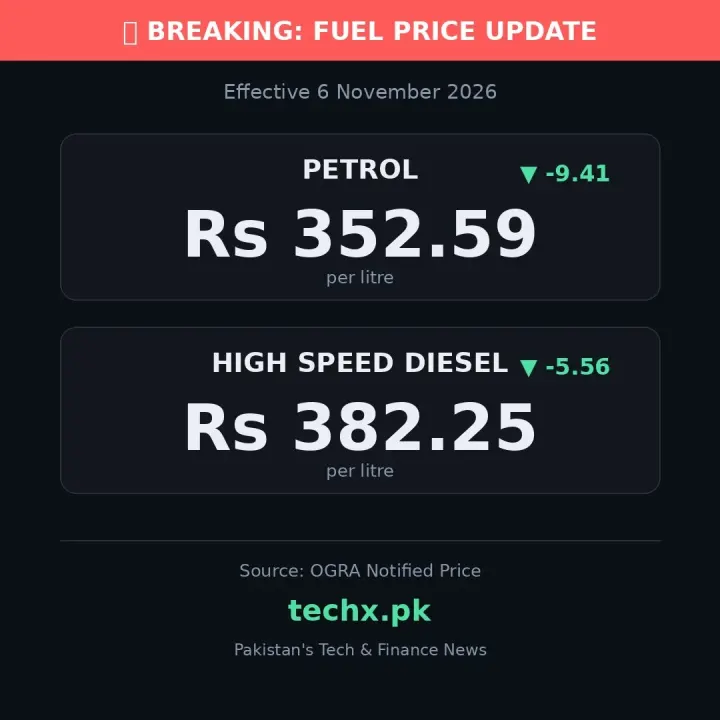
On July 17, 2026 the Oil and Gas Regulatory Authority (OGRA) announced a daily reduction in the ex-depot price of Motor Spirit (petrol) to Rs. 352.59 and High Speed Diesel to Rs. 382.25, marking the first day of a new 24-hour price-review system.
The move follows a government decision to shift to daily price adjustments in order to protect the domestic economy from extreme market swings caused by the ongoing global fuel crisis.
Why Daily Price Adjustments Were Introduced
Pakistan's federal government approved a policy that requires OGRA to revise ex-depot prices of petroleum products every 24 hours. The policy applies to weekdays, Saturdays, Sundays and public holidays, but the quoted block states that the adjustment mechanism will stay the same on weekends and holidays.
Daily revisions are intended to reflect real-time changes in international crude prices, freight costs and exchange rates, thereby preventing large gaps between wholesale costs and retail pump prices. By aligning pump prices more closely with market realities, the government hopes to curb inflationary pressure on transport, agriculture and industry.
How the New Prices Compare to Yesterday's Rates
| Product | Previous Price(05/10/2026) | Revised Price(06/10/2026) | Difference |
|---|---|---|---|
| Motor Spirit (MS) | Rs. 362.00 | Rs. 352.59 | -9.41 |
| High Speed Diesel (HSD) | Rs. 387.81 | Rs. 382.25 | -5.56 |
The table shows a Rs. 9.41 cut for petrol and a Rs. 5.56 cut for diesel. Both reductions represent the first downward move since the daily-price regime began.
Background: The 2026 US-Israel War on Iran and Its Effect on Oil Markets
In early 2026 the United States and Israel launched a coordinated military operation against Iran, citing concerns over nuclear proliferation. The conflict quickly expanded into a broader regional war, disrupting oil flows from the Middle East.
In late February Iran blocked shipping traffic through the Strait of Hormuz, a chokepoint that handles roughly 25 % of the world's seaborne oil trade. The United States responded with a naval blockade of Iranian ports, further restricting outbound shipments.
A brief ceasefire in June raised hopes for a return to normal trade, but the truce collapsed on July 8 when renewed attacks on commercial vessels forced Iran to close the strait again. The United States then conducted successive airstrikes aimed at reopening the passage.
These actions have created the largest disruption to world energy supplies since the 1970s oil shocks, driving up international crude prices and freight rates. The ripple effect has reached Pakistan's domestic market, prompting OGRA's daily-price response.
How OGRA Calculates Daily Prices
OGRA follows a formula that incorporates three main components: the international spot price of Brent crude, the freight cost to Karachi, and the prevailing exchange rate of the Pakistani rupee against the US dollar. Each component is updated daily based on market data from recognized exchanges and financial institutions.
Once the components are refreshed, OGRA adds taxes, levies and margin allowances set by the Ministry of Finance to arrive at the ex-depot price. The resulting figure is then published on the OGRA website and communicated to fuel distributors for immediate implementation.
Impact on Consumers, Businesses and the Economy
The immediate effect of the price cuts is lower fuel costs at the pump. For a typical commuter who drives 40 km per day, the Rs. 9.41 reduction in petrol translates to roughly Rs. 30-40 saved per month, depending on vehicle efficiency.
Transport companies, especially those operating long-haul trucks, stand to save more because diesel consumption is higher. A 15-tonne truck traveling 2,000 km per month could see savings of around Rs. 1,000-1,200 under the new diesel price.
Lower fuel costs can ease inflationary pressure on food and goods, as transportation expenses form a large share of the supply-chain cost structure. However, the daily-price system also introduces volatility; sudden price spikes could quickly erode the short-term gains.
What Comes Next: Monitoring and Future Adjustments
OGRA has committed to publishing daily price updates at 10:00 am local time. The authority will continue to monitor international crude trends, freight disruptions in the Strait of Hormuz and rupee fluctuations.
If the geopolitical situation stabilises and oil shipments resume through the strait, international prices may ease, allowing further domestic price reductions. Conversely, any escalation could push prices upward, triggering higher daily rates.
Stakeholders are advised to watch OGRA's official releases, as well as reports from the State Bank of Pakistan on exchange-rate movements, for clues about upcoming price changes.
Practical Takeaways for Readers
- Petrol is now Rs. 352.59 per litre; diesel is Rs. 382.25 per litre.
- Prices are revised every 24 hours, including weekends and holidays.
- Daily adjustments reflect global oil market shocks linked to the US-Israel war on Iran.
- Consumers can expect modest short-term savings but should anticipate possible rapid price changes.
- Businesses reliant on fuel should adjust budgeting to account for daily price volatility.
These daily adjustments will remain unchanged during weekends (Saturdays and Sundays) and public holidays.