The Federal Government has officially transitioned to a strategy of adjusting petrol and diesel prices daily. Effective July 17, 2026, the Oil and Gas Regulatory Authority (OGRA) has started revising the ex-depot prices of petroleum products, including petrol and diesel, every 24 hours. The government implemented this drastic measure to shield the local economy from the extreme market volatility.
What Daily Price Changes Mean for Consumers
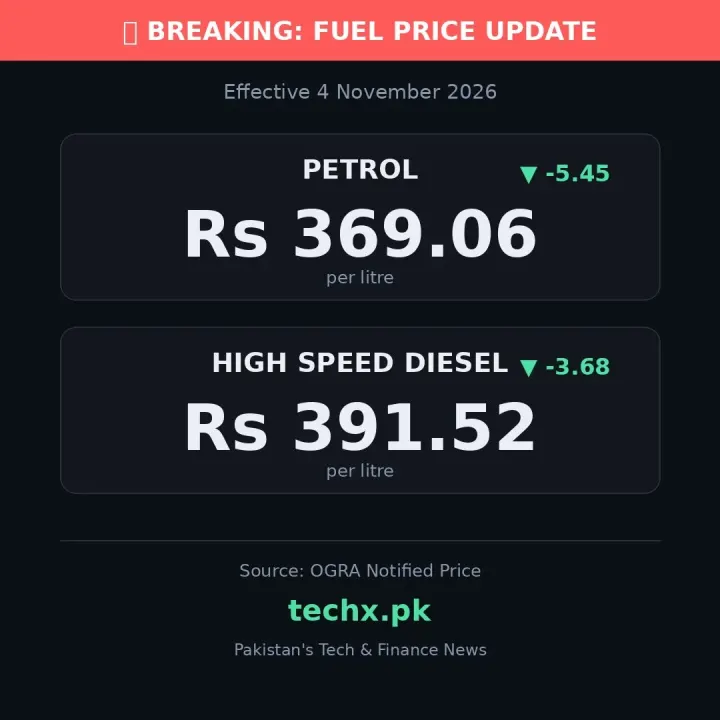
The newly revised prices show a downward trend for consumers. OGRA has announced a reduction in the price of Motor Spirit (MS), commonly known as petrol. Meanwhile, the price of High Speed Diesel (HSD) has also seen a significant decrease.
| Product | Previous Price(03/10/2026) | Revised Price(04/10/2026) | Difference |
|---|---|---|---|
| Motor Spirit (MS) | Rs. 374.51 | Rs. 369.06 | -5.45 |
| High Speed Diesel (HSD) | Rs. 395.02 | Rs. 391.52 | -3.50 |
These daily adjustments will remain unchanged during weekends (Saturdays and Sundays) and public holidays.
Why the Government Adopted a Daily Pricing Model
The shift to daily revisions is a direct response to unprecedented volatility in the global oil market. The 2026 US-Israel war on Iran triggered the largest disruption to world energy supply since the 1970s. In late February, Iran blocked shipping traffic through the Strait of Hormuz, a chokepoint that previously handled about 25% of the world's seaborne oil trade. The United States retaliated with an extensive naval blockade on Iranian ports, further tightening supply.
These actions created a cascading effect on crude oil prices, freight rates, and ultimately on the cost of refined products in Pakistan. By moving to a daily pricing mechanism, the government hopes to pass through market movements more quickly, preventing large price gaps that could hurt consumers and businesses.
Background: The Strait of Hormuz Crisis and Its Global Ripple
The Strait of Hormuz is a narrow waterway between Oman and Iran that connects the Persian Gulf with the Gulf of Oman and the Arabian Sea. Because a quarter of global seaborne oil passes through the strait, any disruption has immediate price implications worldwide. In February 2026, Iran deployed naval mines and anti-ship missiles, halting commercial traffic. The United States responded with a naval blockade, citing security concerns.
A temporary ceasefire in June offered a brief lull, but the truce collapsed on July 8 when renewed strikes on commercial vessels occurred. Iran immediately closed the strait again, prompting the US military to launch consecutive airstrikes aimed at reopening the waterway. The ongoing crossfires have kept oil shipments constrained, forcing refiners to rely on more expensive alternative routes such as the Cape of Good Hope.
How OGRA Calculates Ex-Depot Prices
OGRA's ex-depot price formula incorporates three main components: the international crude price, freight and insurance costs (CIF), and a margin for local refining and distribution. Under the new daily regime, the authority receives updated CIF data each day from the International Energy Agency and adjusts the margin based on domestic logistics costs. The resulting ex-depot price is then published on the OGRA website and disseminated to fuel stations across the country.
Because the daily adjustments do not apply on Saturdays, Sundays, or public holidays, stations continue to sell at the last published price until the next business day. This rule provides stability for retailers while still allowing the government to react quickly on weekdays.
Impact on Different Sectors
Transport operators, including bus companies and freight haulers, stand to benefit from the lower diesel price of Rs. 391.52, a drop of Rs. 3.50 per litre. The reduction in petrol to Rs. 369.06 per litre, down Rs. 5.45, eases operating costs for private car owners and ride-hailing services.
Manufacturing firms that rely on diesel-powered machinery also see a modest cost saving, which could translate into lower product prices if the savings are passed on. Conversely, fuel retailers must adjust their cash-flow forecasts to accommodate daily price swings, requiring tighter inventory and accounting controls.
What Comes Next: Monitoring and Future Adjustments
OGRA has indicated that the daily pricing mechanism will remain in place as long as the global supply situation stays volatile. The authority will continue to publish revised ex-depot prices every 24 hours on weekdays. Stakeholders are advised to monitor the OGRA portal and official press releases for the next set of numbers.
Should the Strait of Hormuz reopen fully or the US-Israel conflict de-escalate, the government may reconsider the daily model and revert to a longer-term price revision schedule. Until then, the daily updates serve as the primary tool to cushion the domestic market from external shocks.
Practical Takeaways for Consumers
Consumers should check the latest ex-depot price before filling up, as the price displayed at the pump may change the next day. Fuel stations are required to update price boards within two hours of the OGRA announcement. Drivers can also use mobile apps that pull OGRA data in real time to stay informed.
Because weekend and holiday prices remain fixed, planning larger fuel purchases for those days could lock in the current rates, potentially avoiding a rise if market conditions worsen.
Overall, the daily price revision is a protective measure aimed at preserving purchasing power amid an ongoing global energy crisis.