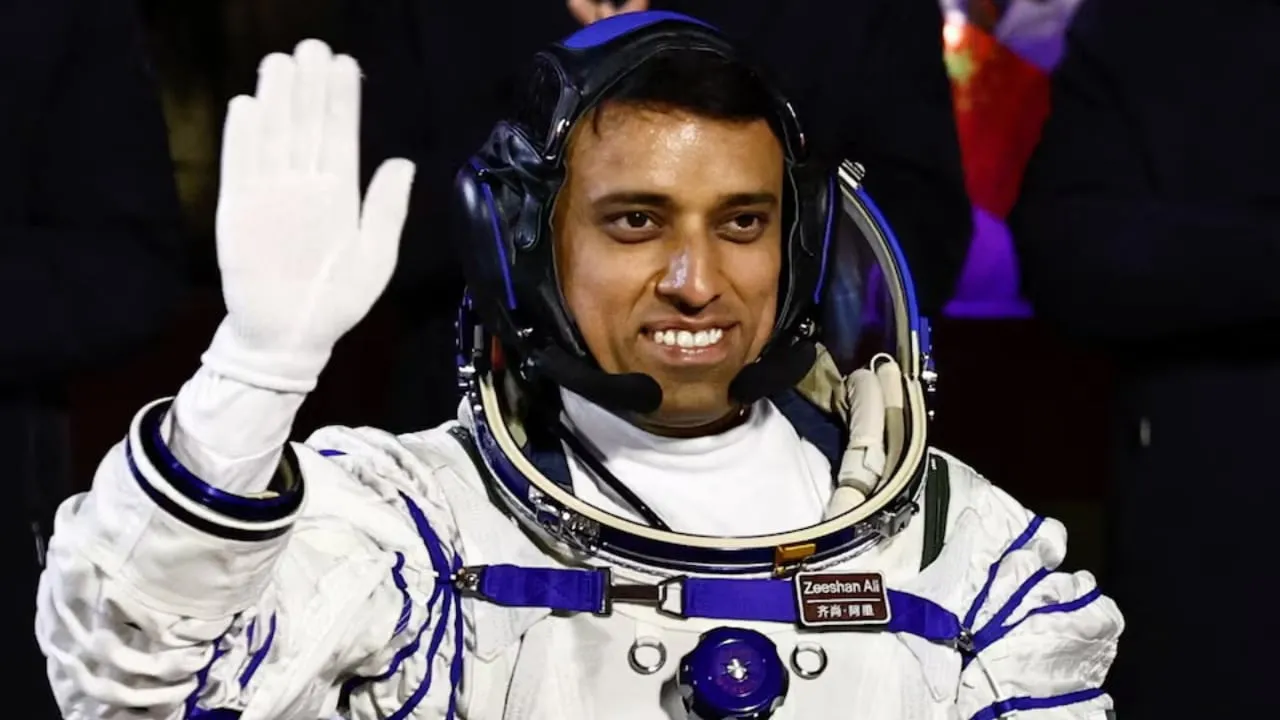
History was made when Muhammad Zeeshan Ali became the first Pakistani national, and the first foreign national ever, to board China Tiangong space station. The milestone was achieved after the Shenzhou-24 spacecraft completed a successful docking procedure in orbit. This development marks a major chapter in international space cooperation and represents a significant scientific achievement for Pakistan as a nation.
The successful docking occurred at 11:56 a.m. Beijing time, which corresponds to 0356 GMT. This orbital link-up happened roughly three-and-a-half hours after the spacecraft lifted off from the Jiuquan Satellite Launch Centre, propelled by a Long March-2F rocket.
How the Shenzhou-24 Docked with Tiangong
The Shenzhou-24 spacecraft executed a fast and automated rendezvous maneuver to dock securely with the front port of the Tianhe core module. Following the successful connection, the three-astronaut crew entered the station. They joined the Shenzhou-23 team that was already residing aboard the orbital laboratory, creating a six-person handover situation inside the space station.
The mission involves careful coordination between the newly arrived personnel and the existing crew members. Orbital docking procedures require high precision, using automated systems backed by ground control teams monitoring every telemetry signal from Earth.
Meet the Full Crew of the Shenzhou-24 Mission
The flight brings together experienced commanders and new specialists from different backgrounds. The crew composition reflects both operational expertise and international partnership.
- Muhammad Zeeshan Ali serves as the payload specialist, marking his status as the first foreign astronaut in the Chinese crewed space programme and Pakistan's first person to reach orbit.
- Tang Hongbo acts as the mission commander on his third spaceflight, making him the first person to visit Tiangong three times.
- Wu Yi participates as a flight engineer on his very first journey into space.
What Muhammad Zeeshan Ali Is Doing Aboard Tiangong
Ali, who is 40 years old and a former Pakistan Air Force fighter pilot, will remain aboard the orbital station for roughly a week before returning to Earth. His scientific schedule during this brief stay is packed with complex experiments. He will study photosynthesis in bacteria, alongside examining the effects of space radiation and microgravity on quinoa seeds.
In addition to the collaborative experiments shared by the crew, Ali is personally managing four specific experiments assigned directly by SUPARCO, which is Pakistan national space agency. Meanwhile, the broader crew is investigating fields such as aerospace medicine, combustion science, and the ways in which the space environment accelerates vascular aging to better understand age-related diseases on Earth.
The Origins of Pakistan Space Cooperation with China
Ali presence in orbit is the direct result of a space-cooperation agreement signed in Islamabad in February 2025. Two Pakistani candidates underwent selection for the program, with Ali ultimately beating out backup candidate Khurram Dawood for the flight assignment. Both individuals completed rigorous training regimens in China.
For Ali, the toughest hurdle during training was not the centrifuge or survival exercises, but rather mastering the Mandarin language. Because every switch, software prompt, and voice announcement on the spacecraft uses Chinese, Ali spent seven months in Beijing studying the language. His training also included calligraphy, Chinese poetry, and table tennis.
Reflecting on the linguistic demands of the mission, he noted that mastering Chinese was the biggest challenge he faced during preparation. Expressing the gravity of his mission before launch, he shared a message with his home country, stating that he carries the name of Pakistan on his shoulder and the hopes of 250 million citizens.
Understanding the Distinction of Orbital Spaceflight
While Ali holds the distinction of being the first Pakistani in orbit, he is not technically the first Pakistani citizen to reach space. That specific title belongs to adventurer Namira Salim, who flew on a Virgin Galactic suborbital flight in October 2023. Orbital spaceflight requires reaching the speed and altitude necessary to circle the Earth, unlike suborbital tourism flights that cross the boundary of space briefly before falling back down.
The mission also establishes a quiet milestone for the Chinese space program. When Ali departs for Earth alongside the returning Shenzhou-23 crew, the third member of that returning crew, Zhu Yangzhu, will actually remain behind. This will make Zhu the first Chinese astronaut to spend a full year in orbit, serving as a operational dry run for future crewed lunar missions.
What Comes Next for International Space Missions
This mission places itself firmly within the realm of space diplomacy between Beijing and Islamabad. The Chinese space administration is signaling that Tiangong operates as an open international research platform rather than an exclusive national facility. Pakistan serves as the first beneficiary of this open-door policy as both nations commemorate 75 years of bilateral cooperation.
While mission commander Tang and flight engineer Wu will remain aboard for their standard six-month rotation, Ali will return to Earth within days. He brings home the weight of a historic first that opens new doors for regional scientific collaboration in high-altitude research.