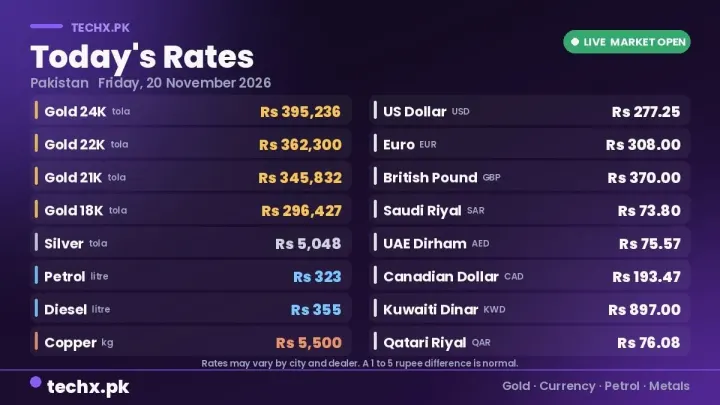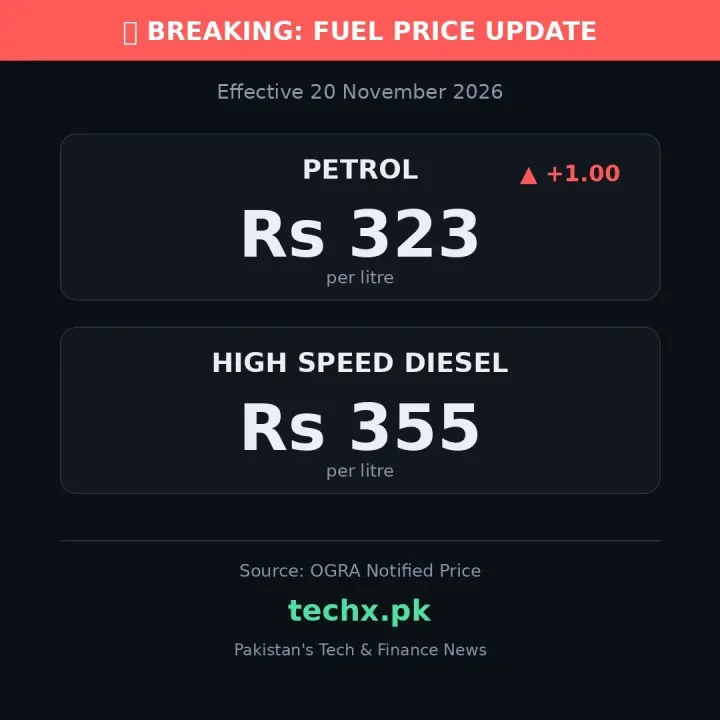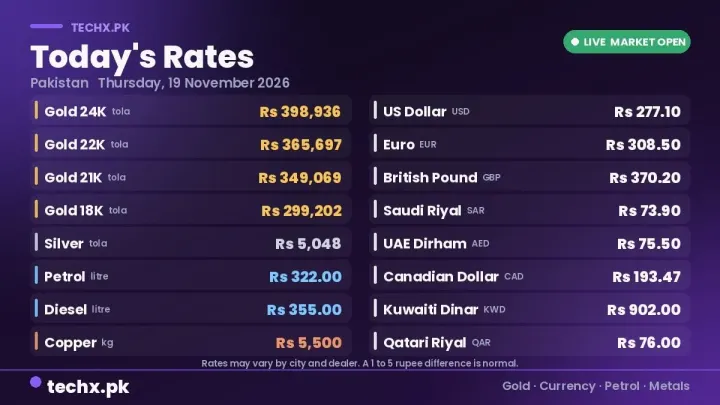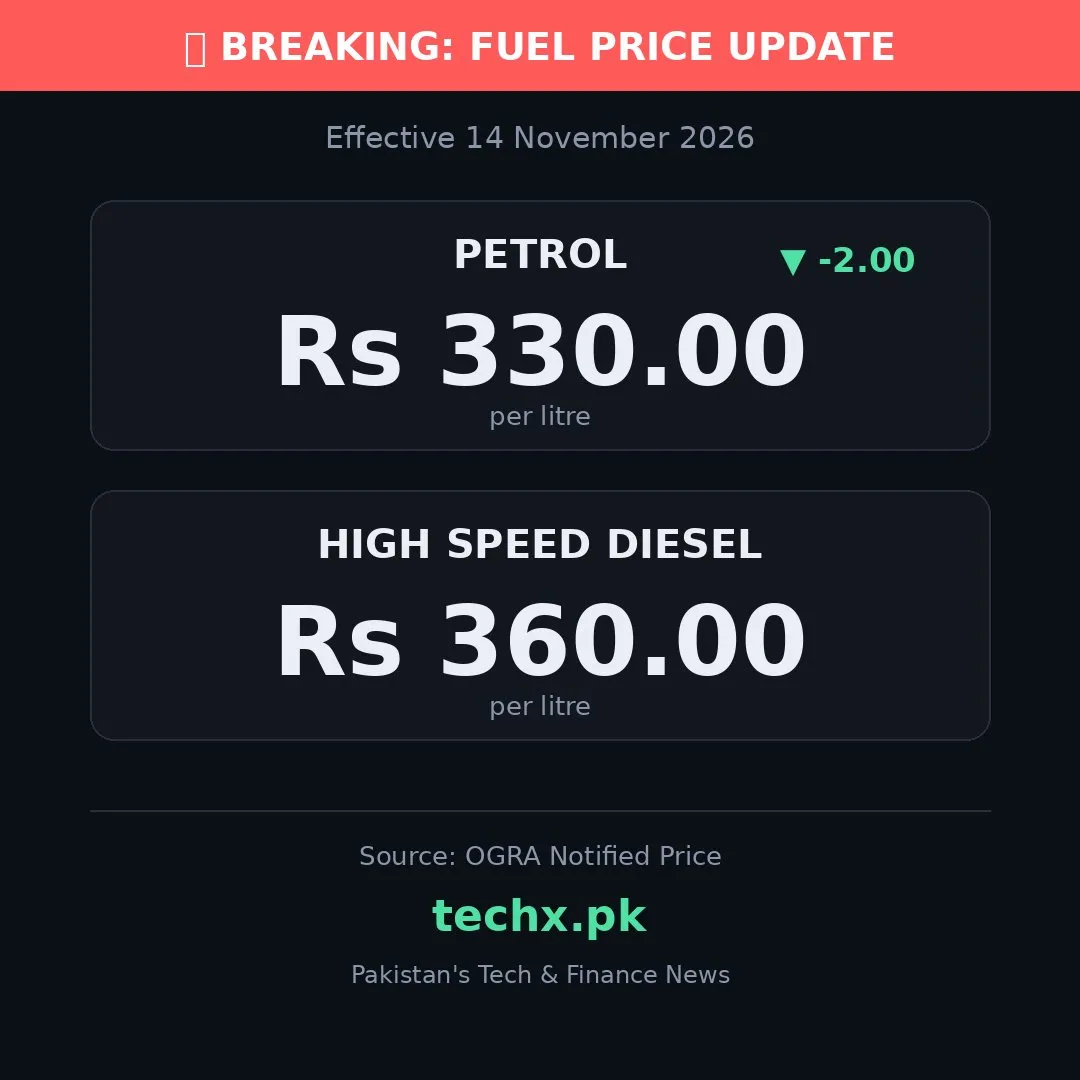
The petrol price in Pakistan today has dropped by Rs 2.00 per litre, effective 14 November 2026. High Speed Diesel, however, stays exactly where it was with no change at all.
Table of Contents
- New Petrol and Diesel Prices in Pakistan
- Why Did Fuel Prices Change?
- What It Means for You
New Petrol and Diesel Prices in Pakistan
OGRA has officially notified the following new petrol price and diesel price in Pakistan for the current fortnightly period. Here is a full breakdown of the latest OGRA fuel prices:
| Fuel | New Price | Change |
|---|---|---|
| Petrol (Super) | Rs 330.00 / litre | -Rs 2.00 |
| High Speed Diesel | Rs 360.00 / litre | -Rs 0.00 |
These prices took effect on 14 November 2026 and apply across Pakistan.
Why Did Fuel Prices Change?
OGRA reviews fuel prices on a fortnightly basis, taking into account global crude oil rates, the Pakistani rupee to US dollar exchange rate, and applicable taxes and levies. The slight reduction in petrol reflects a marginal easing in international oil market conditions during this review period. Diesel prices remained stable as the factors affecting its cost balanced out with no net change.
What It Means for You
For everyday commuters and motorcycle riders, the Rs 2.00 drop in petrol offers a small but welcome relief at the pump. A full 10-litre fill-up now costs Rs 20 less than before. Truck operators and businesses that depend on High Speed Diesel will see no change in their fuel costs this fortnight, keeping transport and logistics expenses steady for now.
Background: How Pakistan's Fuel Pricing System Works
Pakistan's fuel pricing regime is overseen by the Oil and Gas Regulatory Authority (OGRA), an autonomous body created under the Oil and Gas Regulatory Authority Act of 2002. OGRA's mandate includes setting retail prices for petroleum products, ensuring market transparency, and protecting consumer interests while maintaining the financial health of state-owned refineries.
Since the early 2000s, OGRA has moved to a fortnightly price revision model. This schedule replaces the older monthly system and allows the regulator to respond more quickly to fluctuations in global oil markets and exchange-rate movements. The price formula incorporates three core components: the import cost of crude oil (linked to the Brent or Dubai benchmarks), the conversion cost at domestic refineries, and a suite of taxes, duties, and levies imposed by the federal and provincial governments.
Historically, Pakistan has experienced sharp fuel-price volatility, especially during periods of geopolitical tension that affect crude supplies or when the rupee weakens sharply against the US dollar. The most notable spikes occurred in 2018-2019 and again in 2022, prompting public protests and political debate. The current system is designed to smooth such shocks by adjusting prices every two weeks rather than waiting for larger, less predictable changes.
Explainer: What Determines the Petrol and Diesel Rates
Three measurable factors feed into OGRA's price calculations:
- Global crude oil price: OGRA tracks the average of the Brent and Dubai benchmarks over the preceding week. A marginal easing in these benchmarks was recorded in early November 2026, contributing to the Rs 2.00 reduction for petrol.
- Exchange rate: The Pakistani rupee's value against the US dollar is a key variable. In the fortnight leading up to 14 November, the rupee stabilized at around 285 PKR per USD, limiting upward pressure on import costs.
- Taxes and levies: Federal excise duty, sales tax, and provincial petroleum development levy together account for roughly 45 % of the retail price. No changes to these levies were announced for the current period, meaning the price shift stems solely from the first two variables.
Petrol and diesel are priced separately because they have different refinery yields and tax structures. Diesel, used heavily by commercial fleets, often carries a slightly higher tax rate, which can offset modest changes in crude cost. In this cycle, the balancing of all inputs resulted in a zero-change outcome for High Speed Diesel.
Impact: Who Feels the Change and How
Even a Rs 2.00 per litre shift can affect millions of Pakistanis. The average daily commuter who drives a 30-kilometre round trip typically consumes about 2.5 litres of petrol. Over a fortnight, the price cut saves roughly Rs 70 per driver, a modest but perceptible amount for low-income households.
Motorcycle owners, who often purchase fuel in smaller quantities, benefit proportionally. A 10-litre purchase now costs Rs 20 less, translating into a 0.6 % reduction in fuel expenditure for that transaction.
For the logistics sector, diesel stability is the headline. Truck operators, who spend an estimated Rs 2 million on diesel each month, will see no change in operating costs for this period. That steadiness helps maintain freight rates, which in turn influences the price of goods ranging from food staples to construction materials.
Businesses that run diesel-powered generators also avoid a potential cost surge, preserving profit margins in an economy already coping with inflationary pressures.
What Comes Next: Monitoring the Next Review Cycle
OGRA's next price review is scheduled for 28 November 2026. Observers will watch several indicators: any further movement in Brent/Dubai crude, shifts in the PKR/USD rate, and possible adjustments to tax policy announced by the Ministry of Finance.
Stakeholders can access OGRA's detailed price calculation sheet on its official website, where the exact weight given to each component is disclosed. Consumers and businesses are encouraged to track these publications to anticipate future changes.
Practical Takeaways for Readers
1. Fill up before the next review if you anticipate a price rise; the current petrol price of Rs 330.00 per litre is the lowest it will be until at least 28 November.
2. Keep an eye on the rupee's exchange rate, as a sudden depreciation can trigger higher fuel costs in the next cycle.
3. For commercial fleet managers, the unchanged diesel price provides a short-term budgeting certainty, but plan for possible adjustments after the next fortnightly revision.
4. Use the saved Rs 20 on a typical 10-litre petrol purchase to offset other commuting costs, such as vehicle maintenance or public-transport fares.
How the Government Communicates Fuel Prices
OGRA issues a formal notification that is simultaneously published in the Official Gazette and on its website. Media outlets then disseminate the figures, often accompanied by a brief analysis of the underlying market forces. The regulator also holds a press briefing, where senior officials answer questions from journalists about the rationale behind the numbers.
This transparent process aims to build public trust and reduce speculation. It also allows civil-society groups to verify that the price formula is being applied consistently.
Public Reaction and Expert Opinion
Consumer rights organisations welcomed the modest petrol cut, describing it as "a timely relief for everyday commuters who face rising living costs." Energy economists noted that while the reduction is small, it signals that global oil markets are not in a steep upward trajectory at present.
Conversely, some analysts cautioned that the stability of diesel does not guarantee long-term price certainty, especially if the rupee experiences volatility or if the government revises tax rates. They recommend that businesses maintain a fuel-cost contingency in their financial planning.