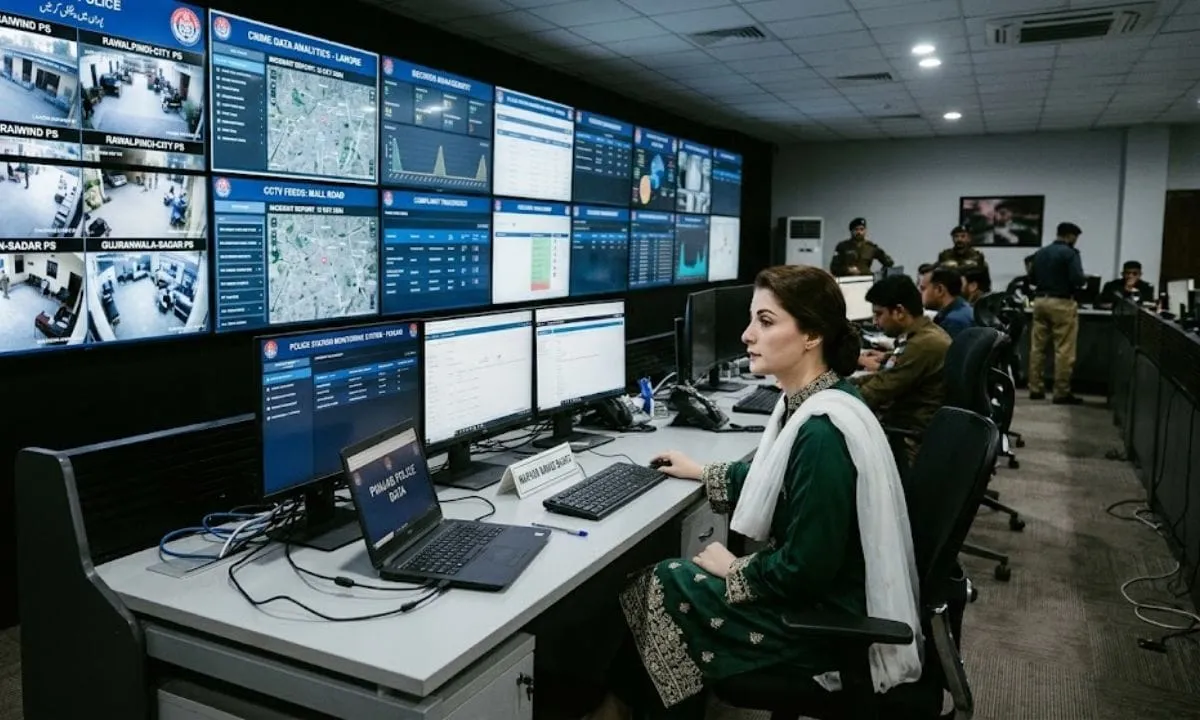
Punjab Chief Minister Maryam Nawaz Sharif on Friday inaugurated the CM Crime Surveillance Unit, a digital system that will monitor crime data and the performance of police officers at the district, circle and police station levels across the province.
The launch marks the first time a province-wide, real-time dashboard will be available to senior officials, allowing them to view up-to-date crime figures for every police station in Punjab with a single click.
How the Crime Surveillance Unit Works
The unit aggregates information from the existing police station record management system. Data on 20 categories of crime - ranging from violent offences such as homicide and robbery to non-violent offences like fraud and cyber-crime - are entered by station house officers (SHOs) at the point of filing a First Information Report (FIR). Once entered, the figures are automatically uploaded to a central server.
At the district level, district police officers (DPOs) can compare their station's numbers with neighboring stations, while deputy superintendents of police (DSPs) receive weekly trend analyses prepared by in-house experts. The system also timestamps each citizen complaint and tracks the interval between filing and resolution, creating a performance score for each officer involved.
What the Unit Monitors
Performance metrics include:
- Number of FIRs registered per officer
- Average time taken to close a case
- Response time to citizen complaints and applications
- Compliance with standard operating procedures for evidence collection
- Identification of delayed or missing reports
In addition to operational data, the unit will scan social media for posts that mention police activity in Punjab. Notable posts are flagged for review, helping the province meet national security monitoring requirements.
Why the System Was Introduced
Punjab has seen a steady decline in overall crime rates over the past five years, a trend the chief minister attributes to recent reforms. However, she also highlighted persistent problems: unjustified delays in registering FIRs, complaints of bias in case handling, and a surge in negative propaganda against the police on digital platforms.
By making data transparent and linking it directly to officer evaluations, the government hopes to close the gap between policy and practice. The chief minister instructed the Inspector General of Punjab Police to submit a comprehensive police reform plan that incorporates the new surveillance data.
Impact on Police Officers and Citizens
For police officers, the system creates a clear benchmark for performance. Officers who consistently meet or exceed targets may be considered for promotions or commendations, while those with repeated delays will face administrative action.
Citizens stand to benefit from faster case processing and a more accountable police force. The ability to track complaint resolution times means that victims can receive updates on the status of their cases, reducing uncertainty and building public trust.
Historical Context of Police Reform in Punjab
Punjab's police reforms began in 2018 with the introduction of the Police Service Act, which sought to modernise recruitment, training and accountability mechanisms. In 2020, the province launched a digitisation drive that installed record-keeping software in over 1,200 police stations. Those efforts laid the technical groundwork for the Crime Surveillance Unit.
Earlier reforms also included the creation of an independent complaints board and the rollout of body-worn cameras in major urban districts. While those steps reduced some forms of misconduct, gaps remained in real-time monitoring, prompting the current initiative.
Next Steps and Implementation Timeline
During the inauguration ceremony, unit head Usman Tahir briefed the chief minister on the structure and operations of the system. He confirmed that the central dashboard is already live for a pilot group of 50 stations and will be rolled out province-wide within the next three months.
Police stations are required to train all relevant staff on data entry protocols by the end of the month. The Inspector General will receive monthly performance reports, and the chief minister's office will review them in quarterly meetings.
Practical Takeaways for Readers
Residents of Punjab can now expect more rapid updates on the status of their complaints. If a complaint remains unresolved beyond the standard timeframe, the citizen can request a review through the provincial grievance portal, which will reference the surveillance data.
Law-enforcement officers should familiarize themselves with the new key performance indicators and ensure accurate, timely entry of FIR details. Failure to do so may result in formal disciplinary action.
Overall, the Crime Surveillance Unit represents a significant step toward data-driven policing in Punjab, aiming to reinforce public confidence while sustaining the province's downward trend in crime.