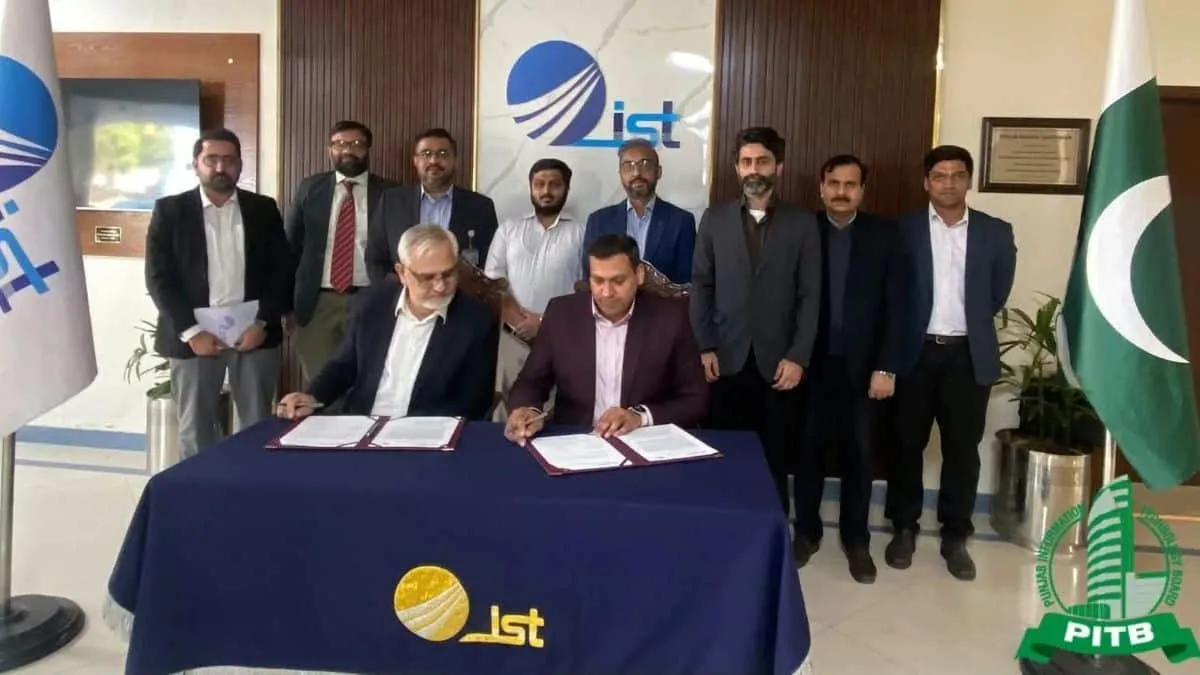
The Punjab Information Technology Board (PITB) signed a Memorandum of Understanding (MoU) with the Institute of Space Technology (IST) on Tuesday, extending the Chief Minister's Initiative Makerspace Punjab to foster innovation, research collaboration and technology-driven product development.
The agreement was formalised by PITB Director Skill Development Ahmad Islam Syan and IST Registrar Dr. Syed Adnan Qasim, with representatives from both organisations in attendance.
What is Makerspace Punjab and why it matters
Makerspace Punjab is a flagship programme of the Government of Punjab, implemented by PITB, that seeks to strengthen Pakistan's hardware innovation ecosystem. The initiative provides advanced facilities for product design, rapid prototyping, testing and local product development, aiming to reduce reliance on imported components and stimulate home-grown manufacturing.
Since its launch in 2022, Makerspace Punjab has established several regional hubs equipped with CNC machines, 3-D printers, laser cutters and electronics workstations. These hubs have supported startups, university teams and private-sector engineers in turning concepts into market-ready prototypes.
How the PITB-IST partnership will work
The MoU creates a structured platform for IST and PITB to explore collaborative opportunities. Key mechanisms include:
- Joint research projects that align IST's aerospace and engineering expertise with PITB's industry networks.
- Exchange programmes for faculty, graduate students and skilled technicians to share technical knowledge.
- Co-hosting hackathons, design challenges and product-development workshops at Makerspace Punjab facilities.
- Facilitating access for IST researchers to PITB's prototyping labs, testing rigs and market-validation services.
Both parties will appoint liaison officers to coordinate activities, monitor progress and report outcomes to the Chief Minister's office.
Background on PITB and its role in Punjab's tech ecosystem
Established in 2000, the Punjab Information Technology Board is the provincial agency responsible for driving digital transformation across government services, skill development and entrepreneurship. PITB has launched multiple initiatives, including the e-Governance programme, the DigiSkills training platform and the Punjab Startup Fund, which together have nurtured over 2,000 tech-enabled enterprises.
Through Makerspace Punjab, PITB aims to complement its software-centric programmes with a strong hardware focus, recognising that sectors such as agriculture, health, renewable energy and defence increasingly demand locally engineered devices.
Institute of Space Technology: academic strength and relevance
Founded in 2002 in Rawalpindi, IST is a public university specialising in aerospace, satellite communications, electronics and related engineering disciplines. The university hosts several research centres, including the Centre for Advanced Materials and the Drone Research Lab, which have produced patents and prototype systems for both civilian and defence applications.
IST's curriculum emphasizes hands-on project work, and its graduates have a reputation for technical competence in hardware design and systems integration. By partnering with PITC, IST can extend its research impact beyond academia into commercial and governmental product pipelines.
What the collaboration means for innovators and businesses
Start-ups and small-medium enterprises (SMEs) in Punjab will gain direct access to IST's research expertise and to state-of-the-art prototyping equipment housed at Makerspace Punjab. This can accelerate product development cycles, lower R&D costs and improve the likelihood of securing funding from venture capital or government grants.
For established manufacturers, the partnership offers a channel to tap emerging technologies such as low-cost sensors, IoT platforms and additive manufacturing techniques, which can be integrated into existing production lines.
Steps ahead and timeline
Both organisations have agreed on an initial 12-month implementation plan. Within the first quarter, a joint steering committee will draft a catalogue of pilot projects, prioritising sectors identified by the Punjab government, such as precision agriculture, medical devices and renewable-energy hardware.
By the end of the second quarter, the first round of collaborative workshops will be held at the Lahore Makerspace hub, featuring IST faculty and PITB industry mentors. Prototypes emerging from these workshops will undergo testing at PITB's certification labs, with successful designs eligible for inclusion in the Punjab Startup Fund's seed-investment pool.
The MoU also stipulates an annual review, during which progress metrics, number of joint projects, patents filed, products commercialised, will be assessed and reported to the Chief Minister's office.
Potential challenges and how they are being addressed
Coordinating academic schedules with industry timelines can be difficult. To mitigate this, the MoU includes provisions for flexible project milestones and remote collaboration tools, ensuring that research teams can continue work even when campus facilities are closed.
Intellectual-property (IP) rights are another focal point. Both PITB and IST have agreed to adopt a joint-ownership model for inventions arising from collaborative work, with clear revenue-sharing clauses to protect the interests of student innovators and university researchers.
Why the announcement matters for Pakistan's broader tech ambitions
Pakistan's Vision 2025 outlines a goal of positioning the country among the top 20 global economies through technology-driven growth. Strengthening the hardware innovation pipeline is essential to achieving that target, as it reduces dependence on imported equipment and creates high-skill jobs.
The PITB-IST MoU signals a shift toward more integrated public-private-academic ecosystems, a model that has proven successful in other emerging economies such as Malaysia and Israel.
Practical takeaways for readers
Entrepreneurs interested in leveraging Makerspace Punjab should register on the PITB portal, submit a brief project proposal and indicate whether they seek IST collaboration. Students at IST can apply for the new "Makerspace Fellowship" to work on industry-relevant prototypes, receiving mentorship from PITB's skill-development team.
Businesses looking to adopt new hardware solutions can contact PITB's Innovation Desk to explore joint development opportunities, gaining access to IST's research labs and the province's prototyping infrastructure.
Overall, the MoU creates a clear pathway for ideas to move from university labs to market-ready products, reinforcing Punjab's role as a hub for technology-enabled manufacturing in Pakistan.