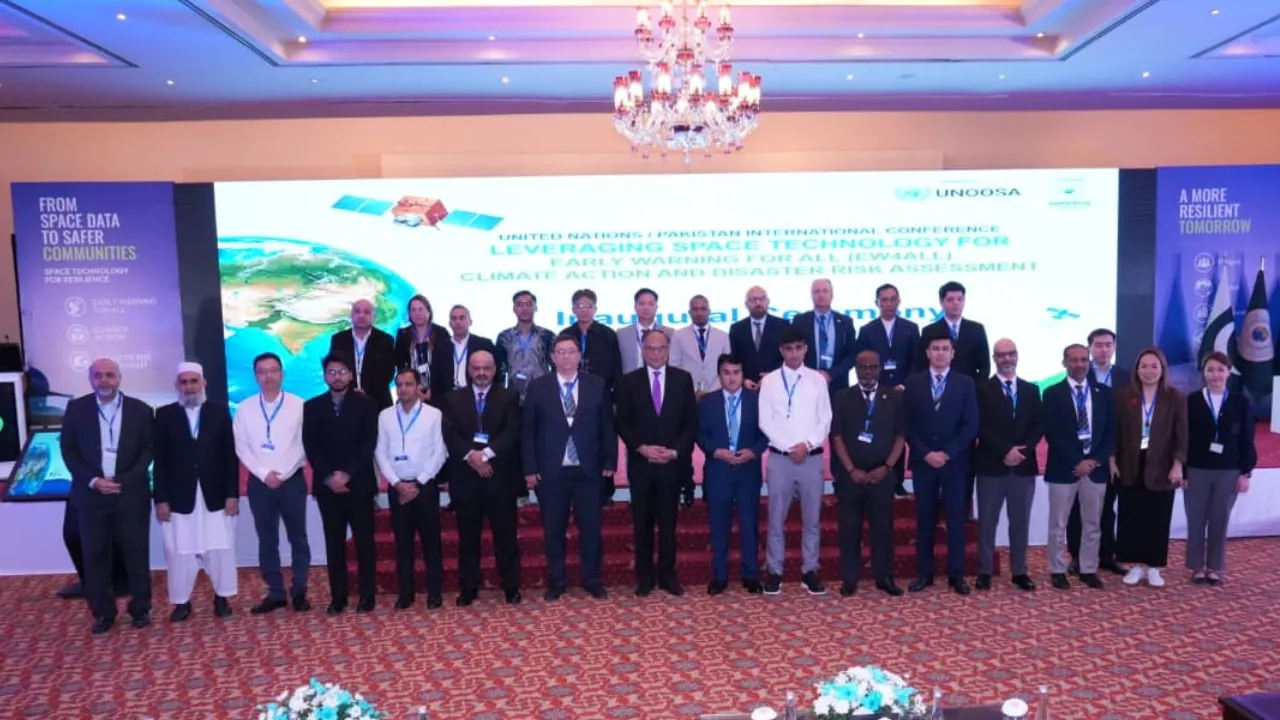
The Space and Upper Atmosphere Research Commission, alongside the United Nations Office for Outer Space Affairs, the Inter-Islamic Network on Space Sciences and Technology, and the Asia-Pacific Space Cooperation Organization, opened an international conference on space technology for early warnings, climate actions, and disaster risk assessment at the Serena Hotel in Islamabad.
Running from 27 to 31 October 2026, the five-day event gathers 250 participants from national and international backgrounds to investigate how space tools can improve early warning systems, climate resilience, and disaster management. Federal Minister for Planning, Development and Special Initiatives, Prof. Ahsan Iqbal, attended as the chief guest for the opening ceremony.
Delegates include around 250 people representing 20 countries. Along with the host organizations, international attendees feature the United Nations World Food Programme, the International Telecommunication Union, and various space agencies from Indonesia, Iran, Iraq, Turkey, Vietnam, and Nepal.
Local participation brings together government bodies, disaster agencies, and public institutions like the Ministry of Climate Change and Environmental Coordination, the Ministry of Foreign Affairs, NDMA, the Pakistan Meteorological Department, and the State Bank of Pakistan.
Academic representatives also joined the sessions, offering experts, policymakers, and researchers a venue to exchange knowledge and build international partnerships regarding space applications for climate and disaster assessment.
SUPARCO Chairman Muhammad Yousaf Khan welcomed attendees and pointed out the increasing value of space applications in tracking climate changes and managing disasters.
Federal Minister Prof. Ahsan Iqbal delivered an address at the opening, stressing the connection between climate risks, economic growth, and poverty reduction, while noting that the 2022 floods caused direct losses equal to roughly 2.2 percent of GDP.
Partner representatives including ISNET Executive Director Munir Ahmad Asad, UNOOSA Director Aarti Holla-Maini, and APSCO Secretary-General Dr. Jiang Hui also spoke during the inaugural session.
The technical schedule features sessions on geospatial technologies, flood risk modelling, multi-hazard mapping, glacial lake outburst flood early warning, and satellite monitoring of glaciers, forests, agriculture, and water supplies.
A technical tour of the National Disaster Management Authority is part of the agenda, and the closing ceremony on 31 October 2026 will present conference findings alongside details of SUPARCO's Space4Climate initiative.
Additionally, a Pakistan-Kazakhstan Joint Climate Laboratory is slated for inauguration, followed by a five-day training course at the COMSTECH Secretariat in Islamabad from 2 to 6 November 2026.