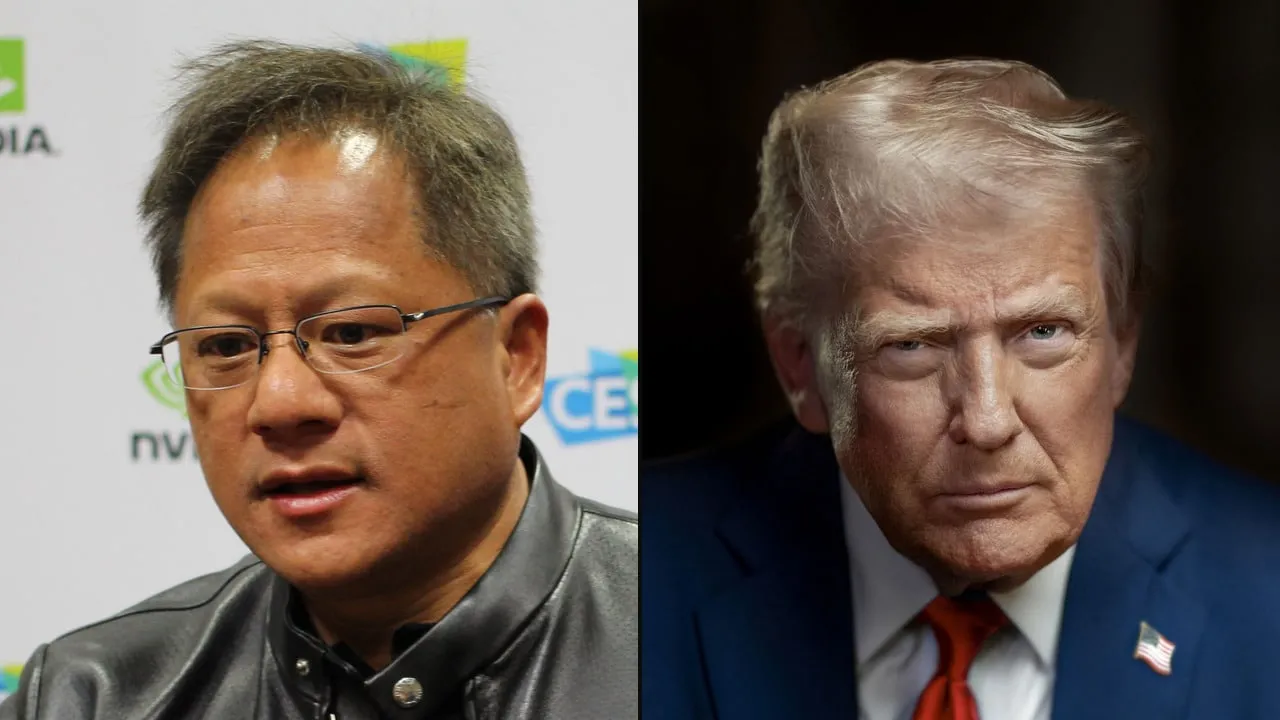
U.S. President Donald Trump said on Monday that he would not mind Jensen Huang returning to Nvidia as chief executive, challenging claims that a Chinese-linked associate posed a national-security risk.
Trump made the remarks at a White House briefing before departing for an Asia tour, noting that many people were asking for Huang's reinstatement and that the idea was not "a bad idea." He added that Huang had "learned a big lesson."
Why Trump's Comment Matters
Trump's endorsement adds political weight to a campaign already supported by tech entrepreneur Elon Musk and an online petition that has gathered roughly 180,000 signatures. The petition argues that Huang's technical vision is essential for Nvidia's future in artificial intelligence and high-performance computing.
At the same time, the president's remarks clash with statements from his own Treasury Secretary, Scott Bessent, who called for a "dramatic shake-up" of Nvidia's leadership and urged the board to consider external candidates.
Background on Huang's Resignation
Jensen Huang stepped down as Nvidia CEO last week after media reports linked him to two separate relationships that raised security concerns. One alleged affair involved a subordinate within Nvidia, while the other involved Alice Huang, a former executive at Singapore-based Megaspeed, one of Nvidia's largest overseas customers.
Alice Huang is suspected by some intelligence sources of working for Chinese intelligence services. The allegations sparked a debate in Washington about whether the relationship could compromise proprietary chip designs and AI technology that are deemed critical to U.S. national security.
Trump's View on the Spy Allegations
During the briefing, Trump said he was not convinced that Alice Huang was a spy. "I don't know that she was a spy at all," he said, adding that national security "was not put at risk." He indicated he might raise the issue with Chinese President Xi Jinping when they meet in Shenzhen on the sidelines of the APEC summit.
Trump also suggested that former Apple chief executive Tim Cook could be considered as an alternative to Jensen Huang, repeating a notion that has circulated among some investors and analysts.
Washington's Mixed Signals
While Trump voiced support for Huang's return, other officials expressed skepticism. Treasury Secretary Scott Bessent's call for a "dramatic shake-up" reflects concerns that the board should look beyond the current executive team to restore investor confidence.
Market analysts largely see a return as unlikely. Prediction-market platform Kalshi lists Huang with a 14 percent chance of becoming Nvidia's next permanent CEO, trailing Arm CEO Rene Haas.
Following the news, Nvidia shares fell about 2 percent in New York trading on Monday, indicating that investors remain cautious about leadership uncertainty.
How Nvidia's Leadership Structure Works
Nvidia's board of directors is responsible for selecting the chief executive. The board typically evaluates internal candidates, such as senior engineers or product leaders, and external candidates with relevant semiconductor or technology experience. A CEO change triggers a review of the company's strategic roadmap, especially in areas like AI chips, data-center GPUs, and automotive platforms.
When a CEO steps down abruptly, the board may appoint an interim chief executive while conducting a broader search. The interim leader often comes from within the senior management team to ensure continuity of ongoing projects.
Potential Impact on the Tech Sector
If Huang were to return, Nvidia could maintain its aggressive product-development cadence, which has driven strong revenue growth in AI-related markets. Conversely, a prolonged leadership vacuum could slow product launches, affect supply-chain contracts, and influence the pricing of graphics processing units that power data-center workloads worldwide.
Customers such as cloud service providers, automotive manufacturers, and gaming companies watch Nvidia's leadership closely because strategic decisions affect hardware roadmaps and software ecosystems.
What Comes Next
The next steps hinge on the Nvidia board's assessment of both internal and external candidates. The board is expected to convene a special meeting within the next two weeks to discuss succession options. If Trump raises the matter with President Xi in Shenzhen, any diplomatic outcome could influence the perception of security risks linked to foreign partnerships.
Investors will likely monitor the APEC summit for any remarks from the U.S. or Chinese leaders that touch on technology transfer or espionage concerns. Additionally, the Treasury Secretary's call for a shake-up may prompt the board to commission an independent review of corporate governance practices.
Regardless of the eventual decision, Nvidia's shareholders, employees, and global customers will feel the effects of the leadership debate as the company navigates a rapidly evolving AI market.