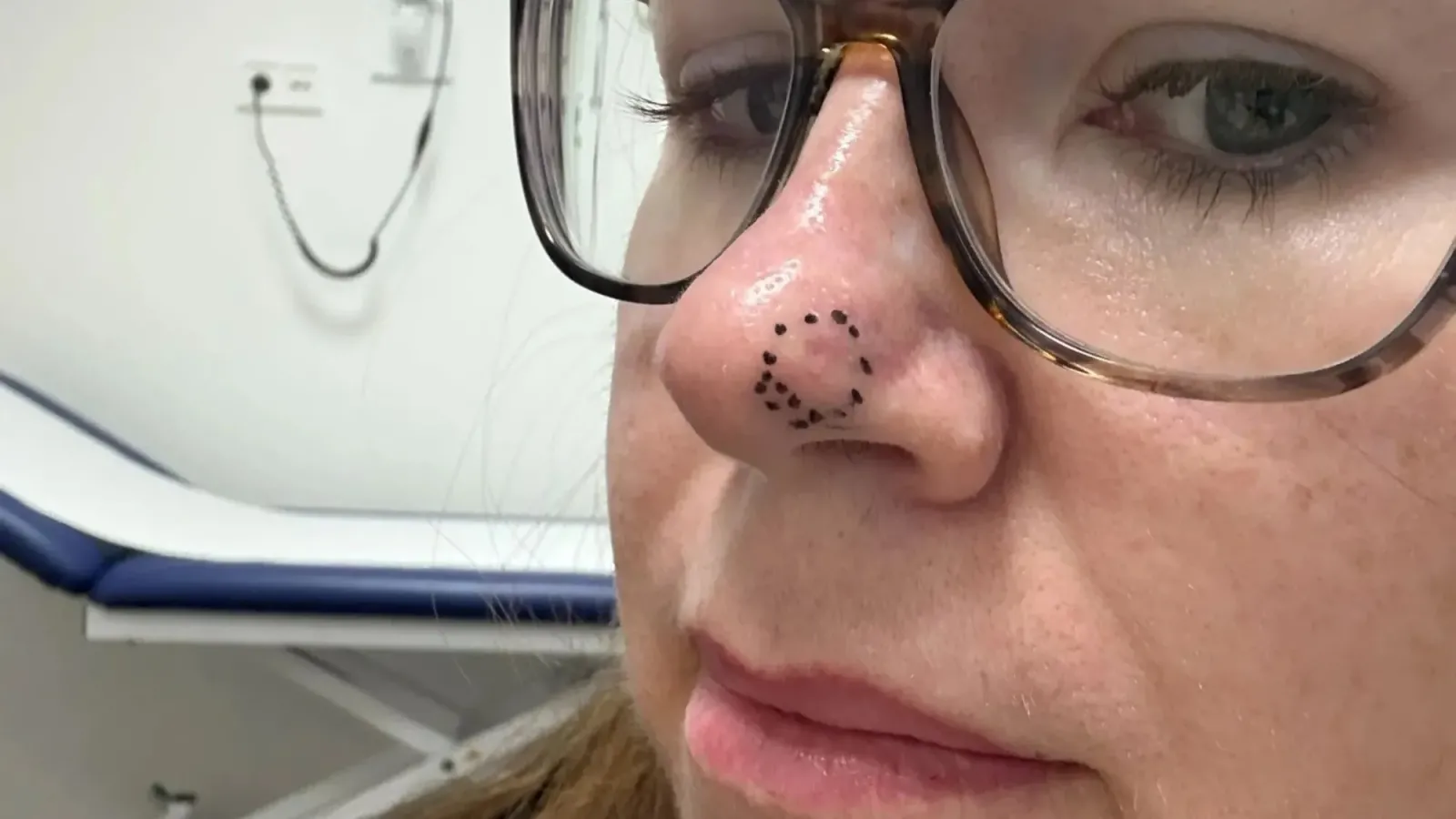
Abby Bookholt, a 42-year-old crisis management advisor living in The Hague in the Netherlands and originally from Busselton in Western Australia, had to undergo major facial reconstruction after two small spots on her nose were diagnosed as basal cell carcinoma, the most common type of skin cancer in the UK. The ordeal began when she visited her general practitioner regarding a dry patch of skin on her cheek, which prompted a referral to a dermatologist who instead focused on the two subtle marks on her nose.
The diagnosis led to a challenging 18-month journey of surgery, healing, and facial reconstruction that left her barely able to leave the house. While the cancer removal was successful and she was deemed cancer-free without needing chemotherapy or radiotherapy, the physical toll required extensive surgical intervention to rebuild her nose using skin from her forehead.
How Two Small Spots Led to Major Facial Reconstruction
When the dermatologist examined her, Abby Bookholt was told they were unconcerned with her cheek but highly focused on her nose. The two spots looked like slightly different pigmentation and were slightly more white than the surrounding skin. She received a call that same evening informing her that the marks were cancerous and would require immediate surgery and reconstruction.
Prior to her first procedure, doctors explained that the cancerous patches would be cut away from her nose and reconstructed using a forehead flap method. A 5cm patch of skin from her forehead was mostly cut away, twisted down onto the remaining structure of her nose, and stitched into place to form a new nose. Because the skin was never detached completely, blood flow kept the tissue alive rather than relying on a traditional graft.
Reflecting on the procedure, Abby Bookholt stated that she was awake for the first surgery under local anaesthetic and described it as horrible. Surgeons left a massive 5cm hole in her forehead, which was left open to heal on its own because of her age. Over subsequent weeks, she watched the skin form again, marking the beginning of a long cosmetic recovery.
Understanding Basal Cell Carcinoma and Common Skin Cancer Signs
Basal cell carcinoma begins in the basal cells, which are a type of cell within the skin that produces new skin cells as old ones die off. People often first become aware of this cancer when they notice a scab that bleeds or does not heal completely, or a lump on the skin that does not go away. Dr Adil Sheraz, a consultant dermatologist and member of the British Association of Dermatologists, notes that these lumps often have a shiny or pearly appearance.
These growths are typically pink or red on lighter skin tones, but may appear brown or black on darker skin tones. Some basal cell carcinomas feature a thickened rim around a central dip, while others appear as flat patches. These growths typically increase in size over time, tend to grow slowly, and almost never spread to other parts of the body.
Dr Rakesh Anand, a consultant dermatologist and British Skin Foundation spokesperson, explains that people often imagine a dark or changing mole when thinking about skin cancer. However, skin cancer does not always look like that, sometimes appearing as a small spot, a dry patch of skin, or a sore that refuses to heal. A major misconception is that skin cancer must look dramatic or cause pain, whereas many presentations are subtle and easily mistaken for harmless blemishes.
Recognising Squamous Cell Carcinoma and Melanoma
Squamous cell carcinoma is the second most common form of skin cancer and typically appears as a rough, scaly, or crusty patch. These lesions may bleed, feel sore or tender, or develop into persistent sores. While they can occur anywhere on the skin, they are more prevalent on sun-exposed areas such as the head, ears, lips, neck, and the backs of the hands.
Unlike basal cell carcinomas, squamous cell carcinomas originate from squamous cells closer to the surface of the epidermis and possess the potential to spread to other parts of the body. Both basal cell carcinoma and squamous cell carcinoma are usually highly treatable when detected early, with surgery serving as the primary treatment method.
Melanoma represents a more aggressive form, with around 15,000 Britons diagnosed each year and incidence rising faster than any other common cancer. Roughly one in every 37 people will be diagnosed with melanoma during their lifetime. Typical signs include a larger skin mole or an irregular pigmented area that grows or changes in shape, colour, or texture.
How to Check Your Skin Using the ABCDE Rule
Experts recommend using the ABCDE rule to check for signs of melanoma and other unusual skin changes:
- Asymmetry: Is your mole or patch of skin uneven in shape?
- Bregularity: Are the edges of it irregular?
- Colour variation: Is it an uneven shade or contain multiple colours?
- Diameter: Is it wider than 6mm?
- Evolving: Has it changed at all, started bleeding, or begun to itch?
On darker skin tones, signs can be more difficult to identify, with moles presenting as symmetrical, ulcerated, pink, located under a nail, or found on the palm or sole. Dr Wilson advises that anyone with a skin lesion in doubt should consult their general practitioner. Abby Bookholt echoes this advice, noting that her spots had likely been present for years while she only knew to look for brown dots.