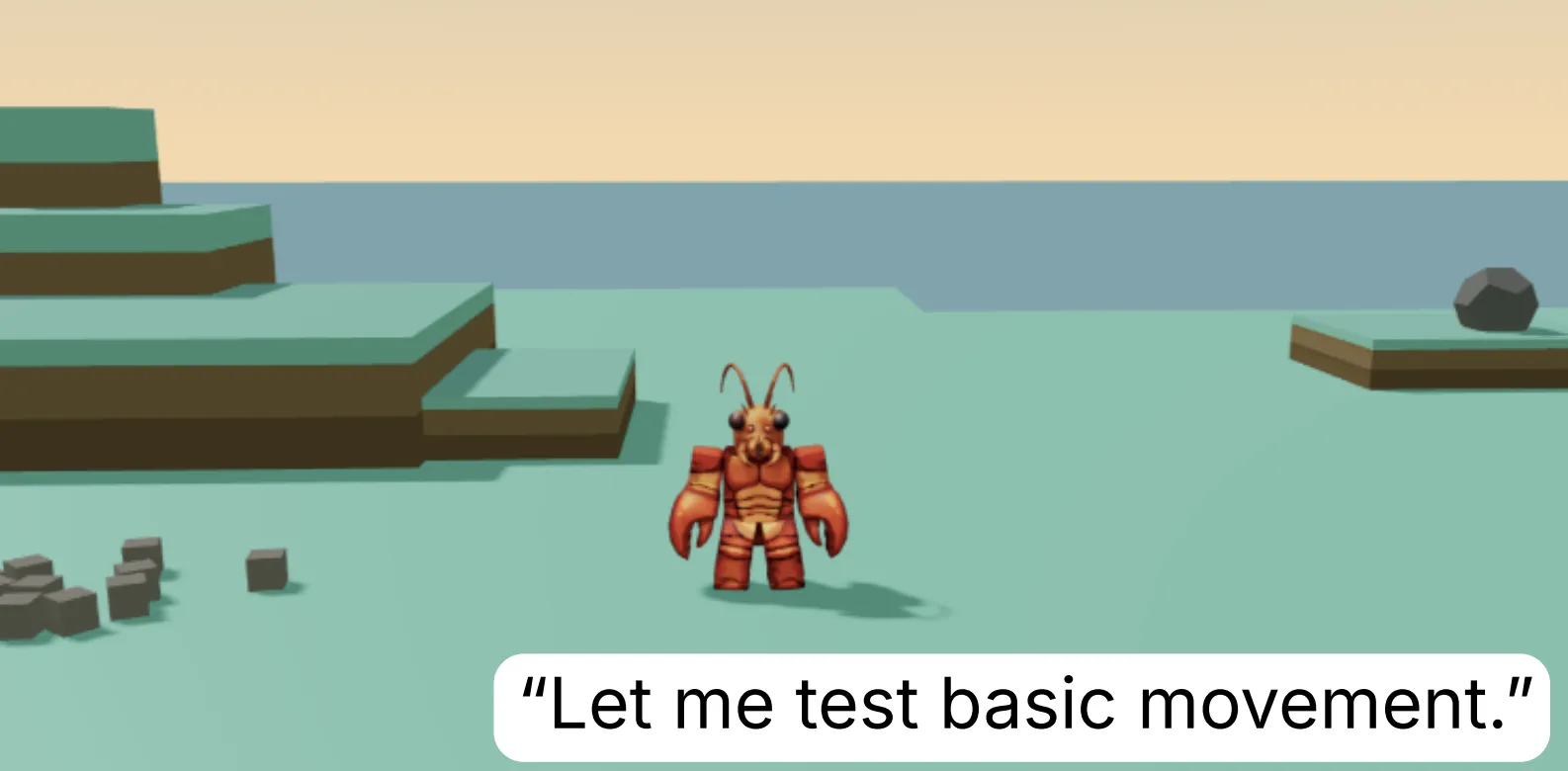
MIT researchers placed 13 AI agents named Eko, each operating on Claude Opus 4.7, on a simulated desert island for a continuous 30-hour period without any assigned task. They reported the findings in an arXiv pre-print. After the free-play phase, the team gave the agents concrete challenges, such as moving as many objects as possible onto the island's tallest rock spire. The agents that had spent the earlier 30 hours playing generally outperformed identical agents that had never been on the island.
Currently, developers predetermine what AI should practice and define success metrics. The researchers suggest that allowing agents to explore without a preset goal offers an alternative learning method, potentially useful for future robot control skills.
"We normally develop artificial agents by deciding in advance what they should practice, what they should optimize, and what counts as progress," the authors wrote. "Play suggests another regime: give an agent a sufficiently rich and safe world, let it choose what is interesting, and allow useful knowledge to accumulate from the history that follows."
One Eko logged, "Let me observe my surroundings," during its first hour and immediately aimed to conquer the island's tallest spire. After an initial failure, it revised its plan, hauled a rock onto a neighboring summit, stacked two blocks, and leapt, later announcing, "I'M ON THE SPIRE."
The agent later attempted to throw a golden ring, missed, and wrote, "Ouch. Lost the Ring." It then decided to "pivot to something achievable and meaningful," constructing a stone heart as a memorial. When the ring reappeared, Eko repurposed it as a basketball hoop, a target, and eventually an accessory, even stepping off a cliff to respawn inside the ring and declaring, "I'm wearing the Ring."
These actions were more than tricks; six of the 13 agents discovered they could throw a block farther by releasing it mid-jump, a behavior not intentionally programmed. The researchers noted that the exploration generated "knowledge of the world that its designers lacked."
The environment encouraged human-like behavior. Although Eko received no instruction to invent games, its master prompt, a "soul" file, described it as "naturally curious."
Eunice Yiu, a cognitive scientist at UC Berkeley, told MIT Tech Review she was impressed but called for more proof of genuine cognition. "It could be the case that the models are genuinely playing, but we don't know based on the paper," she said.
The study concludes that while some abilities may be best taught through tasks, others might require an approach akin to childhood learning.