Financial records revealed to investors this week indicate that Claude Code, the AI coding product from Anthropic, is performing as well as the lab expected. The firm posted an operating profit during the second quarter alongside a net revenue retention of 900%, meaning customer spending from Q3 2025 increased nine times by Q3 2026.
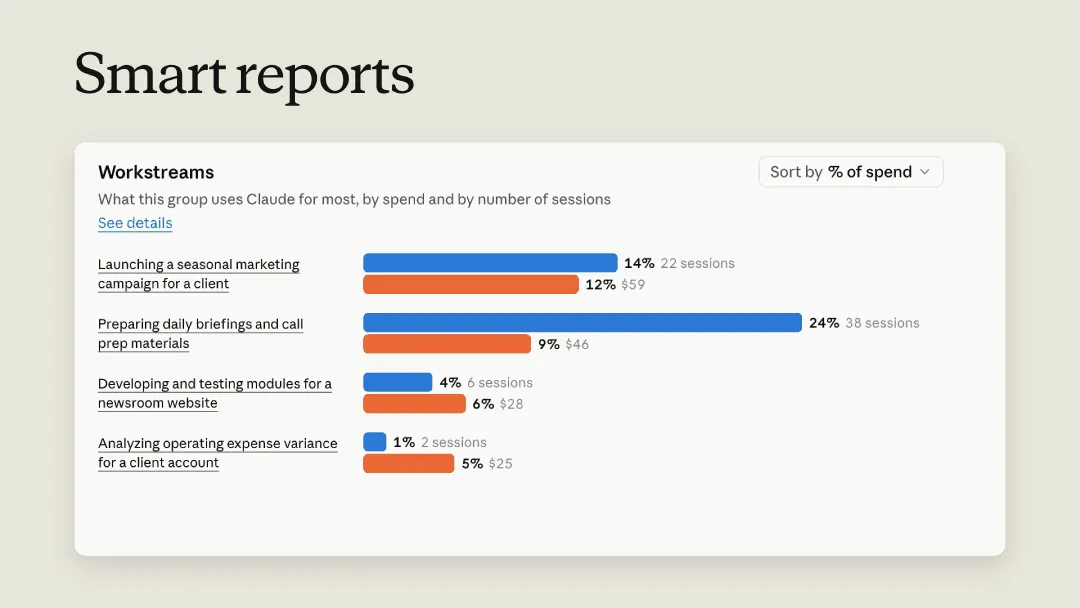
Anthropic concentrated on retaining enterprise clients and on Wednesday launched a fresh set of reporting instruments aimed at giving those buyers detailed insights into the value generated from their token expenditures.
Managers can review team output over specific dates, the items created, total costs, and process bottlenecks by combining internal analytics with employee surveys. Anthropic stated that default settings exclude this information from model training. Suggestions for better outcomes will also be included in the reports.
This move directly addresses return on investment concerns frequently raised by large clients while showing them optimization methods. Anthropic is additionally setting up shared group budgets to help departments control token expenses.
Companies sought such details while determining effective AI deployment strategies. Venture-backed startups drive token usage, whereas most Fortune 500 corporations report limited major returns from AI integration.
Software development tool maker Jellyfish published a report yesterday using data from 276,000 customers employing agentic coding software. Anthropic models and Claude Code remain top choices in the survey, accounting for nearly one third of proposed code modifications submitted for review. Furthermore, spending on these products increased tenfold since January, now representing roughly 2% of overall engineering expenses.
Nicholas Arcolano, chief scientist at Jellyfish, told TechCrunch, "Even if you're saying 2% is still small, that 10x growth is growth that most CFOs didn't plan for. We're certainly getting to the point where people are realizing, okay, it's not enough to just spend a bunch. You now have to optimize it, make it work."
The latest reports from Anthropic address this exact hurdle. Anthropic maintains an advantage among corporate buyers, though pinning down what makes agentic coding products genuinely sticky remains tough. OpenAI launched the Astra model this summer, presenting a potential challenge to Anthropic, yet adoption metrics remain unaffected so far.
Nikolas Albarran, AI product lead at Jellyfish, told TechCrunch, "It took a long time for us to see Codex really pop in our data at all, and it has come up with Astra [OpenAI's latest model]." Regarding online discussions, he added that competitive pressures seem intense on social media platforms, noting that Valley circles praise Codex. Albarran explained that Anthropic succeeded through strong enterprise strategies, reliable performance, and established workflows that discouraged switching.
Corporate switching barriers extend past models and routines. Once an enterprise adopts a frontier lab system, migration proves more difficult than for single developers or small teams. Albarran mentioned that major AI labs fund forward-deployed engineering operations, placing consultants inside client businesses for onboarding support. The new reporting features function as a streamlined, lighter option compared to direct consultant assistance for Anthropic clients.
Albarran stated, "We're at a point now where it's mature enough, where once you're in, it's going to be harder and harder to switch because you've spent the effort. Even if they're all mostly the same, they're all going to be slightly different, have their own slight quirks of how they handle agents to ND files, etc., and so that cost to switch is not zero."