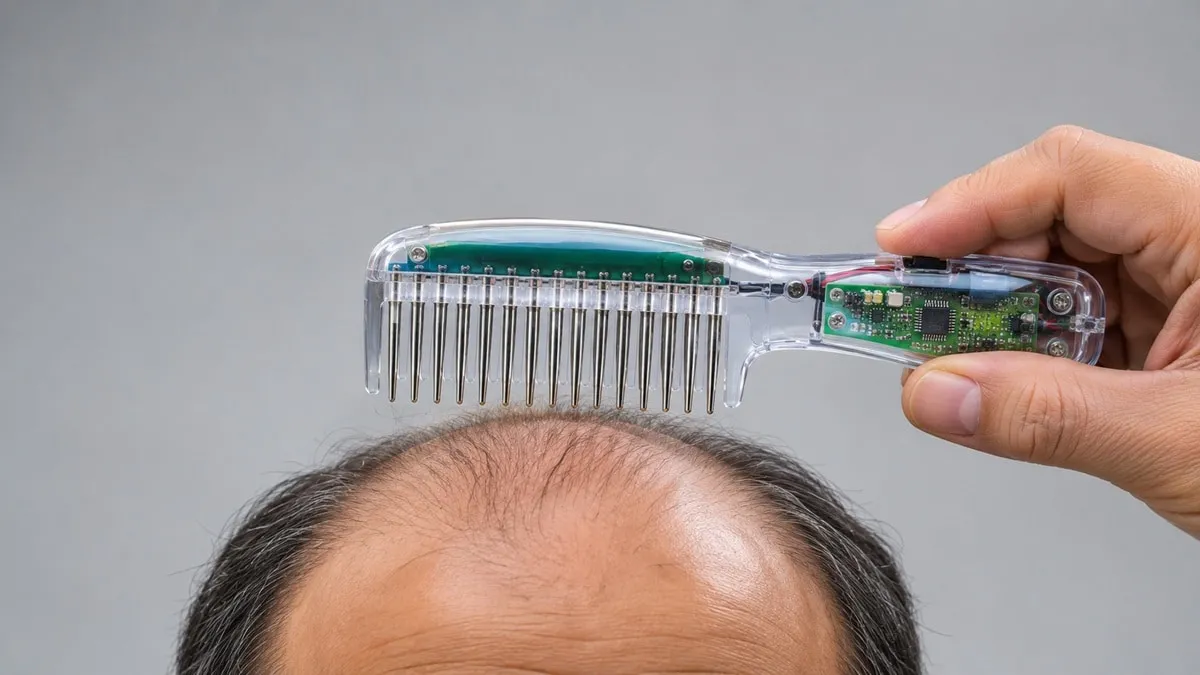
Chinese Scientists Develop Electric Comb For Hair Regrowth
Chinese scientists have developed an experimental electric comb that achieved nearly 98% hair regrowth in mice within 28 days, offering a potential new treatment for pattern baldness.
The device, named Detangle after Disney's animated film Tangled, is designed to treat androgenetic alopecia, a common form of hair loss affecting more than 1.5 billion people worldwide.
How the Detangle Electric Comb Works
According to a study published in Nature Communications, the comb uses specially designed teeth to deliver mild electrical pulses alongside two experimental gene-based treatments.
One treatment promotes the growth of blood vessels around hair follicles, while the other reduces the production of dihydrotestosterone, a hormone that causes hair follicles to shrink. The electrical stimulation also helps the treatments penetrate deeper into the skin.
To test its effectiveness, researchers divided mice with induced hair loss into several groups and compared the results with conventional treatments.
Comparing Hair Loss Treatments and Results
Untreated mice showed just 1% hair regrowth, while electrical stimulation alone resulted in 40% regrowth. Finasteride and minoxidil, two commonly used hair loss medications, achieved approximately 50% and 70% hair restoration, respectively.
In comparison, mice receiving the complete Detangle treatment achieved 97.85% hair regrowth across the treated area after 28 days.
These findings suggest that combining electrical stimulation with targeted gene therapies creates a synergistic effect that significantly outperforms standard pharmaceutical approaches tested in the laboratory environment.
Understanding Androgenetic Alopecia
Androgenetic alopecia is the medical term for male and female pattern baldness, which remains the leading cause of hair loss globally. The condition is largely driven by genetic factors and the hormone dihydrotestosterone, commonly known as DHT. Over time, DHT binds to receptors in hair follicles, causing them to miniaturize and eventually stop producing visible hair strands.
Current medical interventions typically rely on oral medications like finasteride or topical solutions like minoxidil. While these treatments slow hair loss and promote partial regrowth for many users, they require continuous application and often produce variable results depending on the individual patient.
The Mechanics of Electrical Stimulation in Dermatology
Electrical stimulation has increasingly attracted interest in regenerative medicine and dermatology for its ability to enhance tissue healing and cellular repair. Low-intensity electrical pulses can temporarily alter the permeability of cell membranes, a process known as electroporation. This mechanism allows therapeutic compounds and genetic materials to cross the skin barrier more effectively than passive topical application.
In the case of the Detangle device, the specialized teeth act as electrodes to deliver these precise electrical signals directly to the scalp tissue. By simultaneously promoting angiogenesis, which is the formation of new blood vessels, the treatment ensures that reviving hair follicles receive an adequate supply of oxygen and essential nutrients.
Current Experimental Stage and Future Human Trials
Despite the promising findings, the device remains in the experimental stage and has not been tested on humans. Laboratory animal models provide critical initial data, but biological differences between mice and humans mean that researchers must exercise caution before advancing to clinical applications.
Researchers will need to confirm its safety, effectiveness, and long-term benefits in human trials before it can be made commercially available. These upcoming phases will determine whether the impressive regrowth rates observed in mice can be safely replicated in human patients suffering from androgenetic alopecia.