Gold Rate in Pakistan Today 11 November 2026
The gold rate in Pakistan today on 11 November 2026 has experienced a slight downward correction compared to yesterday, with the 24K gold per tola price now standing at Rs 430,836. Meanwhile, silver has moved in the opposite direction, registering a modest gain. Alongside precious metals, petrol and diesel prices have also come down today, offering tangible relief to everyday consumers, motorists, and commercial transport operators across the nation. Understanding these financial metrics requires examining how local markets interact with international commodity exchanges, currency valuations, and domestic economic policies.
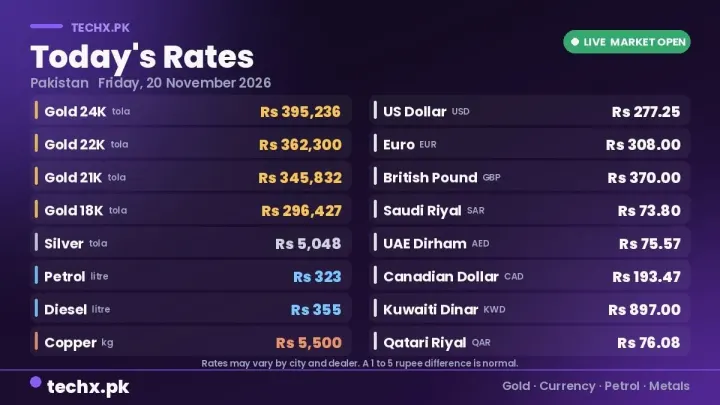
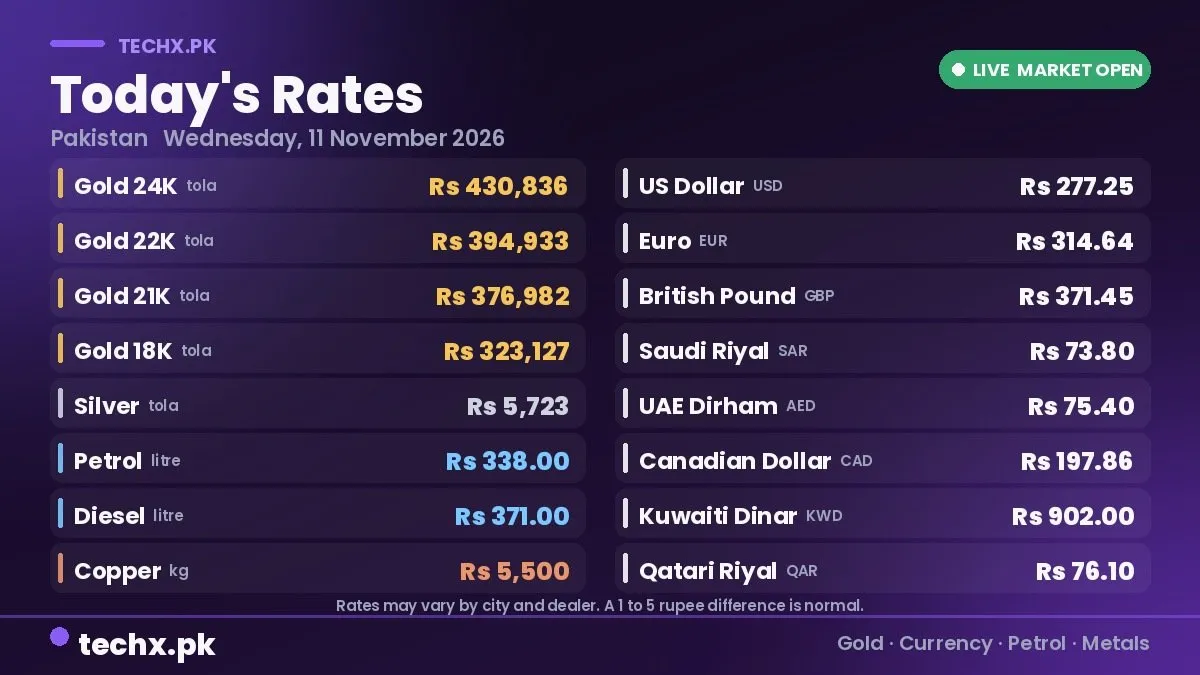
Today, the 24K gold price per tola in Pakistan is Rs 430,836, marking a decrease of Rs 1,500 compared to the previous trading session. The silver rate today per tola is Rs 5,723, showing an increase of Rs 60. All karat varieties of gold have declined in tandem. For 22K gold, the price per tola is Rs 394,933 after a drop of Rs 1,375. The 21K gold per tola stands at Rs 376,982 following a decrease of Rs 1,312, while 18K gold per tola is priced at Rs 323,127 after falling by Rs 1,125. In smaller weight measurements, 24K gold per 10 grams is recorded at Rs 369,372, down by Rs 1,286.
Purchasers looking to acquire gold jewellery or invest in bullion coins may find today's lower rates a favourable entry point compared to yesterday's peaks. Conversely, silver holders benefit from the small upward tick of Rs 60 per tola. Domestic bullion prices in Pakistan are closely tied to international spot gold rates, which are converted into local currency using prevailing exchange rates against the US Dollar.
Dollar and Currency Rates in Pakistan Today
Foreign exchange stability remains a cornerstone of the domestic economy, influencing import costs, manufacturing inputs, and consumer purchasing power. Today, the US Dollar is trading at Rs 277.25 in Pakistan's open market, remaining entirely unchanged from yesterday. This stability provides reassurance to importers and businesses engaged in cross-border trade, as predictable currency values help prevent sudden inflationary spikes in imported goods and raw materials.
While the US Dollar remained flat, other major global currencies showed varied movement. The Euro gained Rs 5 to reach Rs 314.64, and the Kuwaiti Dinar rose by Rs 4 to settle at Rs 902.00. Other notable currency figures for the day include the British Pound at Rs 371.45, the Saudi Riyal at Rs 73.80, and the UAE Dirham at Rs 75.40, the latter holding steady with no change. Additionally, the Canadian Dollar is valued at Rs 197.86, the Australian Dollar increased by Rs 2 to Rs 193.00, the Qatari Riyal stands at Rs 76.10, and the Omani Rial slipped by Rs 1 to Rs 720.00. Remittance senders using Gulf corridors will note that the UAE Dirham remains stable, while minor fluctuations in the Euro and Kuwaiti Dinar reflect broader international forex trends.
Petrol and Diesel Prices Today
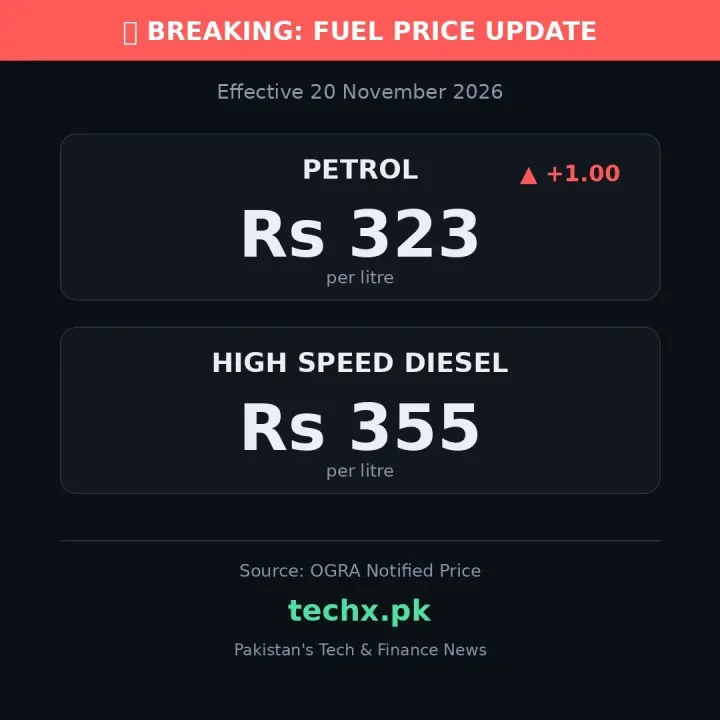
Energy costs directly influence nearly every sector of the domestic economy, from household utility management to large-scale supply chain logistics. The petrol price in Pakistan today is Rs 338.00 per litre, registering a notable drop of Rs 8 compared to yesterday. Simultaneously, High Speed Diesel has fallen by Rs 7, bringing its price to Rs 371.00 per litre. This reduction delivers welcome relief to everyday drivers, public transport operators, and commercial enterprises dependent on fuel-powered machinery and transport fleets.
A decrease of Rs 8 in petrol and Rs 7 in diesel creates a measurable positive impact for ordinary citizens. Lower diesel costs are especially critical because they directly influence the freight and shipping charges associated with moving consumer goods across provinces. When transport expenses decline, the cascading effect can help stabilize or reduce everyday commodity prices in local bazaars and retail markets. Private vehicle owners will likewise experience direct savings at fuel stations during their next fill-up.
Copper Rate Today
Industrial metals play an essential role in construction, electrical engineering, and local manufacturing sectors. Today, the copper rate in Pakistan is Rs 5,500 per kilogram. While no change data is available relative to yesterday's figures, this benchmark remains a vital metric for builders, contractors, electricians, and industrial producers who rely on copper wiring, piping, and structural components for their ongoing commercial and residential projects.
Why Did Rates Change Today?
Market analysts examine multiple interconnected variables to explain daily price shifts across bullion, energy, and currency sectors. Gold prices fell today primarily due to a downward movement in international bullion benchmarks. Because local gold rates derive their baseline from global spot prices converted via the USD-PKR exchange rate, the flat performance of the US Dollar at Rs 277.25 means the entire reduction originated from international markets. Silver experienced a minor gain, a phenomenon that occasionally occurs when market participants reallocate capital into lower-cost alternatives as gold prices fluctuate.
Fuel prices adjusted downward in response to softening global crude oil benchmarks, refinery cost calculations, and government tax adjustments. International oil markets experienced mild easing in recent days, directly translating into the Rs 7 and Rs 8 reductions witnessed at domestic pumps. Currency variations, such as the gains seen in the Euro and Kuwaiti Dinar, stem from specific cross-border demand patterns and international forex market realignments rather than systemic domestic shocks. These daily economic indicators provide crucial data for individuals and enterprises making financial decisions across Pakistan.