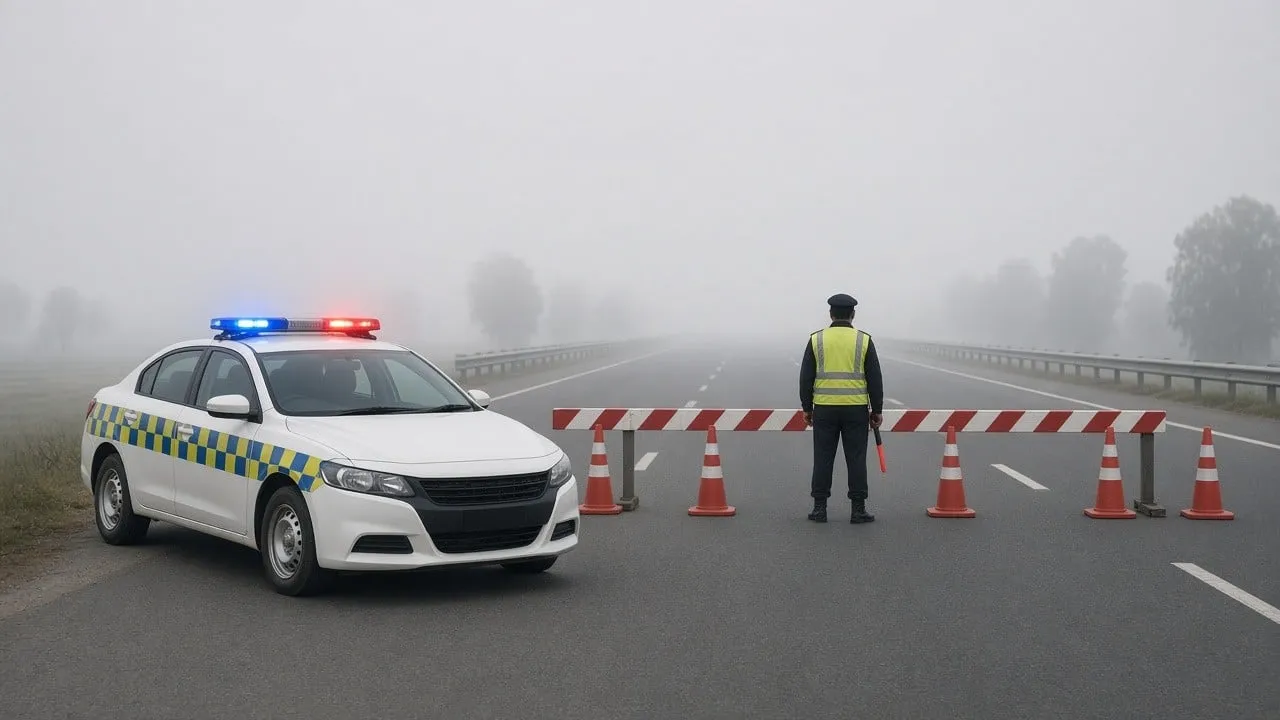
The National Highways and Motorway Police (NHMP) has told travelers to limit journeys to the 10 am to 6 pm window for safer passage during the current foggy season, after dense fog forced the closure of the M4 Motorway from Shamkot to Abdul Hakeem for all traffic.
According to Syed Imran Ahmed, spokesperson for the NHMP Central Region, the M4 stretch from Sher Shah (Multan) to Khanewal has also been closed to heavy traffic because of the same weather conditions.
Ahmed explained that the closures aim to protect the lives and property of the public, and he urged people to avoid unnecessary travel in fog and to prefer daylight journeys.
Why Fog Causes Repeated Motorway Shutdowns in Punjab
Punjab's winter months are characterised by temperature inversions that trap moisture close to the ground, creating thick layers of fog that can reduce visibility to less than 30 metres. When visibility drops below the safety threshold set by the NHMP, officials are mandated to restrict traffic on high-speed corridors to prevent collisions.
The province's extensive motorway network, built to connect major agricultural hubs and industrial zones, is especially vulnerable because many routes run across flat, open plains where fog forms quickly and persists for hours. Historically, the NHMP has issued temporary closures on the M3, M4, M5 and other arteries during similar events.
Current Closures and Their Geographic Scope
NHMP's 8 am road-status update on Tuesday listed three specific closures:
- The M4 stretch from Abdul Hakeem to Gojra, closed to heavy traffic.
- The M4 segment from Shamkot to Abdul Hakeem, shut for all traffic.
- The M1 Motorway from the Peshawar main toll plaza to Rashakai, closed earlier in the morning due to dense fog.
In addition, the M4 section from Sher Shah (Multan) to Khanewal remains inaccessible to heavy vehicles, while lighter traffic may be allowed at the discretion of on-site police units.
Motorway Police Safety Advice for Drivers Who Must Travel
For motorists who cannot avoid travel during foggy periods, the Motorway Police issued a concise set of recommendations:
- Keep your speed low and maintain a safe distance from the vehicle ahead.
- Stay in your lane and avoid unnecessary overtaking and sudden braking.
- Use fog lights and make sure your headlights, tail lights, and wipers are working properly.
These measures align with the NHMP's standard operating procedures, which stress reduced speed, clear signalling and minimal lane changes to lower the risk of multi-vehicle pile-ups.
Historical Context: Past Fog-Related Shutdowns
Fog regularly forces motorway closures in Punjab during winter. Last week, the M3 Motorway was closed from Faizpur to Jaranwala because of dense fog, and five major motorways were shut for the same reason in January. These incidents illustrate a pattern that the NHMP monitors through its meteorological liaison unit, which receives real-time data from the Pakistan Meteorological Department.
In 2022, a similar fog episode on the M2 resulted in a three-hour shutdown that delayed freight shipments worth Rs. 1.6 billion. The economic impact of such closures is felt most strongly by logistics companies, agricultural exporters and commuters who rely on the motorways for daily travel.
Impact on Commuters, Trade and Regional Mobility
The immediate effect of the current closures is a disruption to both passenger and freight movement across central Punjab. Trucks carrying wheat, rice and other staples often use the M4 corridor; a halt forces them onto secondary roads that are not designed for high-volume, high-speed traffic, increasing travel time by up to 45 minutes per trip.
For daily commuters, especially those travelling between Multan, Khanewal and the surrounding districts, the advice to travel only between 10 am and 6 pm may mean adjusting work schedules, school timings and personal appointments. Public transport operators have reported a surge in demand for early-morning and late-evening bus services, prompting some private operators to add extra trips.
Businesses that depend on just-in-time delivery warn that prolonged fog could affect inventory levels and contract fulfillment. While the NHMP's decision to limit traffic is aimed at safety, the ripple effect on supply chains is a key concern for regional manufacturers.
What Comes Next: Monitoring, Communication and Future Planning
The NHMP has committed to issuing hourly updates on the status of affected motorways through its official website, mobile app and roadside signage. Drivers are encouraged to check these sources before embarking on a journey.
In the longer term, the Ministry of Communications is reviewing the feasibility of installing fog-detecting sensors and variable-message signs on high-risk sections of the network. Such technology could provide earlier warnings and allow for more targeted lane closures rather than full shutdowns.
Until any new infrastructure is deployed, the NHMP's current strategy relies on real-time weather data, rapid police deployment to enforce speed limits and the public's cooperation with the advised travel window.
Practical Takeaways for Readers
Motorists planning to use the M4 or M1 during the fog season should:
- Check the latest road-status bulletin before departure.
- Schedule trips between 10 am and 6 pm when visibility is typically better.
- Equip vehicles with functional fog lights, clean windshields and well-maintained wipers.
- Allow extra travel time and consider alternative routes if possible.
By following these steps, drivers can reduce the likelihood of accidents and help keep the motorways open for essential traffic.
Fog will likely persist in the region for the next two weeks, according to forecasts from the Pakistan Meteorological Department. The NHMP has warned that further closures may be announced if visibility drops below safe levels.
For the latest information, motorists should follow NHMP's official channels or tune into local radio traffic bulletins.