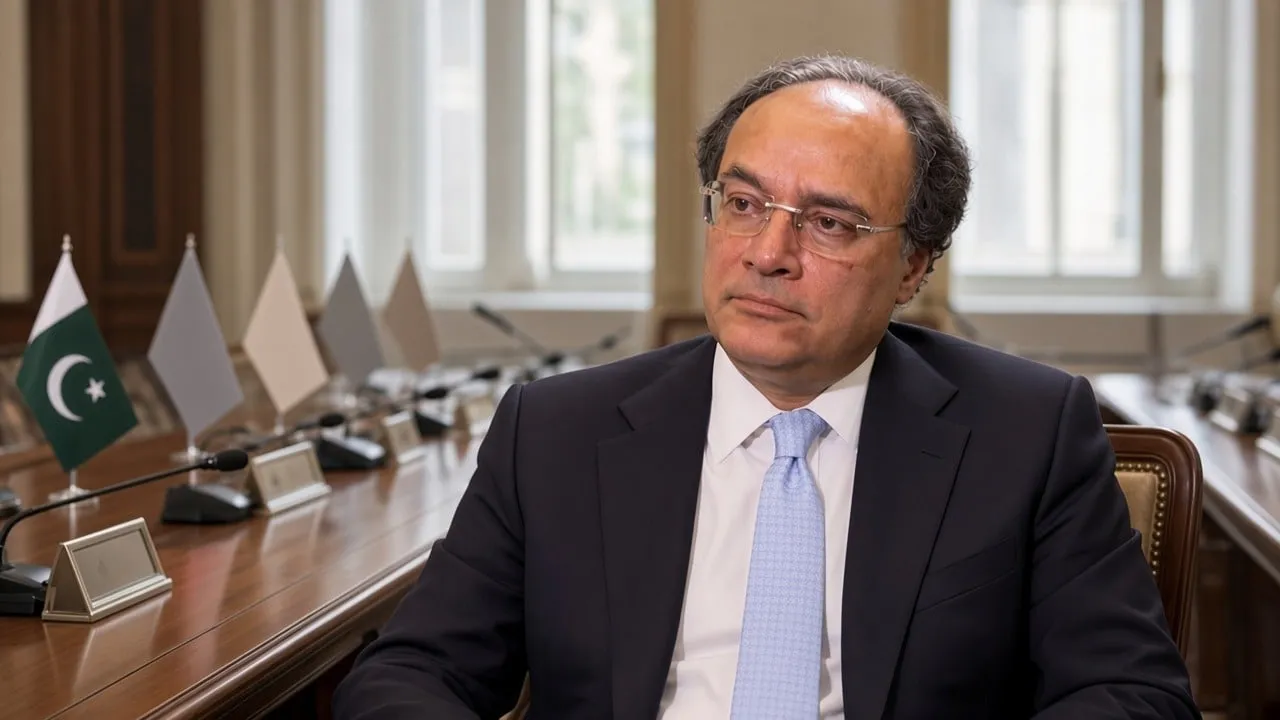
Pakistan officially took charge of the Intergovernmental Group of Twenty-Four on Sunday, with Finance Minister Muhammad Aurangzeb outlining three core goals for the tenure. These include placing development at the heart of global economic policy, increasing the influence of developing nations in international organizations, and overhauling the global financial architecture.
The Finance Division released a statement noting that Pakistan succeeded Nigeria in the leadership role. Aurangzeb described taking the chair as a profound responsibility, urging stronger international cooperation to address climate shocks, funding shortfalls, and rising economic fragmentation worldwide.
"The future of developing economies is not peripheral to the future of the global economy. It is central to it," the finance minister said.
Pakistan's 3 Priorities as G-24 Chair
1. Development at the centre of economic policymaking: Aurangzeb stated that macroeconomic stability must serve as the basis for investment, productivity, employment, and shared prosperity. The goal helps low-income and developing nations transition away from crisis management and toward sustainable expansion.
2. Fairer and more representative global institutions: Pakistan intends to advocate for equitable governance, active participation in decisions, and increased responsiveness from the Bretton Woods institutions, the International Monetary Fund, and the World Bank toward their members.
3. A development-oriented financial system: The agenda covers accessible and timely development funding, sustainable debt solutions, robust global financial safety nets, climate resilience, and the mobilization of public and private capital.
"Our task is to ensure that the immense potential of developing economies is not constrained by an international financial architecture that has yet to fully adapt to a changing world," Aurangzeb said.
What the G-24 Does
The G-24 acts as a coalition of developing nations that coordinates stances on international monetary and development finance matters, particularly within the World Bank and the IMF. Its membership comprises 28 countries spanning Africa, Asia, the Middle East, and Latin America and the Caribbean, featuring nations like Brazil, India, Egypt, Nigeria, South Africa, and Sri Lanka.
Aurangzeb mentioned that Pakistan will guide its tenure using the group traditions of consultation, consensus, and joint advocacy. The nation will collaborate with regional members, the World Bank, the IMF, and other global partners to convert shared goals into concrete outcomes.
What This Means for You
Taking the chair does not immediately deliver funds or policy adjustments for citizens in Pakistan. The importance rests within the agenda itself, as the selected focal points such as affordable development loans, debt relief choices, and climate resources directly mirror Pakistan's own economic challenges.
Pakistan currently operates under a $7 billion IMF program and recently secured a staff-level agreement expected to release roughly $1.2 billion following Executive Board approval. Additionally, the State Bank of Pakistan estimates the nation requires $331 billion in climate financing by the year 2030.
Aurangzeb used this background, explaining that domestic stabilization and reform prove financial stability must align with long-term development targets. He noted that transforming economies require adequate funding and policy flexibility to expand sustainably.
Should the G-24 successfully persuade international lenders to provide affordable financing and flexible debt resolutions, nations like Pakistan might experience reduced borrowing expenses eventually. Such a shift could free up budget space for development projects instead of debt payments, though these shifts rely on choices made by the World Bank, the IMF, and major shareholders over time.
Judged by Results, Not Rhetoric
Aurangzeb thanked Nigeria for its leadership during the previous term and confirmed Pakistan will continue advancing the progress achieved by the group.
He emphasized that joint leadership must be evaluated by practical development results. "The true measure of our collective leadership will not simply be the strength of our voice, but the difference that voice makes," he said.
He concluded that Pakistan remains dedicated to shifting the G-24 mission from a shared voice into shared influence, and from shared influence toward tangible advancement.