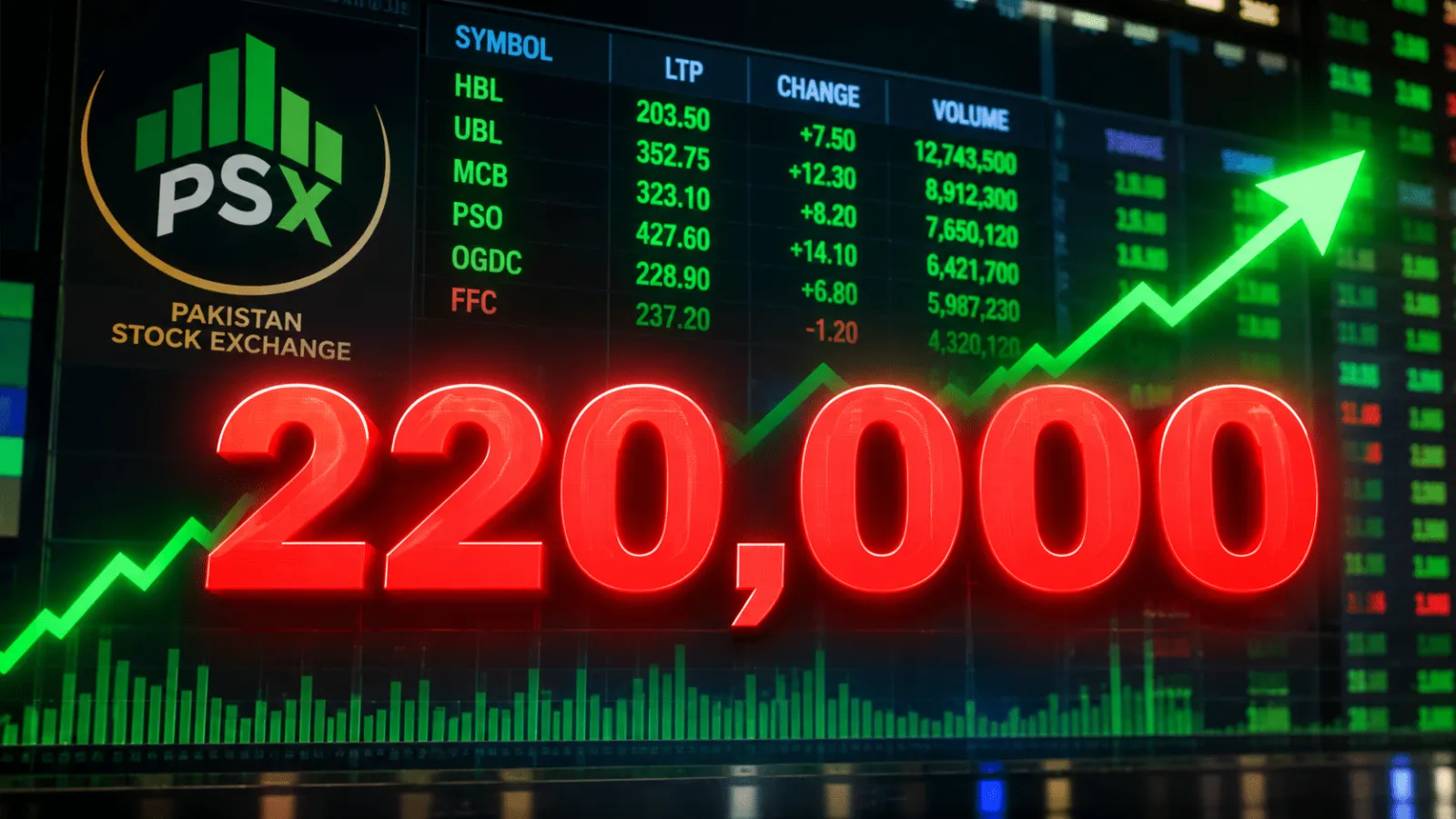
Topline Securities expects the Pakistan Stock Exchange (PSX) benchmark KSE-100 Index to reach 220,000 points by December 2027, delivering a potential total return of 25 percent that includes dividend income.
The projection hinges on an anticipated price-to-earnings (PE) ratio of 7 times for 2027 and an estimated dividend yield of 7 percent. The forecast reflects expectations of improving economic conditions and stronger corporate earnings, according to the research house.
What Is the KSE-100 Index and Why It Matters
The KSE-100 Index is the flagship benchmark of the Pakistan Stock Exchange, tracking the performance of the 100 most liquid stocks listed on the market. It is widely used by investors, fund managers, and policymakers as a barometer of Pakistan's equity market health. Movements in the index influence portfolio allocations, affect foreign investment inflows, and shape public perception of the country's economic trajectory.
How the 220,000 Target Was Calculated
Topline Securities arrived at the 220,000 level by applying a forward-looking PE multiple of 7 to the aggregate earnings forecast for the index constituents in 2027. The firm also incorporated an expected dividend yield of 7 percent, which together generate a total return estimate of 25 percent. This methodology aligns with standard equity valuation practices that combine price appreciation potential with dividend income to assess overall investor returns.
Key Drivers Behind the Forecast
Several macro-economic and sector-specific factors underpin the optimistic outlook:
- Falling interest rates: Lower borrowing costs are likely to boost demand for capital-intensive sectors such as cement and automobiles, enhancing earnings growth.
- Improving corporate earnings: Analysts expect profit margins to expand as inflation eases and input costs stabilize, particularly for export-oriented firms.
- Higher dividend yields: Sectors like banking and fertilizer are projected to offer attractive yields, drawing income-focused investors.
Preferred Sectors for 2027
Topline Securities highlighted five sectors it expects to outperform the broader market:
- Banks - anticipated to benefit from stable net interest margins and higher dividend payouts.
- Cement - poised for growth as infrastructure projects gain momentum and financing becomes cheaper.
- Pharmaceuticals - expected to see demand resilience due to demographic trends and export opportunities.
- Exploration and Production (E&P) - likely to profit from stable oil and gas prices and potential new discoveries.
- Automobiles - set to gain from consumer financing improvements and a youthful population seeking mobility.
Background: Recent Trends on the PSX
Over the past three years, the KSE-100 index has experienced volatility driven by fluctuating foreign exchange rates, political uncertainty, and global commodity price swings. However, the index has also shown resilience, closing 2023 at around 45,000 points, a modest gain from the pandemic low. The market's liquidity has improved, with daily turnover reaching historic levels in early 2024, reflecting growing participation from domestic retail investors and regional institutional funds.
Regulatory reforms introduced by the Securities and Exchange Commission of Pakistan (SECP) in 2022, such as tighter disclosure requirements and the launch of a new electronic trading platform, have enhanced market transparency and investor confidence. These reforms are cited by analysts as a foundation for the more optimistic earnings outlook projected for 2027.
How the Forecast Impacts Different Stakeholders
Retail investors: A 25 percent total return suggests that long-term holders could see meaningful portfolio growth, especially if they allocate to high-yielding sectors identified by Topline.
Institutional investors: Pension funds, mutual funds, and sovereign wealth entities may recalibrate asset-allocation models to increase exposure to Pakistani equities, viewing the forecast as a signal of reduced risk and higher upside.
Corporate issuers: Companies in the favored sectors may find it easier to raise capital at lower cost, as investor appetite for equity financing strengthens under a bullish market outlook.
Potential Risks and Uncertainties
While the projection is optimistic, several risk factors could derail the target:
- Persistent inflation could erode real earnings and pressure corporate margins.
- Geopolitical tensions in the region might trigger capital outflows and increase the cost of external financing.
- Policy missteps, such as unexpected tax hikes or delays in structural reforms, could dampen investor sentiment.
Analysts recommend monitoring inflation trends, foreign exchange stability, and the implementation timeline of economic reforms to gauge whether the 220,000 target remains realistic.
What to Watch for as 2027 Approaches
Investors should keep an eye on the following indicators:
- Quarterly earnings releases of the top-weight constituents in the KSE-100, especially banks, cement, and pharmaceuticals.
- SECP's regulatory updates, particularly any changes to dividend distribution rules or listing requirements.
- Macro-economic data such as GDP growth, interest-rate decisions by the State Bank of Pakistan, and inflation reports.
- External factors like global oil prices, which directly affect E&P company profitability.
By tracking these data points, market participants can assess whether the underlying assumptions of the 7-times PE and 7% dividend yield remain valid.
Practical Takeaways for Investors
For those looking to align their portfolios with the forecast, consider the following steps:
- Diversify across the five preferred sectors to capture both growth and income potential.
- Prioritize stocks with a history of consistent dividend payouts, as they contribute directly to the projected total return.
- Stay informed about interest-rate movements, as they influence financing costs for cyclical sectors.
- Use a disciplined rebalancing schedule to adjust exposure as earnings data and macro-economic conditions evolve.
By following a data-driven approach, investors can position themselves to benefit from the anticipated market rally while managing downside risk.