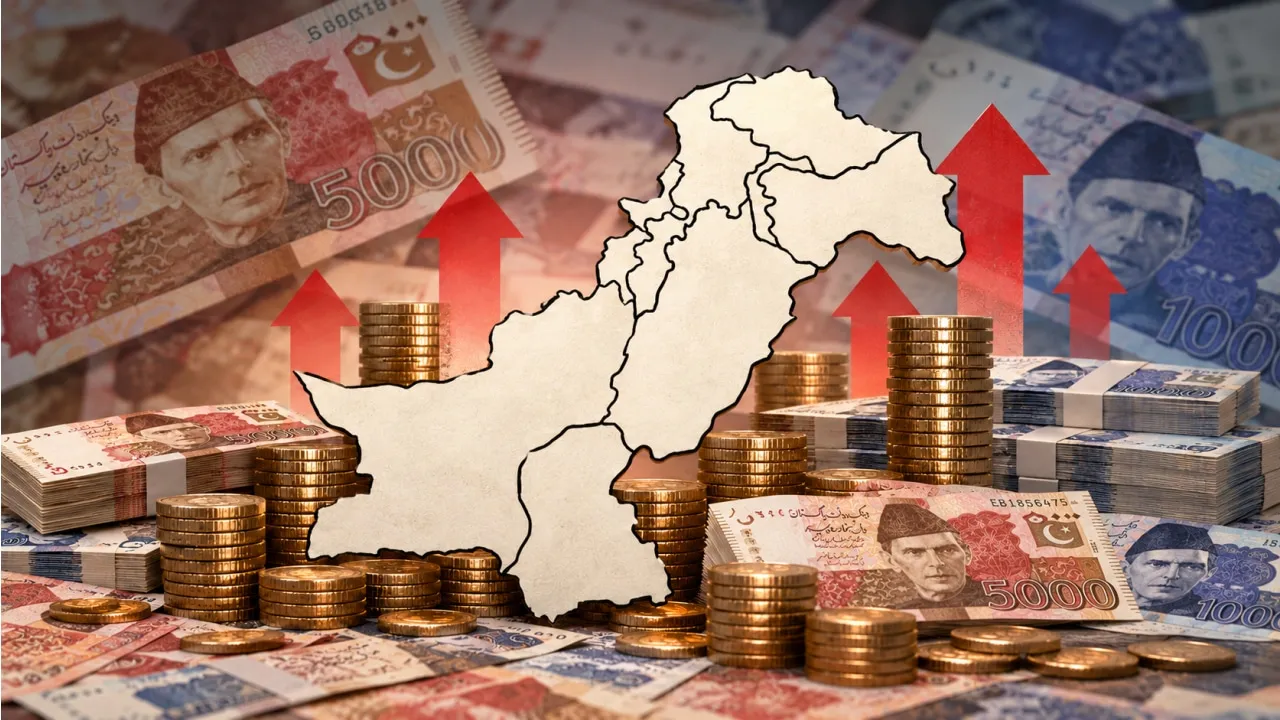
A private research group has cautioned that establishing new provinces in Pakistan could place a heavy, ongoing strain on government finances, with yearly expenses potentially reaching Rs. 730.3 billion if every current administrative division were upgraded to provincial status.
The institute suggested that strengthening existing local governments should be the priority if the aim is better public-service delivery.
In its most recent market study, the Policy Research Institute of Market Economy (PRIME) looked at the budgetary effects of two different provincial-restructuring options.
The study projects that adding two provinces in Punjab would require between Rs. 46.9 billion and Rs. 56.2 billion each year, while converting all 30 divisions into provinces could lift the net recurring cost to a range of Rs. 609.2 billion to Rs. 730.3 billion.
The analysis examines how the current provincial share of the divisible pool would be re-allocated among the new units under the 7th National Finance Commission (NFC) Award and the extra recurring spending each new provincial government would need. It does not claim that more provinces would automatically improve governance or service delivery.
PRIME Examines Two Provincial Restructuring Scenarios
The report outlines two possible ways to redraw Pakistan's provincial map.
Scenario one would split Punjab into Bahawalpur, South Punjab and the remaining Punjab, raising the national total from four to six provinces.
Scenario two would treat every existing administrative division in Punjab, Sindh, Khyber Pakhtunkhwa and Balochistan as a separate province, creating 30 provinces overall, including 26 new ones.
PRIME clarified that the 30-province model is offered only as a fiscal stress test, not as a recommended territorial layout.
District-level population and area figures from the Pakistan Bureau of Statistics' 2023 census were used to build the proposed units.
The study estimates that the basic recurring cost of running a new provincial government would lie between Rs. 22.4 billion in a low-cost scenario and Rs. 25.9 billion in a high-cost scenario. That translates to annual outlays of Rs. 46.9 billion-Rs. 56.2 billion for two new provinces and Rs. 609.2 billion-Rs. 730.3 billion for a 30-province structure.
How the NFC Allocations Stack Up
In the six-province case, South Punjab would obtain an illustrative Rs. 1 trillion under the current NFC Award, while Bahawalpur would receive Rs. 537 billion.
Under the 30-province scenario, allocations would differ widely, ranging from Rs. 720 billion for Lahore and Rs. 691 billion for Karachi down to Rs. 46 billion for Loralai and Rs. 50 billion for Zhob. The analysis notes that eleven of the thirty proposed units would get less than Rs. 150 billion each year.
Smaller Units Face Higher Fiscal Burdens
Applying a 10 percent fiscal-sustainability benchmark based on the low-cost estimate, sixteen of the thirty proposed provinces would stay at or below the threshold, while fourteen would exceed it.
The smallest units would feel the greatest pressure. Even with the low-cost figure, the core provincial structure would consume about 49 percent of Loralai's NFC share, 45 percent of Zhob's and 37 percent of Rakhshan's.
Any proposed province with fewer than 1.2 million residents would need more than one-third of its NFC allocation to cover the core government costs.
The findings show that the fiscal impact of restructuring hinges on how many and how large the new provinces are. Limited changes involving relatively big units would generate a modest recurring load, whereas many small, division-based provinces would face disproportionately high administrative expenses compared with their expected NFC resources.
The analysis also warns that new provinces could increase fiscal pressure on smaller provinces, especially those with lower NFC allocations and limited revenue-raising ability, leaving less room for public services and development spending.
PRIME stressed that any provincial reshuffle should be judged not only on political or administrative grounds but also within a clear fiscal framework.