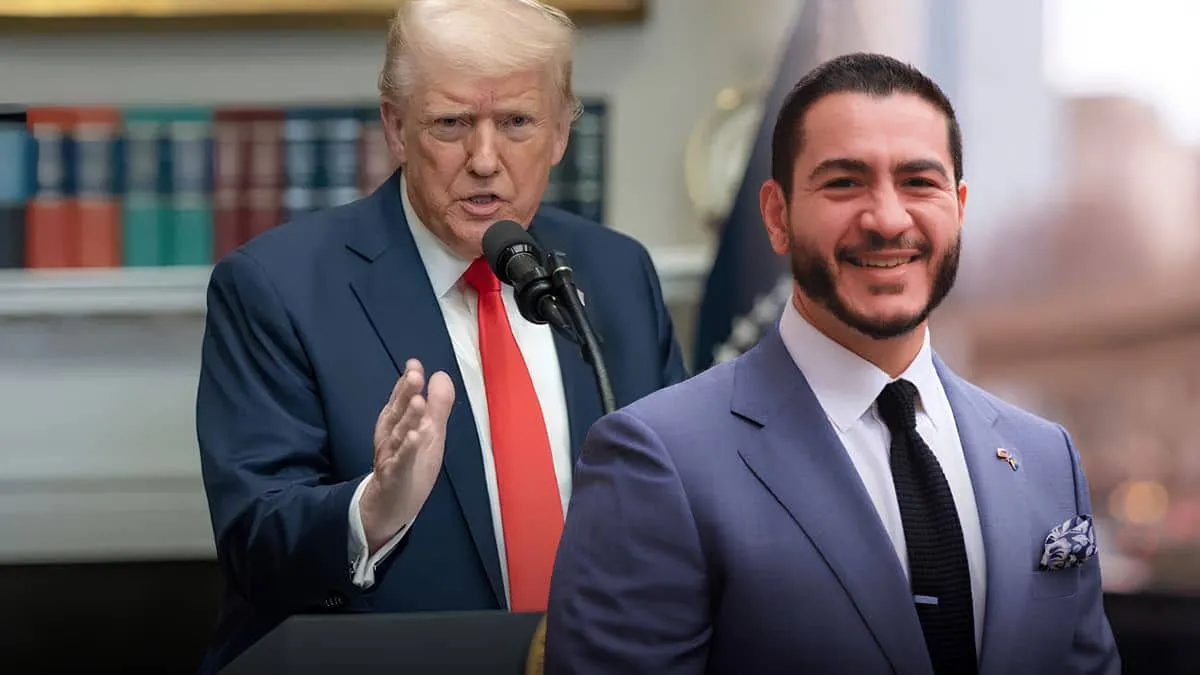
Abdul El-Sayed has become one of the most closely watched political figures in the United States ahead of the November 3, 2026, midterm elections, with President Donald Trump repeatedly targeting the Michigan Democrat during the closing weeks of the campaign.
El-Sayed is a physician, epidemiologist, former public health official and Democratic nominee for the open U.S. Senate seat in Michigan. He is running against Republican former congressman Mike Rogers, a Trump ally, for the seat being vacated by Democratic Senator Gary Peters.
Who Is Abdul El-Sayed and What Is His Background?
Abdul El-Sayed was born and raised in southeastern Michigan to Egyptian immigrant parents. He trained as a physician and epidemiologist, building much of his professional career around public health initiatives.
El-Sayed graduated from the University of Michigan and later studied at the University of Oxford as a Rhodes Scholar, earning a doctorate in public health. He also received his medical degree from Columbia University and worked as an assistant professor of epidemiology at Columbia.
He later returned to Michigan and became executive director and health officer of the Detroit Health Department. Appointed to help rebuild the city's health department following Detroit's municipal bankruptcy, he became one of the youngest health officials running a major American city's health department.
El-Sayed subsequently led Wayne County's Department of Health, Human and Veterans Services. His public health work included programs involving medical debt, air-quality monitoring and healthcare access.
Previous Political Campaigns and the 2026 Primary
This is not El-Sayed's first major political campaign. He first attracted significant national political attention when he ran for governor of Michigan in 2018 as a progressive, receiving support from figures including Bernie Sanders and Alexandria Ocasio-Cortez, before losing the Democratic primary to Gretchen Whitmer.
In 2026, El-Sayed returned to electoral politics by running for the U.S. Senate. He narrowly defeated U.S. Representative Haley Stevens in the Democratic primary on August 4, receiving approximately 48.5% of the vote compared with Stevens' 47.5%.
His victory placed him in a nationally important general-election contest against Republican Mike Rogers. Republicans entered the 2026 election cycle controlling the Senate, meaning Democrats need to hold Michigan while also gaining Republican-held seats if they want to regain control of the chamber.
Policy Differences and Political Ideology
There are genuine and substantial policy differences between Trump and El-Sayed. El-Sayed comes from the progressive wing of the Democratic Party and has campaigned for policies including Medicare for All, stronger restrictions on corporate influence in politics, and expanded government involvement in healthcare.
El-Sayed has also taken positions on U.S. foreign policy that put him sharply at odds with many Republicans, particularly regarding Israel. He has called for ending U.S. military assistance to Israel, making the issue one of the major dividing lines during his Senate campaign.
These policy disagreements provide one conventional political explanation for Trump's opposition. However, Trump's rhetoric has increasingly focused not simply on El-Sayed's policies, but on his Muslim identity and alleged extremist connections.
Allegations About Religious Affiliations and Fact-Checking
Trump's criticism has gone far beyond normal disagreements over healthcare, taxes or foreign policy. He has repeatedly focused on El-Sayed's Muslim faith, accused him of links to the Muslim Brotherhood, and described him as a jihadist.
The confrontation escalated significantly during Trump's October 25 campaign rally in Port Huron, Michigan. Trump told supporters that he had come to Michigan to prevent what he called a jihadist Muslim Brotherhood member from becoming a U.S. senator, and invoked the September 11, 2001, attacks while discussing El-Sayed.
Independent reporting and fact-checking have found no evidence that El-Sayed has been a member of the Muslim Brotherhood or advocated violent jihad. PolitiFact investigated Trump's allegation and found no evidence that El-Sayed had been a Muslim Brotherhood member or advocated violence, rating Trump's claim false at its strongest rating.
The Associated Press similarly reported that there is no evidence showing El-Sayed has an affiliation with the Muslim Brotherhood. El-Sayed has repeatedly denied belonging to the organization and has publicly disavowed it.
Family Background and 2012 Statements in Egypt
Republicans have pointed to old social-media posts written by El-Sayed's half-sister, Eman Abdelhadi. In 2012, she wrote that her family had longstanding connections to the Muslim Brotherhood and referred to their mother's involvement with the movement during the early 1970s.
El-Sayed has rejected efforts to connect those statements to him, noting that his parents separated when he was a young child and he was raised primarily by his father and stepmother rather than his biological mother. When questioned about the issue, El-Sayed stated that he never had conversations with his mother about the Muslim Brotherhood.
Another source of controversy involves a statement El-Sayed signed during the political upheaval in Egypt in 2012. Mohamed Morsi, who was affiliated with the Muslim Brotherhood, had become Egypt's first democratically elected president following the overthrow of Hosni Mubarak.
El-Sayed joined dozens of Egyptian Americans in signing a statement supporting some of Morsi's actions during the constitutional crisis, including his temporary assumption of expanded powers and controversial language calling for the purging of the media and police. Trump and other Republicans cited the statement as evidence of support for the Muslim Brotherhood, but experts interviewed by PolitiFact noted that support for Morsi during that specific conflict did not establish membership in the organization.
Associations and Other Campaign Controversies
El-Sayed's association with political streamer Hasan Piker has also become part of Republican attacks. Piker appeared with El-Sayed multiple times during the Democratic primary campaign, including around his primary victory, but has generated controversy for comments concerning the September 11 attacks, Israel, Hamas and Jewish people.
Not every controversy surrounding El-Sayed comes from unsupported allegations. He faced criticism earlier in 2026 following an attack on a synagogue in the Detroit area when he used the phrase hurt people hurt people while discussing the attacker's circumstances.
Critics argued that the comment appeared to rationalize the synagogue attack. El-Sayed later apologized, saying that he had not intended to justify what happened and was sorry to anyone hurt by his comments.
Wider Reactions and Voter Impact
Trump has also repeatedly suggested that El-Sayed wants Islamic Sharia law imposed in the United States and has repeatedly altered El-Sayed's name during campaign appearances, using variations involving Mohammed. PolitiFact found that Trump's claims about Sharia law distorted El-Sayed's previous statements.
El-Sayed argues that Trump's attacks on his faith are designed to divert attention from issues such as healthcare, fuel prices, groceries and the broader cost of living. Bernie Sanders has made a similar argument, accusing Republicans of focusing on religion rather than economic issues.
Trump's comments have drawn criticism from some Arab-American figures who previously supported him. The Associated Press reported that Bishara Bahbah, founder of Arab Americans for Trump, condemned Trump's rhetoric after the Port Huron rally, creating tensions within a constituency where Trump had recently made political gains.
El-Sayed and Rogers face voters in Michigan on November 3, 2026. As the contest enters its final hours, El-Sayed would make history as the first Muslim elected to the U.S. Senate if he wins, while his candidacy has turned Michigan into a national debate over progressive politics, religious rhetoric and electoral boundaries.