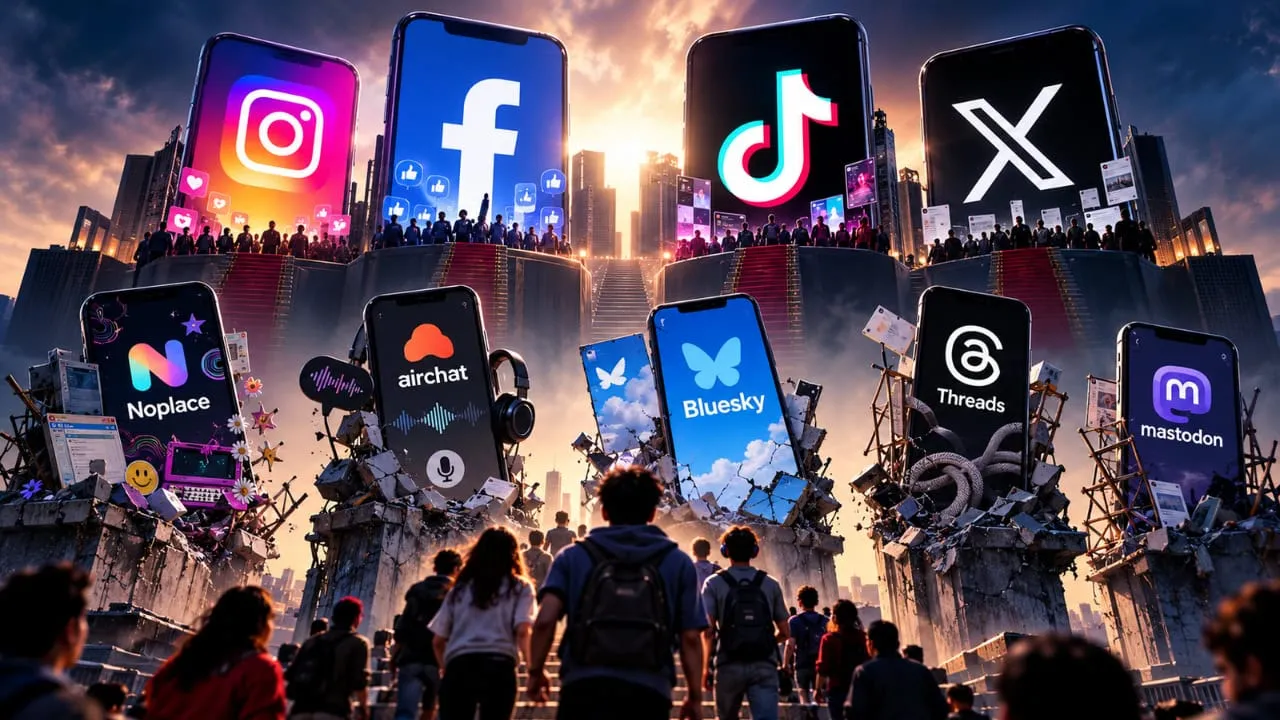
Every year brings fresh social media platform launches, yet very few manage to endure against entrenched titans. Daily life revolves around Facebook, Instagram, TikTok, and X, which people view as the standard version of social networking. Consequently, services such as Noplace, Airchat, Bluesky, and Threads find it difficult to secure permanent footing.
Last year saw the introduction of Noplace, a vibrant and customizable network tailored for Gen Z that embraced a retro early-2000s MySpace aesthetic. Although it briefly reached the top of the App Store rankings, technology experts doubt its future endurance.
Taking a different path, Airchat introduced audio posts instead of text messages, requiring users to record voice updates rather than type them. Despite this unique feature, the application has failed to reach a broad audience.
Bluesky provides a clear warning example. The network attracted new members following the November 2024 departure from X, but its growth has since slowed down. To be specific, Bluesky recorded 10.4 million monthly active mobile users in June 2026, marking a 27.2% decline compared to the previous year. Moreover, daily mobile active users fell by 25.6% year-over-year in July, reaching roughly 3 million.
By comparison, X and Threads completely overshadow these figures, as both services maintain hundreds of millions of active participants individually. Meanwhile, Mastodon stays even smaller than Bluesky and seldom features in comparisons.
Multiple elements account for the difficulties faced by emerging applications. Market saturation leaves fresh competitors zero space to breathe against major players, while network effects form a cycle where people refuse to migrate unless their friends do.
User retention presents another significant obstacle. Fresh platforms lack years of consumer data needed to power effective engagement algorithms, causing people to view them as boring and drift back to the giants within days.
Monetization likewise destroys numerous hopeful networks. Maintaining servers, security, and software updates demands substantial funds, and most startups exhaust their financial backing before establishing a steady audience. Since people demand free service, advertising turns into the primary income source, but brands hesitate to invest in spaces lacking reliable viewership.
At the same time, Instagram and TikTok attract brands and content creators by offering financial bonuses and precise audience metrics, advantages that fresh platforms cannot replicate.