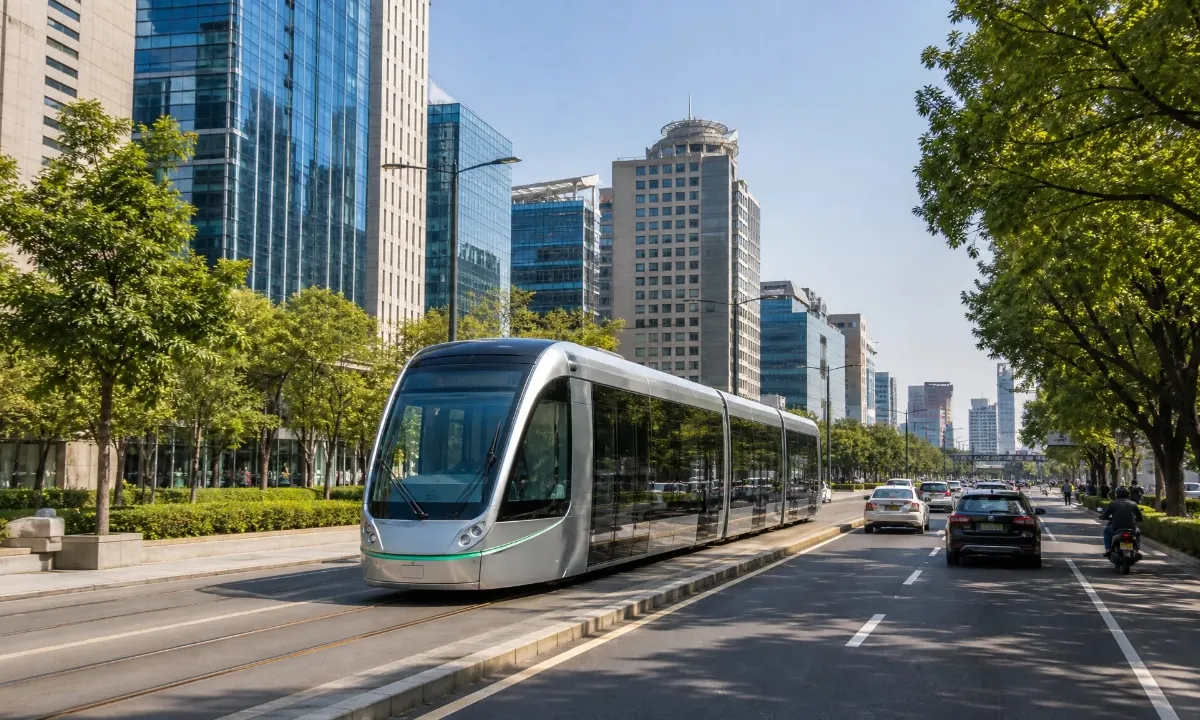
Punjab Chief Minister Maryam Nawaz announced on her official X account that Lahore's trackless electric tram will hit the streets next week. The launch is part of the provincial government's effort to expand cleaner, modern public transport.
The announcement came after a series of delays linked to technical challenges, funding limits and environmental concerns. The tram, imported from China and assembled locally, is expected to begin trial rides free of charge.
What Is the Lahore Trackless Electric Tram?
The vehicle is officially described as an Autonomous Rapid Transit (ART) system, also referred to as SART. Unlike traditional trams, it runs on rubber tires rather than steel rails. Sensors and cameras guide the vehicle along ordinary roads, allowing it to operate without a fixed track infrastructure.
Each unit consists of three connected compartments and can carry roughly 250 to 300 passengers. The battery-powered system offers a range of about 25 to 27 kilometres after a fast charge of around 10 minutes, according to project reports.
Why Was the Original Canal Road Route Dropped?
The initial plan called for a roughly 27-kilometre route along Canal Road, extending from Thokar Niaz Baig to Harbanspura. Environmental groups raised concerns that the tram would require the removal of mature trees along the corridor. In response, the government removed Canal Road from the alignment.
Technical issues, such as integrating the sensor-based guidance system with existing traffic patterns, and funding constraints also contributed to the decision to revise the route. No alternative alignment was disclosed in the chief minister's statement.
How Was the Tram Built and Tested?
The tram was manufactured in China and shipped to Pakistan in kit form. Local engineers assembled the units at a dedicated facility in Lahore, following a technology-transfer agreement that included training for Pakistani technicians.
Preparation work has included road testing on selected streets and the fitting of specialist tires designed for the vehicle's weight and speed profile. The testing phase also involved calibrating the on-board sensors and cameras to ensure reliable navigation in mixed traffic conditions.
What Are the Expected Costs for Riders?
During the initial trial period, passengers will be able to ride the tram for free. Early fare estimates published by the provincial transport department ranged from Rs. 20 to Rs. 30 per ride once regular service begins.
The government has not yet released a detailed fare structure or subsidy plan, but officials indicated that the low-cost model is intended to encourage public adoption and reduce reliance on private vehicles.
How Does This Project Fit Into Punjab's Transport Strategy?
Punjab's transport policy has emphasized a shift toward electric and low-emission modes. The trackless tram aligns with the province's broader Clean Air Initiative, which targets a reduction in urban air pollutants by expanding electric buses, bike lanes and pedestrian zones.
By avoiding the high capital cost of laying rail tracks, the ART system offers a quicker, more flexible option for cities seeking to upgrade mass transit without extensive construction disruptions.
What Remains Unclear?
The chief minister did not name a replacement route, leaving the final alignment open to speculation. Authorities have said a detailed route map will be released after the trial phase, once data on traffic interaction and passenger demand are analyzed.
Funding sources for the project included a mix of provincial budget allocations and a loan from a Chinese development bank. The exact repayment schedule and any conditions attached to the loan have not been disclosed.
Punjab has stepped into a new era of futuristic development and next-generation progress! The arrival of the track-less SRT tram, set to hit the streets of Lahore next week, is another exciting milestone in our journey towards a modern, future-ready Punjab.
Every passing day… pic.twitter.com/P6SfgUyjX6
— Maryam Nawaz Sharif (@MaryamNSharif) November 25, 2026
What Should Commuters Expect When the Tram Starts?
Commuters can expect a modern, air-conditioned vehicle that boards through three doors per compartment. The fast-charge capability means that a short stop of about ten minutes can replenish the battery for another 25-kilometre run.
Because the tram runs on existing roads, it will share space with cars, buses and motorcycles. The on-board guidance system is designed to maintain safe distances and obey traffic signals, but drivers are advised to stay alert during the early weeks of operation.
What Are the Next Steps for the Project?
After the launch next week, the transport department will monitor ridership numbers, operational reliability and any safety incidents. Findings will inform the decision on when to introduce regular fares and whether to expand the service to additional corridors.
Stakeholders, including local businesses and environmental NGOs, have been invited to submit feedback during a public consultation period scheduled for the month following the trial.