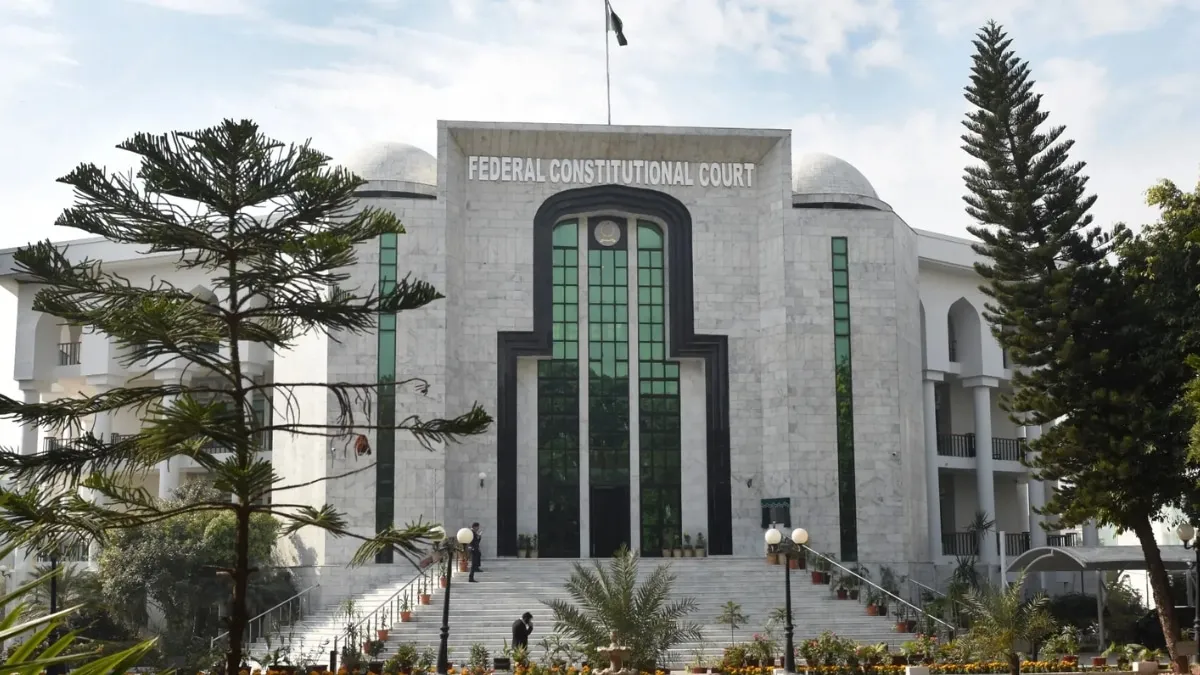
The Federal Constitutional Court has ruled that the mere registration of an FIR will not be a cause of disqualification for government employment.
What the Court Said About FIR Registration and Job Eligibility
In a landmark judgment, a division bench headed by Chief Justice Amin Khan issued directions to federal and provincial authorities and law-enforcement agencies. The bench instructed them to adopt uniform, transparent and constitutionally-compliant regulations for checking past records during government recruitments.
The court emphasized that judicial directions must be given importance while reviewing a candidate's past. Character verification, it said, should rely on authentic and independent confirmation rather than speculation or suspicion. A case shall not be shown negatively in the police character certificate after acquittal.
Why the Ruling Matters for Recruitment Processes
When a First Information Report (FIR) is lodged, it merely records an allegation. The court clarified that an FIR is not proof of guilt and should not be treated as evidence of a crime. This distinction is crucial because many government agencies previously used FIRs as a blanket reason to reject applicants.
By separating the registration of an FIR from a judicially proven offence, the judgment protects individuals who may be under investigation but have not been convicted. It also aligns recruitment practices with the principles of merit, fairness and due process enshrined in the constitution.
How Verification of Past Records Currently Works
Under existing practice, many ministries request a police character certificate as part of the recruitment file. The certificate often lists pending cases, FIRs and convictions. However, there has been no uniform standard for how pending cases are reported. Some agencies note only the case number, while others write descriptive remarks that imply guilt.
The court's direction mandates that when proceedings are pending, only the fact of their pendency shall be mentioned without presuming the crime in advance. This means a simple statement such as "Case pending under Section 376 of the Penal Code, case no. 12345/2024" is sufficient.
Legal Standards Governing Removal From Service
The judgment also reinforced procedural safeguards for current employees. No candidate shall be removed from service without being heard and without a decision based on arguments. Any disciplinary action must follow the principles of natural justice, giving the employee an opportunity to present a defence.
Recruitment decisions must be in accordance with legal standards, merit and justice. The court warned that any deviation could be challenged in higher courts, potentially leading to reversal of appointments and compensation claims.
Background: FIRs, Police Certificates and Past Precedents
In Pakistan, an FIR is the first step in criminal investigation. It is filed under the Code of Criminal Procedure and triggers police inquiry. Historically, the Supreme Court of Pakistan has held that an FIR alone does not constitute a conviction. In *Mujtaba v. Federation of Pakistan* (2018), the apex court ruled that pending cases cannot be used to deny a government job unless a final judgment is rendered.
Despite that precedent, lower courts and some recruitment boards continued to interpret FIRs as a negative factor. The lack of a uniform policy created legal uncertainty and led to numerous petitions challenging disqualification orders.
Impact on Job Seekers and Current Employees
The decision directly benefits thousands of aspirants for civil service, police, judiciary, and other federal or provincial posts. Candidates who were previously barred because of an FIR can now expect a fairer assessment based on actual convictions, if any.
For existing employees, the ruling offers protection against arbitrary removal. If an employee faces disciplinary action due to a pending FIR, the employer must now follow the hearing procedure outlined by the court.
What Agencies Must Do Next
All federal and provincial recruitment authorities are required to revise their standard operating procedures within 90 days. The revisions must include:
- A clear definition of what constitutes an FIR versus a conviction.
- Template language for police character certificates that only notes pendency without implication.
- Procedures for giving the candidate an opportunity to respond to any adverse information.
- Training modules for HR officials on constitutional compliance.
Law-enforcement agencies must also cooperate by providing factual, concise case status updates rather than detailed investigative notes that could prejudice the candidate.
Practical Takeaways for Applicants
Applicants should request a copy of their police character certificate early in the recruitment process. If an FIR is listed, they can submit a written clarification stating that the case is pending and that no conviction has been recorded.
Should an employer attempt to reject an applicant solely on the basis of an FIR, the applicant can cite the Supreme Court judgment and file a petition in the appropriate high court.
What to Watch for After the Verdict
Legal analysts expect a wave of petitions challenging past disqualifications. The courts will likely examine whether agencies complied with the 90-day deadline for policy changes. Monitoring the implementation will reveal whether the ruling translates into real-world fairness.
Additionally, civil society groups have pledged to monitor recruitment boards for compliance, and they may file public interest litigations if deviations are observed.
The judgment marks a significant step toward aligning recruitment practices with constitutional guarantees of equality before the law and the right to livelihood.