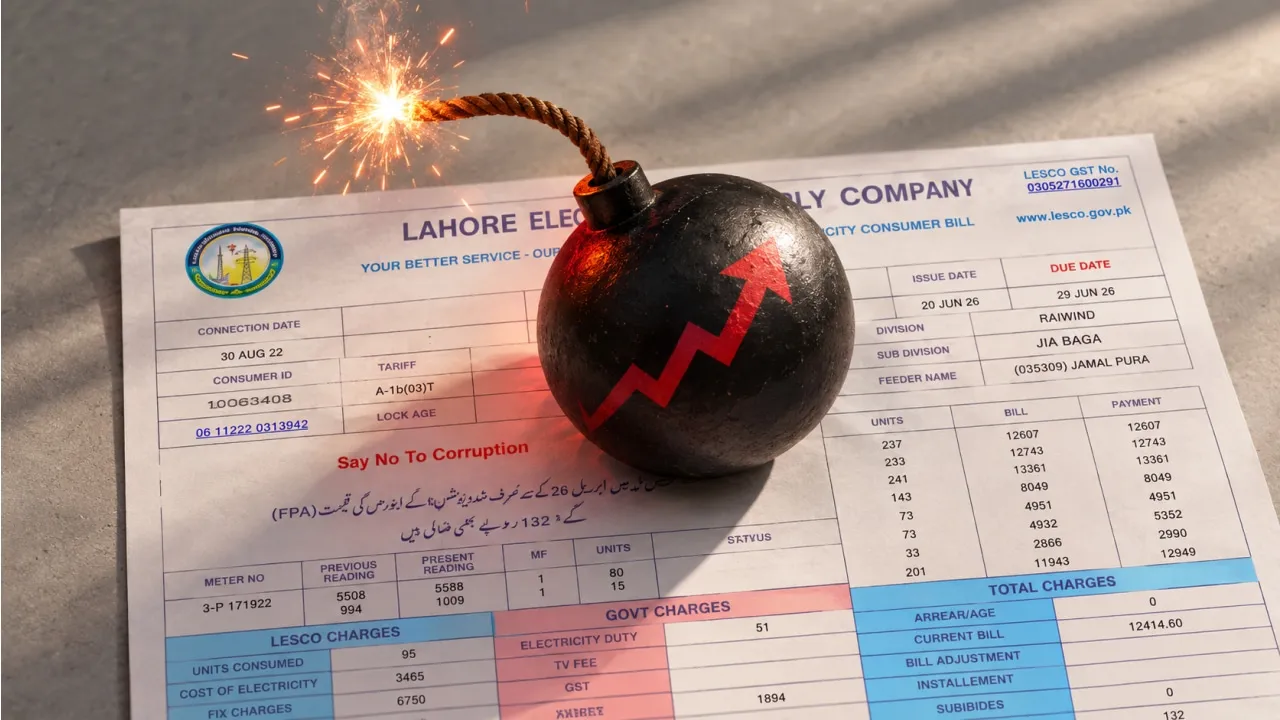
Pakistan power distribution companies are pushing for an additional Rs. 23.326 billion in revenue through higher electricity tariffs, a move that could increase the cost of electricity by Rs. 1.34 per unit for consumers between December 2026 and February 2027. This proposed financial adjustment stems from quarterly filings submitted by utility providers seeking to recover operational costs and financial obligations from the billing period spanning July to September 2026.
The requested increase would extend to K-Electric customers as well, operating under the federal government uniform electricity tariff policy. The National Electric Power Regulatory Authority will review the proposed charges at a public hearing scheduled for November 17 before deciding how much can be passed on to consumers.
Capacity Charges Drive Proposed Increase
According to applications submitted by the 11 former WAPDA distribution companies, capacity charges account for the largest portion of the requested adjustment, at Rs. 38.917 billion. This figure also includes the impact of net metering and net billing units, reflecting the evolving structure of power generation and consumer solar adoption across the country.
The companies have additionally sought Rs. 5.597 billion for variable operation and maintenance costs and Rs. 7.790 billion to cover the impact of transmission and distribution losses on monthly fuel cost adjustments. Another Rs. 272 million relates to use of system charges and the Central Power Purchasing Agency Guaranteed agency fee.
However, a negative adjustment of Rs. 29.252 billion arising from incremental electricity consumption offsets a substantial portion of the additional costs, bringing the combined net adjustment request to Rs. 23.326 billion. These competing financial factors form the core of the upcoming regulatory review.
IESCO and FESCO Seek Largest Adjustments
Among individual distribution companies, Islamabad Electric Supply Company has requested the largest positive adjustment of Rs. 10.535 billion, followed by Faisalabad Electric Supply Company at Rs. 10.462 billion and Peshawar Electric Supply Company at Rs. 6.978 billion. These regional utilities face distinct financial pressures based on local recovery rates and consumer bases.
Multan Electric Power Company has sought Rs. 3.366 billion, Lahore Electric Supply Company Rs. 2.995 billion, Gujranwala Electric Power Company Rs. 1.637 billion and Hazara Electric Supply Company Rs. 521 million. Utility performance varies significantly across different administrative boundaries within the national grid.
Several other companies have reported negative adjustments. Tribal Electric Supply Company has calculated a negative adjustment of Rs. 5.875 billion, followed by Quetta Electric Supply Company at Rs. 4.088 billion, Hyderabad Electric Supply Company at Rs. 2.154 billion and Sukkur Electric Power Company at Rs. 1.051 billion.
NEPRA to Examine September Fuel Costs
The regulatory body noted that the September 2026 fuel charges adjustment had not been officially notified when the distribution companies submitted their applications. As a result, they calculated the impact of transmission and distribution losses using the adjustment requested by the Central Power Purchasing Agency Guaranteed.
The regulator will examine these calculations during the November 17 hearing before determining the admissible adjustment. It will also consider extending the quarterly increase to K-Electric consumers in line with federal government guidelines requiring uniform quarterly tariff adjustments.
The proposed Rs. 1.34 per unit increase is not final and remains subject to approval by the regulatory authority. The actual amount recovered from consumers will depend on the final determination issued after the public scrutiny process concludes.
Background of Pakistan Power Sector Adjustments
Power sector adjustments in Pakistan are regular regulatory mechanisms designed to bridge the gap between estimated costs and actual expenditures incurred by distribution companies. These quarterly petitions deal with capacity payments owed to power producers, transmission losses, and variable operation expenses. Under the legal framework governing the power sector, utilities must justify their financial numbers to the independent regulator to ensure transparency before bills are adjusted.
Capacity payments constitute a major share of financial burdens in the national grid because of long term take or pay contracts signed with independent power producers. Even when electricity demand drops or plants sit idle, the government remains legally obligated to pay for available generation capacity. This structural reality drives the massive capacity charge figures seen in regular tariff petitions.
Understanding the Uniform Tariff Policy
The federal government maintains a uniform electricity tariff policy across Pakistan to ensure that base consumer prices remain identical regardless of which distribution company supplies the power. Under this policy, adjustments approved for the former WAPDA distribution companies are typically mirrored for K-Electric, the private utility serving Karachi. This prevents regional disparities in electricity pricing for residential and industrial users.
Implementing uniform rates requires complex financial reconciliation among various state owned entities and independent power distributors. When quarterly adjustments are approved, they are spread across specific billing months to cushion the immediate financial blow to end users, though cumulative increases still strain household budgets.
The Role of Net Metering and Incremental Consumption
Net metering has expanded rapidly as homes and businesses install rooftop solar systems to escape high grid prices. The financial reports submitted by utilities incorporate the impact of net metering and net billing units, which alter the volume of power purchased from the central pool and fed back into local distribution lines.
At the same time, incremental consumption programs offer discounted rates for electricity usage that exceeds specified historical baselines. The negative adjustment of Rs. 29.252 billion reported by utilities demonstrates how higher consumption volumes can offset capacity and operational expenses, providing a balancing mechanism within the quarterly tariff calculations.
What Consumers Can Expect Next
The public hearing scheduled for November 17 serves as the primary forum where consumer advocates, industrial representatives, and utility officials present arguments regarding the proposed financial adjustments. Following this session, the regulatory authority will analyze the data and issue a formal determination specifying the exact per unit adjustment allowed.
If approved, the new rates will take effect on consumer bills starting in December 2026 and run through February 2027. Households and businesses must prepare for potential adjustments in their monthly electricity expenditures while awaiting the final verdict from the regulatory authority.