Pakistan is entering a fresh era in its mineral industry as worldwide needs for copper, gold, chromite, lithium, and rare earth elements present a strategic opening for the South Asian nation to secure funding, build fresh supply chains, and expand its foreign currency earnings.
The potential is massive. Pakistan holds extensive mineral-rich territory and sits within the Tethyan Metallogenic Belt, recognized as a premier global copper and gold zone. Out of 92 identified minerals in the country, 52 undergo commercial extraction.
The Institute of Cost and Management Accountants of Pakistan (ICMA) estimates the national mineral deposits at roughly $8 trillion across 600,000 square kilometres, pointing to the enormous economic capacity of local mining.
ICMA noted that the mining sector historically accounts for under 3 percent of the gross domestic product (GDP). The organization projected that improved security and administration could push yearly mineral exports from about $3 billion to $8 billion, while lifting GDP expansion from roughly 3 percent to 6 percent.
The difficulty lies in translating underground wealth into financed ventures, shipments, employment, and industrial muscle. Achieving this demands exploration, geological data, advanced technology, infrastructure, financing, steady rules, environmental protections, and alliances with global firms. Pakistani policy increasingly targets the creation of that framework.
Reko Diq Copper and Gold Project
Situated in the Chagai district of Balochistan, Reko Diq ranks among the largest unexploited copper and gold deposits globally. Barrick Mining Corporation owns a 50 percent share in the joint venture, while the Balochistan administration holds 25 percent and three federal state-owned corporations share the remaining 25 percent.
Barrick released a revised feasibility study for Reko Diq in February 2025. The venture will become a primary driver of the national economy and is anticipated to fundamentally change Balochistan province.
The updated study projects a 37-year operational span with an overall capital cost of $8.83 billion. Two stages will comprise the development, with Phase 1 needing an estimated $5.6–$6.0 billion, and initial output anticipated by late 2028.
Phase 1 will handle 45 million tonnes of ore yearly, yielding about 240,000 tonnes of copper and 297,000 ounces of gold annually. Slated for 2034, Phase 2 will double processing volume to 90 million tonnes per year, boosting average annual yields to 460,000 tonnes of copper and 520,000 ounces of gold over the initial decade.
Probable mineral reserves at Reko Diq stand at approximately 3 billion tonnes, housing an estimated 15 million tonnes of copper and 26 million ounces of gold, per the feasibility assessment. Barrick calculates the site could yield $90 billion in operating cash flow and $70 billion in free cash flow throughout its lifespan. Reko Diq stands as the biggest foreign direct investment venture in Balochistan and ranks among the largest nationwide.
Global lenders have put together a funding package surpassing $2.6 billion. The Asian Development Bank cleared $410 million in August 2025, featuring $300 million in loans and a $110 million guarantee backing Balochistan's equity share. The International Finance Corporation (IFC) and World Bank cleared a $700 million concessional loan in June 2025. The US Export-Import Bank authorized $1.25 billion in December 2025, which the US embassy stated could release up to $2 billion in American mining equipment and service shipments while supporting roughly 13,500 jobs across both nations. Initial shipments from Reko Diq are projected to bring in $2.8 billion in export value once active.
Global Demand, Local Advantage
Wood Mackenzie projects that worldwide copper needs will climb 24 percent to reach 42.7 million tonnes annually by 2035, fueled by electrification. The International Energy Agency stated that electricity demand originating from artificial intelligence data centres will quicken this trend further. Moreover, the European Union Critical Raw Materials Act and American efforts to diversify rare earth supply chains have heightened the strategic value of fresh, dependable supply sources.
Pakistan boasts a mining background older than Reko Diq. The Saindak copper-gold venture, built alongside Chinese partners, stems from aerial surveys of Balochistan conducted in the 1950s and Geological Survey of Pakistan exploration during the 1960s.
Pakistan's Frontier Works Organisation and Missouri-based US Strategic Metals (USSM) executed two memoranda of understanding on September 8, 2025, concentrating on processing critical minerals, including rare earth elements, alongside logistics services. The pact sets up a collaboration framework across various vital minerals required by the defense, aerospace, and technology sectors.
The Prime Minister Office stated that the alliance will begin immediately via shipments of readily accessible minerals from Pakistan, including antimony, copper, gold, tungsten, and rare earth elements. This collaboration establishes the groundwork for expanding toward a proprietary, highly adaptable poly-metallic refinery operated by USSM inside Pakistan. The facility will create intermediate and final goods aimed at satisfying the surging needs of the American market. The initial stage of this agreement envisions roughly $500 million of investments directed at the critical minerals sector of Pakistan.
Upcoming measures for the MoU involve establishing dedicated teams to investigate the full extent of the national resource base, pinpointing critical minerals for prompt export, and building a foundational position for a long-term partnership spanning exploration, extraction, and processing. Significantly, the collaboration will prioritize sustainability, profitability, and ecological responsibility to guarantee advantages for the populations of both countries.
PMIF26: The Investment Platform
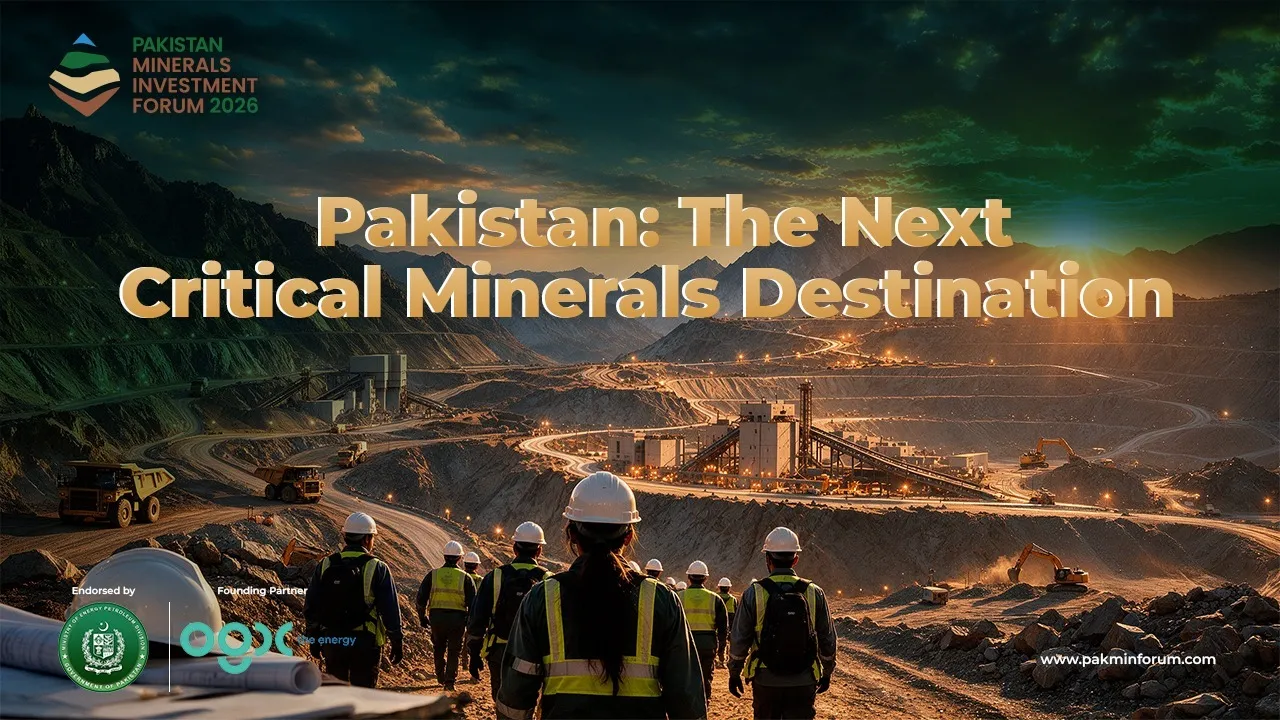
Serving as the principal government venue for advancing mineral sector investments, the Pakistan Minerals Investment Forum (PMIF) connects the nation with international investors, mining firms, financial institutions, and technology providers. The gathering unites policymakers and industry leaders to display the mineral potential of Pakistan, foster partnerships and investments, and encourage sustainable growth and value addition throughout the industry.
Last year, the Pakistan Minerals Investment Forum (PMIF25) drew 5,000 delegates originating from over 50 countries. The gathering witnessed the signing of 16 memoranda of understanding and featured 18 panel discussions.
Originally planned for April 8-9 at the Jinnah Convention Centre in Islamabad, the 2026 iteration, PMIF26, was shifted to November 12-13, 2026, at the same location. Federal Minister for Energy (Petroleum Division) Ali Pervaiz Malik noted that the event aims to foster mining awareness and secure sustainable investments, asserting that the mineral wealth of Pakistan has remained largely unexploited for decades.
The investment-oriented venue links governments, investors, mining corporations, technology suppliers, and further participants across the mineral value chain. PMIF26 is anticipated to place heavier emphasis on project execution, exploration, technology, value addition, and investment.
Its technical schedule encompasses geological exploration alongside resource evaluation, remote sensing, geophysics, and alternative technologies aimed at deepening comprehension of the mineral geology of Pakistan.