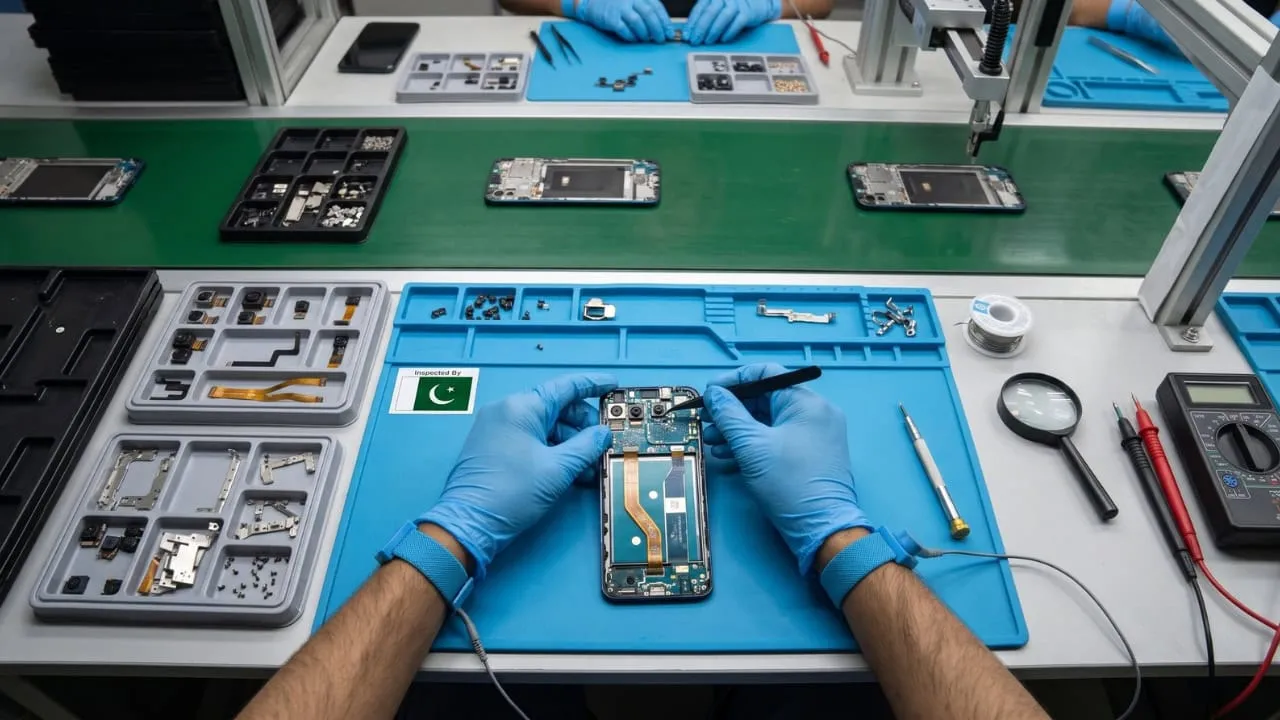
Pakistan is working to reshape its domestic mobile phone manufacturing industry. The Ministry of Industries and Production is drafting a new Mobile Device Manufacturing Policy to move the sector away from import-dependent assembly and toward domestic component production, with the ultimate goal of reaching up to 50% domestic value addition.
This new strategy follows the Mobile Device Manufacturing Policy 2020-2023, which brought local and foreign investments to set up assembly plants nationwide. While domestic value addition currently stays between 10% and 20%, the upcoming policy emphasizes local parts, technology transfer, and industrial growth.
Local Plants Meet Most Domestic Demand
Domestic mobile factories are currently supplying the majority of the internal market. From January to September 2026, Pakistan manufactured 20.08 million mobile handsets locally. Commercial imports reached only 2.85 million units in that same timeframe. The local production included about eight million smartphones and 12 million 2G phones. Figures from the Pakistan Telecommunication Authority show smartphones make up 71% of active mobile devices on domestic networks.
As a result, dependence on foreign finished handsets is dropping fast. In the first quarter of fiscal year 2026-27, the mobile import bill dropped by 16.6% to $417.24 million, down from about $500.01 million during the same period last year. Imports increased by 7.1% in September 2026 to $143.14 million compared to $133.66 million in August, but stayed 28.2% lower year-on-year against September 2025.
Market Leaders Shift as Production Spreads
The market shares among local assemblers are changing. In the first nine months of 2026, VGO TEL became the top producer in Pakistan, surpassing brands like Infinix and Itel. Infinix led the local assembly market in 2024 with 3.98 million units and in 2025 with 3.65 million units. Recent figures indicate production is now distributed among multiple companies.
- VGO TEL: 2.50 million
- Infinix: 1.96 million
- Itel: 1.59 million
- TECNO: 1.16 million
- Samsung: 1.04 million
- Vivo: 0.99 million
- Nokia: 0.97 million
- China Mobile: 0.72 million
- X Mobile: 0.71 million
- G'FIVE: 0.64 million
The success of the proposed policy depends on building a competitive local supply chain for components, keeping prices stable, managing exchange rates, and securing access to necessary imported parts.