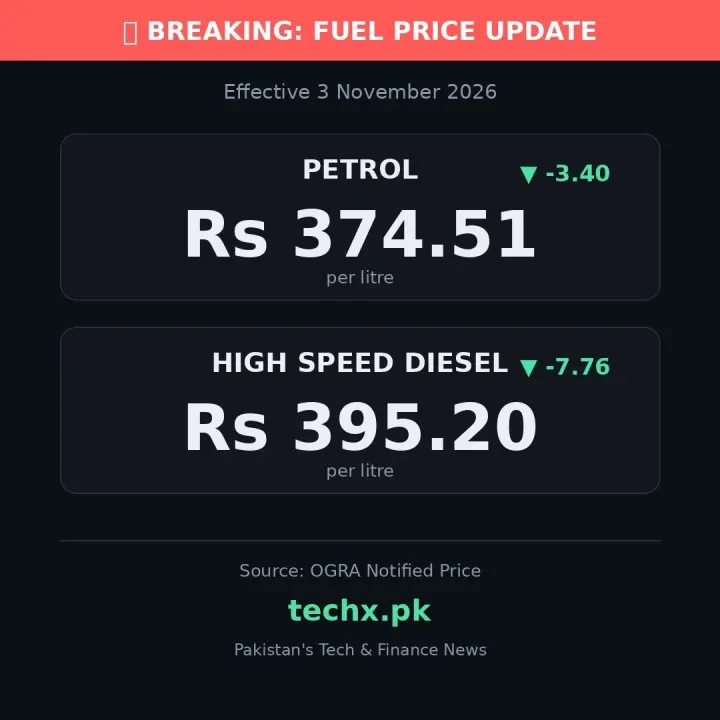
On July 17, 2026, the Oil and Gas Regulatory Authority (OGRA) announced that the ex-depot price of Motor Spirit (petrol) fell to Rs. 374.51 per litre and High Speed Diesel dropped to Rs. 395.02 per litre, reflecting a daily-adjustment policy introduced by the Federal Government.
The move follows the government's decision to revise petroleum product prices every 24 hours, a step taken to protect the domestic economy from extreme market swings caused by the ongoing global fuel crisis.
Why the Government Adopted Daily Price Adjustments
Pakistan's fuel market has long been vulnerable to external shocks because the country imports the majority of its oil. When world oil prices surge, the cost of imported crude passes through the supply chain, raising pump prices and inflating transport costs for businesses and households. By moving to a daily-adjustment framework, authorities aim to smooth out short-term spikes and prevent sudden price shocks that could destabilise inflation.
The policy applies to all days except weekends and public holidays, when prices remain unchanged. This rule, stated in an official OGRA notice, is intended to give traders and retailers a predictable schedule for price updates.
Details of the Latest Price Revision
| Product | Previous Price(31/10/2026) | Revised Price(03/10/2026) | Difference |
|---|---|---|---|
| Motor Spirit (MS) | Rs. 377.91 | Rs. 374.51 | -3.40 |
| High Speed Diesel (HSD) | Rs. 402.96 | Rs. 395.02 | -7.76 |
Petrol fell by Rs. 3.40 per litre, while diesel saw a larger cut of Rs. 7.76 per litre. Both reductions are the first under the new system and signal a downward trend for consumers.
Background: The 2026 US-Israel War on Iran and Its Impact on Oil Supply
In early 2026, a military confrontation between the United States and Israel against Iran erupted, disrupting the world's energy supply chain. The conflict escalated in February when Iran blocked shipping traffic through the Strait of Hormuz, a narrow waterway that handles roughly 25% of global seaborne oil trade.
The United States responded with a naval blockade of Iranian ports, further limiting the flow of oil. A brief ceasefire in June raised hopes for a return to normalcy, but the truce collapsed on July 8 after renewed attacks on commercial vessels. Iran closed the strait again, and the United States launched successive airstrikes to force it open. The repeated closures and military actions have choked oil shipments, pushing global crude prices upward and creating volatility in downstream markets.
How Daily Adjustments Work in Practice
OGRA collects data on international crude prices, exchange rates, freight costs, and domestic taxes each day. An algorithm calculates the ex-depot price for each product, adding a fixed margin for transport and distribution. The resulting figure is published at a set time, typically early morning, giving fuel stations a window to update pump prices before the day's end.
Because the policy excludes Saturdays, Sundays, and public holidays, price changes are paused on those days. Traders therefore anticipate a two-day lag over a weekend, which can lead to a larger adjustment on the next working day if market conditions shift sharply.
Impact on Consumers, Businesses, and the Economy
Lower pump prices translate directly into reduced operating costs for transport firms, taxi drivers, and logistics companies. A cut of Rs. 7.76 per litre for diesel can save a 10-tonne truck operator roughly Rs. 77,600 per month, assuming an average consumption of 30 litres per 100 km and 2,000 km of travel each month.
For households, the price drop eases the burden of daily commuting and the cost of running small generators, which many families rely on during load-shedding periods. The reduction also eases inflation pressure, as fuel costs feed into the price of food, goods, and services.
What to Watch for Next
Analysts will monitor the daily price bulletins for signs of further declines or rebounds. Key indicators include the Brent crude price, the Pakistani rupee's exchange rate against the dollar, and any escalation in the Hormuz conflict.
Should the strait remain closed for an extended period, freight costs could rise, potentially offsetting the current price cuts. Conversely, a diplomatic de-escalation could restore shipping lanes, stabilising supply and allowing OGRA to keep prices lower for longer.
Stakeholders are advised to follow OGRA's official releases, which are posted on the authority's website and disseminated through major news wires each morning.
Practical Takeaways for Readers
- Petrol is now Rs. 374.51 per litre; diesel is Rs. 395.02 per litre.
- Prices will stay unchanged on Saturdays, Sundays, and public holidays.
- Daily adjustments are driven by global oil market volatility linked to the Hormuz crisis.
- Consumers can expect modest savings at the pump until the next price bulletin.
- Businesses should factor the two-day weekend lag into budgeting for fuel expenses.
These daily adjustments will remain unchanged during weekends (Saturdays and Sundays) and public holidays.